AI Video Interviewing Platforms: The Next Evolution in Recruitment?
Elevating interviews to the next level
Artificial Intelligence (or AI) is transforming almost every stage of the way we find, assess, and develop talent. Now, it is changing the interview itself.
AI video interviewing platforms are emerging as a new way for organisations to conduct structured interviews at scale, helping recruitment teams, education providers and learning and development professionals rethink the process that has traditionally depended on diaries, availability, and considerable human resource.
However, this isn’t simply about putting an interview on a screen.
The latest generation of AI interview technology is moving beyond traditional video calls and pre-recorded responses towards more interactive, intelligent screening experiences.
So, what exactly is an AI video interviewing platform? What does it mean for the job market, university and college admissions, and training and development for staff?
Join Interviewa now as we take a deep dive into the details.
What is an AI video interviewing platform?
88% of companies now use AI for initial candidate screening, and for good reason. AI video interviews can handle 10,000+ applications for 100 positions. We're talking about screening at scale, in a fraction of the time.

An AI video interviewing platform uses artificial intelligence to support, conduct, or analyse video-based interviews. These platforms ask for recorded, candidate responses turning each of their answers into a short video for the hiring team to review later.
Depending on the technology, this might include:
- Structured interview questions
- Automated follow-up questions (in some, not all cases)
- Transcription
- Scoring frameworks
- Interview summaries
- Candidate feedback
- Performance insights
As part of many modern job application processes, these questions can crop up halfway through the application process. Job seekers who sat down to merely fill out an online job application form are suddenly expected to be camera ready, and to jump into immediate ‘interview mode’, which can come as an inconvenient surprise, and potentially put applicants off of completing their application.
The fact of the matter is, these one-ways video interview systems are becoming standard for high-volume roles. If that's the case, imagine what a system that facilitate two-way AI interviews can do.
How is the Interviewa platform different from the rest?
At Interviewa, it’s entirely different. First and foremost, the application process remains separate from the interview process.
Candidates apply for their role, and instead of videos forming a part of the application, an interview link is sent only to the applicants who meet the criteria of the available role. The first-stage, two-way interview with an interactive, AI avatar can happen in a place entirely of the candidates’s choosing, on any device, in their own time, wherever they happen to be (all they need is access to WiFi or mobile data).
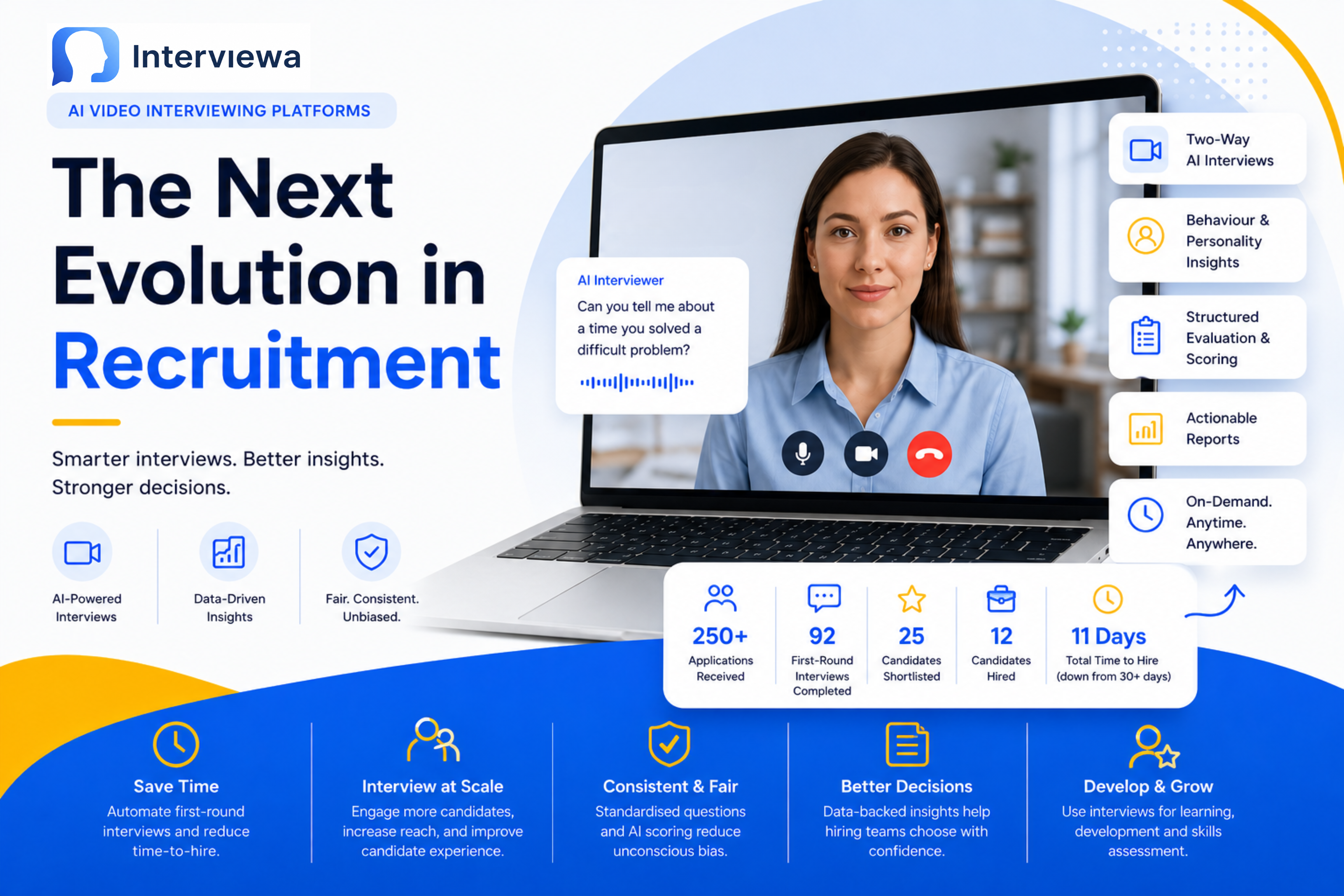
The Interviewa platform records the conversation as it unfolds, evaluates how the individual came across, scores their suitability based on their answers, personality, demeanour, creates an intricate applicant tracking system, and more. The human decision makers behind the scenes then have a comprehensive overview to work from. This also expedites the hiring process overall.
With all first-stage interviews taken care of, hiring managers can determine who they progress to second stages based on the data the Interviewa platform provides, meaning things can move along much faster than previously possible.
Rather than simply collecting recordings like one-way video interviews, Interviewa creates a much more responsive interview experience, analysing answers against consistent criteria, and turning real conversations into useful insights. This opens the technology to applications far beyond alternative methods to screen candidates.
Why are AI video interviewing platforms growing?
Part of the answer to this question is simple. Interviewing is valuable, but resource-intensive.
Consider a recruitment team screening hundreds of candidates. Or, a university admissions department interviewing course applicants during a concentrated admissions period, such as Clearing. Or an L&D team wanting employees to practice difficult conversations, or test how much information they’ve absorbed so far before applying their skills in the workplace.
Traditional interviews require people to be available at the same time. Every additional interview creates another diary commitment. AI alters that equation.
AI can reduce candidate screening time from hours to minutes. Interview scheduling, interview intelligence, and automated candidate screening at that first key hiring stage of the recruitment process can take care of those important initial conversations. They are also available on demand, allowing people to participate when it suits them while enabling organisations to review results at a time that fits into their diaries.
What does this mean from a day-to-day perspective?
Structured, recorded interview responses give organisations another layer of information. The Interviewa platform provides even more than that, with live interviews, applicant tracking, Here’s what this emergent technology means for:
- Recruiters and recruitment agencies: Less time spent coordinating first-round interviews, and performing repetitive tasks; more time engaging with the strongest candidates, and on candidate verification. Enables data-driven hiring decisions
- Admissions teams: Potential to interview larger applicant cohorts using a consistent framework
- Training teams: Makes repeated interview-style practice possible without requiring a trainer to personally facilitate every session.

So, it’s not about using AI for AI’s sake, or even about automation. It’s about scalability. The Interviewa platform creates an opportunity to expand what’s possible and accelerate hiring processes, as well as freeing up resources and making lives easier.
From CVs to summaries: the value of conversational AI interviews
There’s another reason AI is becoming prevalent in interviewing. Organisations increasingly want better evidence of what somebody can actually do.
In recruitment, skills-based hiring is gaining ground as employers look beyond qualifications and previous job titles, towards capability, communication, and potential.
At the same time, generative AI has made written applications easier to optimise. CVs, cover letters, and application responses can all be polished. That doesn’t make them meaningless. Teams can hear candidates explain their thinking, respond to questions, and demonstrate their understanding in their own words.
Interviewa further elevates these advantages. The two-way nature of the first-stage interview via the platform documents so much more than a recording could (recordings which candidates often have the option to re-do if they were not happy with their first attempt at the answer). The conversation unfolds as naturally as it would with a real person, with a realistic one-time opportunity to respond and demonstrate on-the-spot thinking, which often makes responses more genuine and heartfelt.
This is why Interviewa moves a step beyond standard AI video interviewing. It sits within a much broader shift towards real-time, skills-based assessment.
Recruitment is only part of the story
Although AI video interview software is often associated with hiring, it has a much wider potential to be used in many other areas. For example:
- Recruitment and staffing: Recruiters can use AI interviews to support candidate screening before progressing applicants to human-led stages. Structured questions can create greater consistency across larger candidate pools, while summaries, scores, and insights can provide a more rounded evaluation of the individual. The aim is not to remove recruiters from recruitment. The goal is to empower the human decision-makers by reducing repetitive administration, enabling them to focus their energy where it adds the post value.
- University and college admissions: How do you assess large numbers of applicants fairly and consistently without bias, while making the process as efficient as possible? AI interviews can provide an essential assessment stage for courses, scholarships, and other competitive programmes. Applicants can respond remotely, while institutions gain structured information that complements written applications, academic records, and subsequent human review.
- Learning and development: An AI interview doesn’t necessarily need to be an assessment with a pass-or-fail outcome. It can become a safe environment for practice. Employees can rehearse role-specific scenarios, receive feedback, and improve their skills. This turns the technology from an assessment tool into a development tool. With Interviewa specifically, the platform can be configured to a number of needs, making it a versatile asset for any organisation.
It's this versatility and potential personalisation that makes Interviewa a valuable asset to any organisation.
Does AI make interviewing less human?
This is a common question that occurs when AI enters any equation. The job market is no exception.
Automation can create efficiency. However, interviewing involves people making decisions about people. Candidates and applicants deserve transparency, consistency, and appropriate human oversight.

At Interviewa, we believe the strongest use of AI isn’t replacing human judgement. It’s deciding where human judgement matters most. If technology can handle repetitive, early-stage processes, summarise responses, and create structured information, that means recruiters, admissions professionals, and trainers can spend more of their time on the interactions requiring experience, empathy, and expertise.
In other words, the future doesn’t have to be AI versus humans. It can be about creating a human-first hiring system with AI supporting more informed hiring decisions.
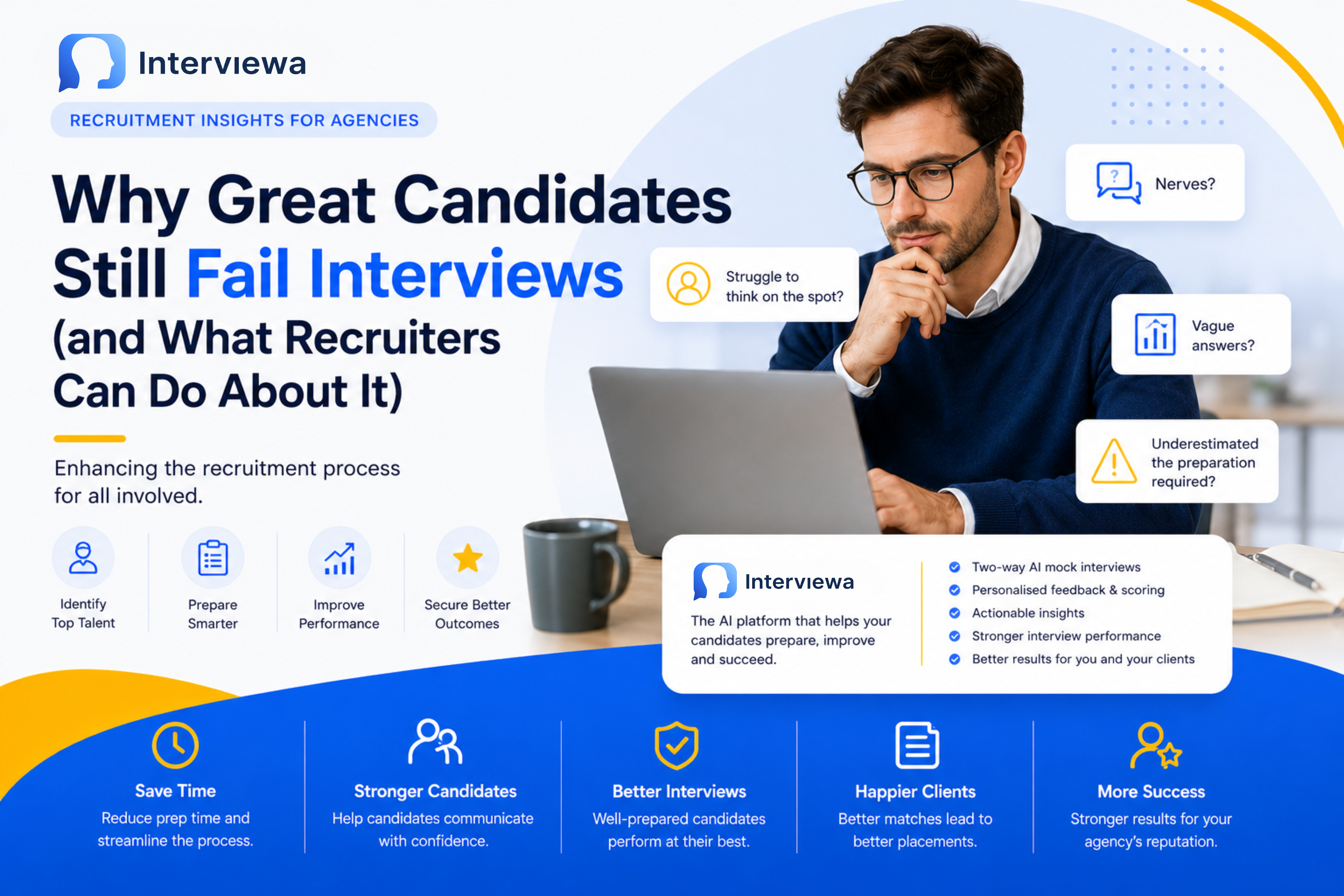
Another function of Interviewa is that job seekers can use it to prep for upcoming appointments. Recruitment agents can set candidates up with an account where they can go through mock interviews to see how successful they could be in the real scenario, and learn how they can strengthen their responses. Individuals don't need technical skills to use it either. Interviewa has a user-friendly interface for ease of use and instant access to detailed feedback.
What should organisations look for in an AI video interviewing platform?
Interviewa’s advice? Don’t just seek an AI video interviewing platform. You could have so much more than one-sided, recorded answers, and a single-function tool. Our platform, for example, provides realistic, two-way conversations, and can be adapted for different uses within your organisation, so the value you stand to gain from it has a range of possibilities. Flexibility matters.
Ask yourself whether the platform you’re considering can:
- Support a range of interview scenarios
- Be adapted for different roles, courses, and training objectives
- Integrate smoothly with existing applicant tracking systems
- Offer features such as automated scoring, transcription, and compliance with regulations (platforms should comply with local data privacy laws such as GDPR, for example)
- Put the decision making in the hands of the humans (it's imperative that any AI you implement does not decide who to hire on a human's behalf, as there are legal ramifications to consider there)
- Make it easy to review what happened during the interview rather than filling out score sheets after the fact, lengthily meetings, or bias (which 67% of job seekers believe impacts hiring decisions)
The quality of the AI interviewing platform you choose should ultimately hinge on the decisions and experiences it enables.
Always-on, always available
For decades, traditional hiring has been constrained by one fundamental requirement: two or more people needed to be available at roughly the same time.
AI is beginning to remove that, and other limitations.
At Interviewa, our team is exploring what happens when structured interviews can take place 24/7, at scale, and whenever they’re needed, across recruitment, education, and training.
Interviewa is passionate about helping organisations conduct and manage screening processes while also giving individuals opportunities to develop, and receive personalised feedback. It enables recruitment specialists to line up top talent with the right roles, taking into account personality traits, candidate engagement, communication skills and more. Not just keywords in their CV derived from basic resume screening.
This is technology that’s still evolving. Organisations should approach it thoughtfully, with humanity in mind. That's what we're doing at Interviewa. Our AI-powered platform is transforming talent acquisition. It not only streamlines processes and enables data-driven decision-making for professionals, but it also creates a much better candidate experience. The entity of the interview isn’t disappearing. It’s only becoming more accessible, more scaleable, and more intuitive. That's not fuel for fear. It's a reason to celebrate.
Are you ready to take your interview and screening processes to the next level? Reach out to our team. The Interviewa platform can help you harness the power of conversation. Leverage AI to enhance human experiences. Email [email protected] today.