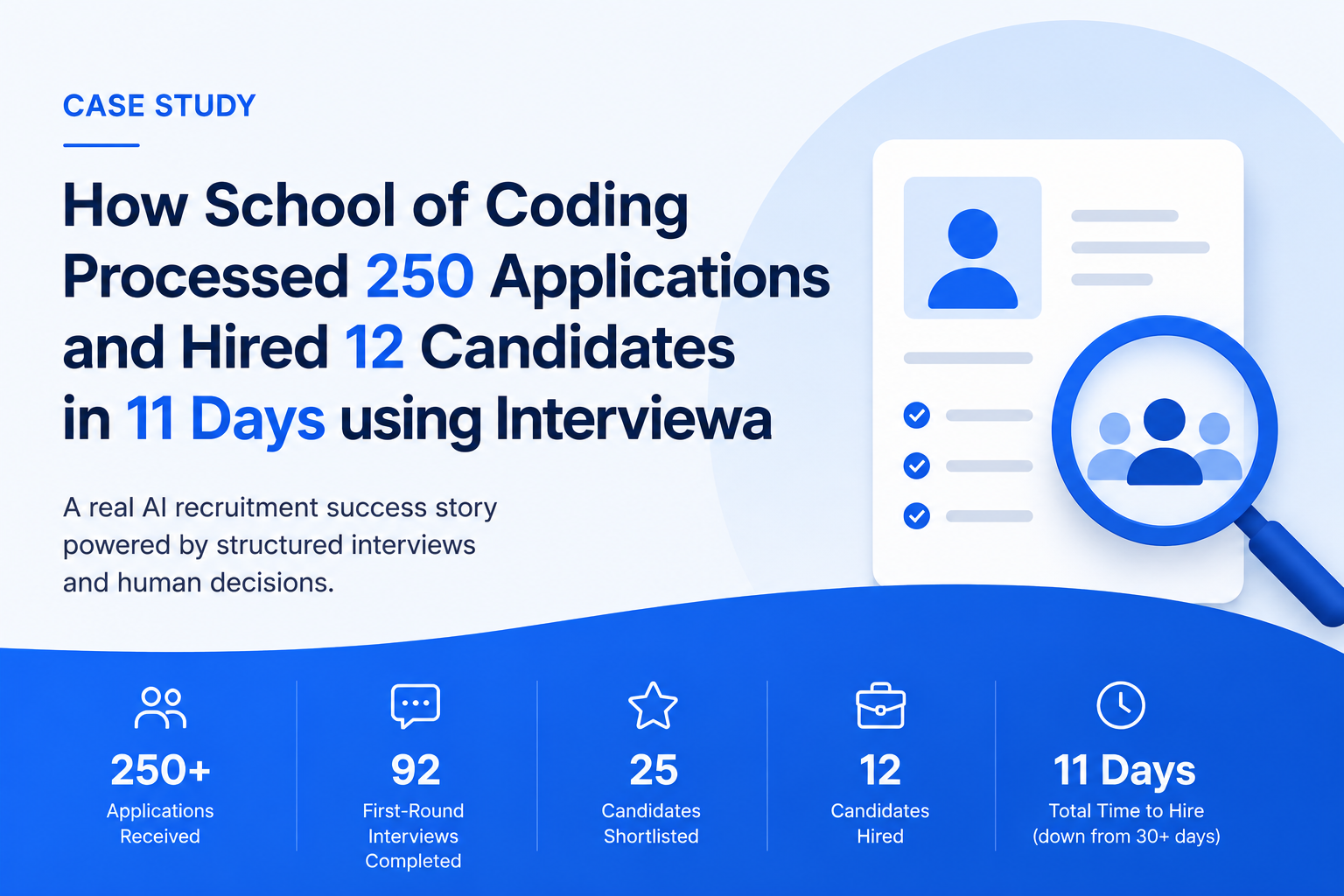
How School of Coding Processed 250 Applications and Hired 12 Candidates in 11 Days using Interviewa
Introduction
School of Coding received 250 applications in a single day. As the team prepared to grow from around 150 to over 200 employees, they quickly realised that manually screening every CV would take weeks.
The recruitment campaign was led by Romina, with Jordan supporting candidate reviews throughout the hiring process. Early on, the team recognised that CVs only tell part of the story. As Jordan explained:
“CVs sometimes don’t show people’s personalities.”
That made it hard to tell who would fit the team, who could communicate clearly, and who had the potential to learn on the job.
So rather than judge candidates on paper alone, the team used Interviewa to run structured first-round interviews. This gave every applicant a fair shot to speak for themselves and demonstrate communication, personality, and potential before any recruiter made a call.
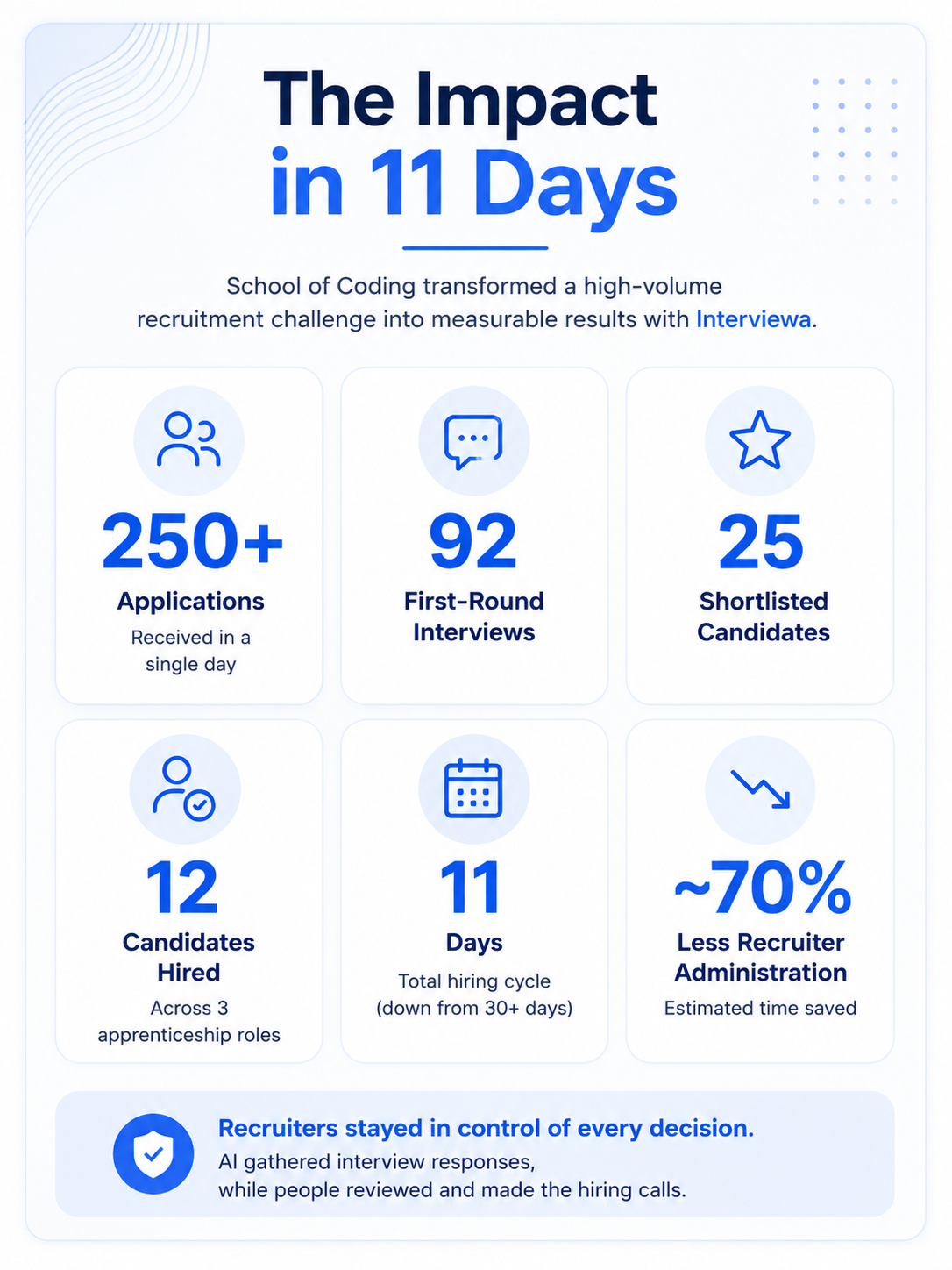
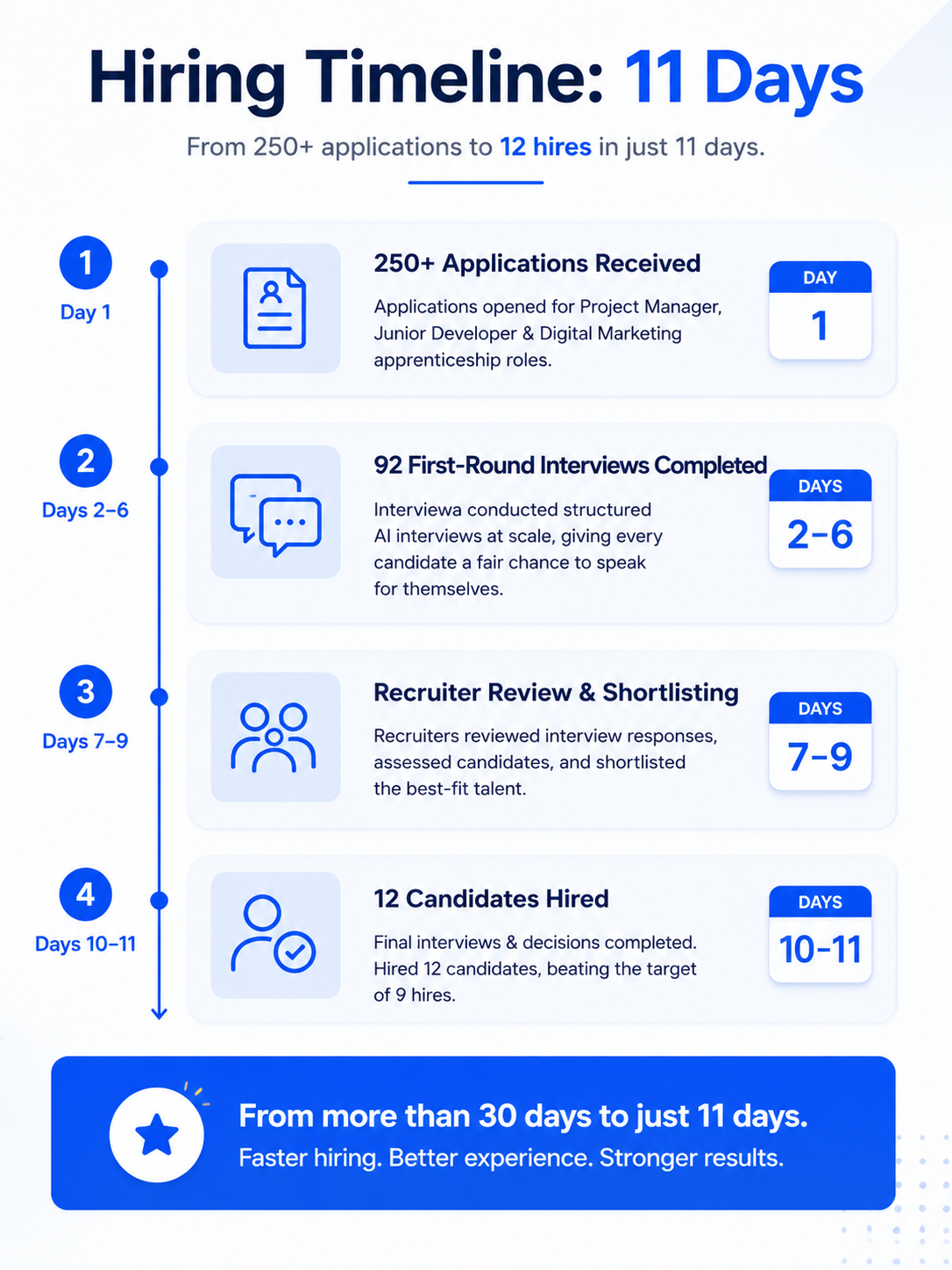
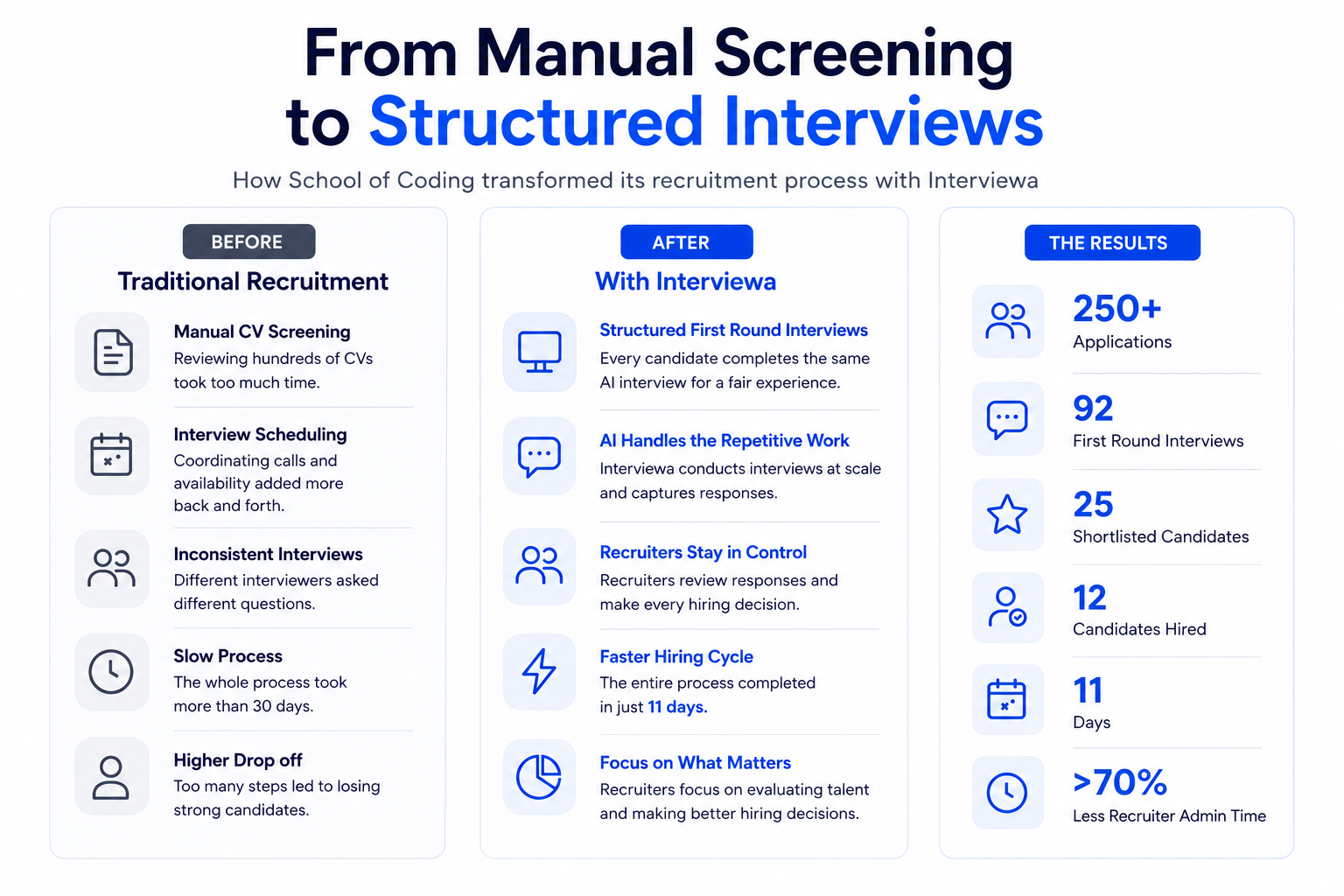
The results were striking. In just 11 days the team handled 250+ applications, completed 92 first-round interviews, shortlisted 25 candidates, and hired 12 people across three apprenticeship roles, beating their target of nine hires. The whole cycle shrank from more than 30 days to 11, while recruiters stayed in control of every decision.
The change was simple: they cut through the noise and focused on people, not just paperwork. As the team had learned, don’t judge a book just by its cover. Hence, giving candidates the chance to show who they are, uncovered talent that a CV alone would have missed.
Below we’ll walk through the exact workflow School of Coding used, the practical changes they made, the numbers behind the impact, and the lessons other organisations can borrow when hiring at scale.
About School of Coding
School of Coding is a UK training provider focused on helping people develop digital skills and launch careers in technology through apprenticeship programmes and hands-on learning. As the organisation continued to grow, with plans to expand to more than 200 employees, so did the demand for hiring talented people across its own teams.
For this recruitment campaign, School of Coding was hiring Project Managers, Junior Developers, and Digital Marketing apprentices. The organisation regularly receives thousands of applications each year.
Why Traditional Recruitment Was No Longer Sustainable
As the School of Coding continued to grow, so did the volume of applications. For this campaign alone, the team received 250+ applications within a single day, and Jordan explained that they receive enormous amounts of applications a year. While having a large talent pool is a positive challenge, processing every application fairly and efficiently quickly became unsustainable using their existing recruitment process.
Before implementing Interviewa, recruiters relied on reviewing CVs, selecting candidates for screening calls, and then progressing successful applicants through multiple interview rounds. The process worked, but it required significant manual effort and often delayed hiring decisions.
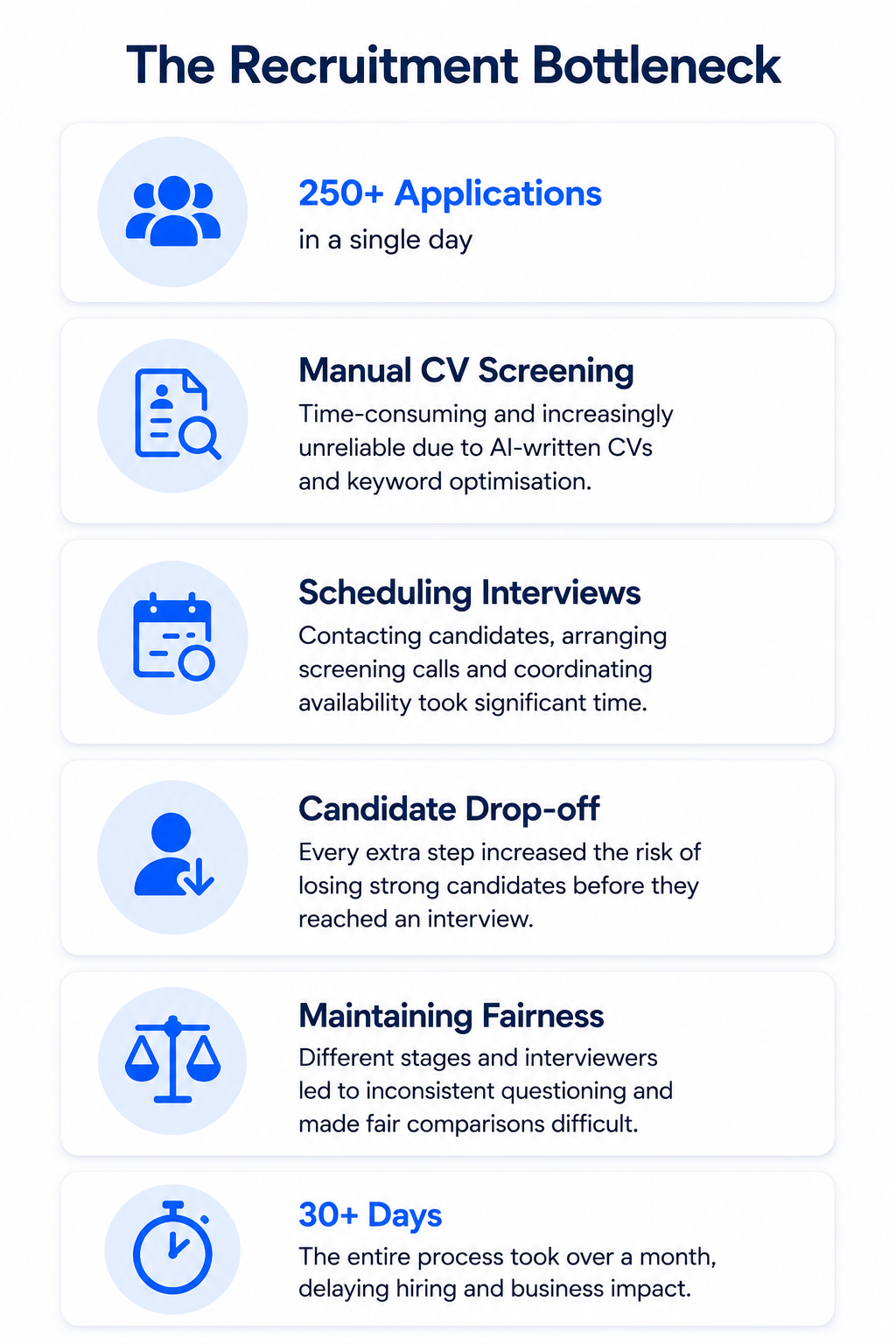
Jordan also highlighted another challenge that many recruiters will recognise. A CV can tell you about someone's qualifications and experience, but it rarely shows how they communicate, whether they'll fit your culture, or how they think on their feet.
"CVs sometimes don't show people's personalities... it's difficult to read a CV and really understand what somebody's like beyond words on the paper."
For apprentice and entry-level roles, this became an even bigger issue. Many candidates had limited work experience, meaning their CVs offered very little insight into their potential. As a result, promising applicants could easily be overlooked before they ever had the opportunity to speak with a recruiter.
By the time the team had reviewed applications, scheduled screening calls, and progressed candidates through multiple interview stages, the recruitment process typically took more than 30 days. School of Coding needed a way to move faster without sacrificing consistency or leaving great candidates behind.
What Success Needed to Look Like
School of Coding wasn't looking for a way to automate recruitment for the sake of it. Their goal was to build a recruitment process that could handle growing application volumes while keeping the experience fair, efficient, and people-focused.
The hiring team still wanted recruiters to make every hiring decision. What needed to change was everything leading up to those decisions.
Based on the challenges they faced, the team identified five outcomes that would define a successful recruitment process.
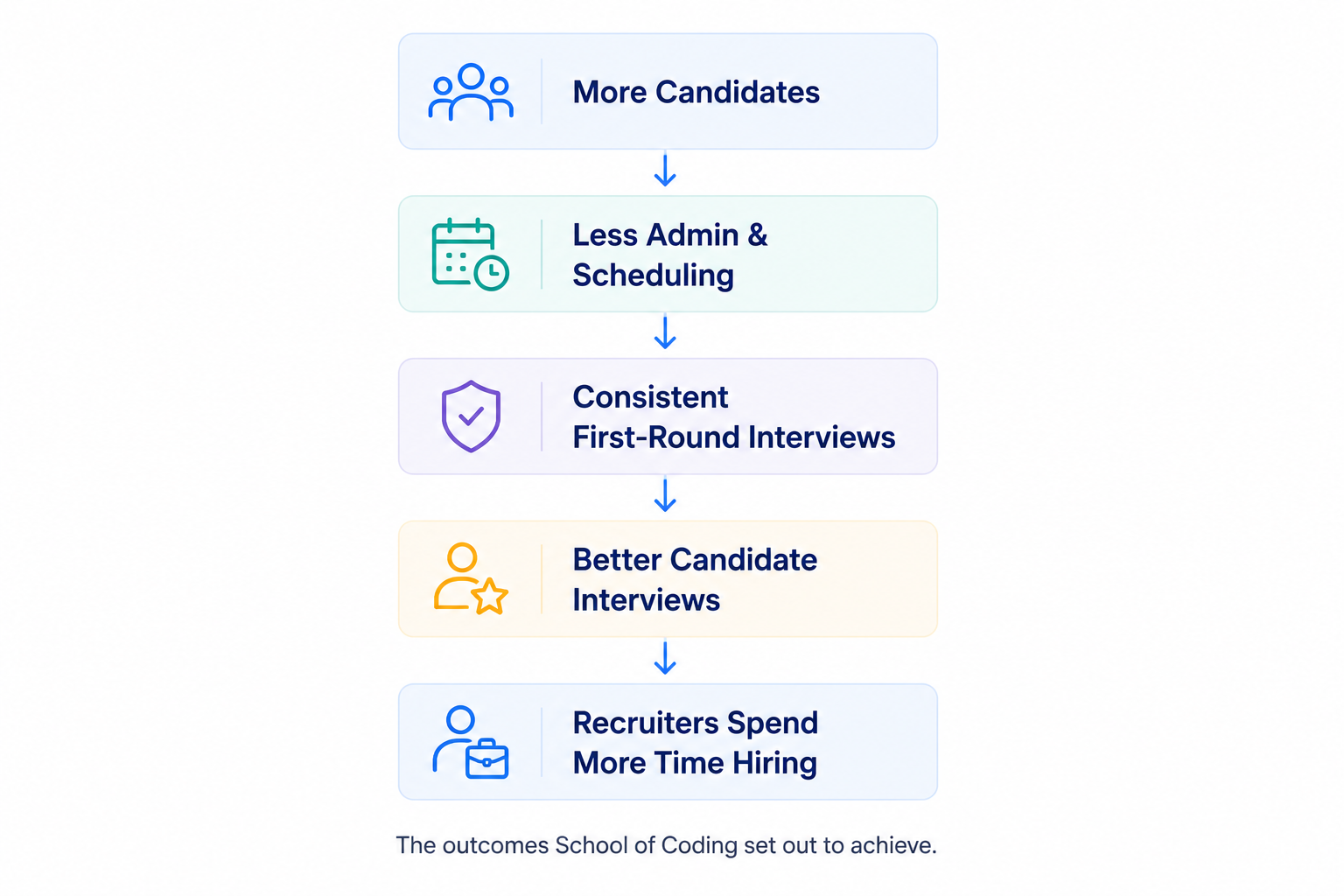
- Process Hundreds of Applications Quickly:
With 250 applications arriving in a single day and thousands received each year, manually reviewing every CV and arranging screening calls simply wasn't sustainable. The team needed a process that could scale without sacrificing quality or leaving promising candidates waiting weeks for a response. - Keep Every First-Round Interview Consistent
Traditional interviews often vary depending on who conducts them, what follow-up questions are asked, and how much time is available.
School of Coding wanted every candidate to begin with the same structured interview, so that the recruiters could compare candidates using consistent interview responses rather than different interview experiences. This was especially important for apprentice roles, where potential and communication skills often matter more than extensive work history. - Give Candidates a Better Opportunity to Demonstrate Their Potential
Jordan explained that CVs rarely tell the full story. Many entry-level candidates have little professional experience, making it difficult to judge their suitability from a document alone. A structured interview would allow candidates to demonstrate their communication skills, personality, and motivation before being shortlisted or rejected. - Reduce Recruiter Administration
Recruiters wanted to spend less time reading CVs, arranging screening calls, and coordinating calendars, and more time evaluating candidates.
Before Interviewa, the process typically took more than 30 days and involved significant administrative effort. The goal wasn't to remove recruiters from the process, but to remove repetitive tasks that slowed them down. - Allow Recruiters to Focus on Hiring Decisions
Ultimately, recruiters provide the greatest value when they're evaluating people, discussing candidates with hiring managers, and making informed hiring decisions, not scheduling interviews.
School of Coding wanted a workflow where technology handled the repetitive first stage of recruitment, while recruiters remained responsible for reviewing interview responses, comparing applicants, selecting finalists, and making every hiring decision. That principle remained central throughout the recruitment campaign.
How School of Coding Used Interviewa Throughout Their Recruitment Process
School of Coding wanted a faster and more consistent way to manage the first stage of recruitment without compromising the candidate experience. To achieve this, they adopted Interviewa's recruitment workflow, enabling every applicant to complete a structured first-round interview while reducing repetitive administrative work for recruiters.
Instead of relying solely on CV screening, School of Coding invited every applicant to complete a structured AI interview before recruiters reviewed the interview responses and decided who should progress.
Throughout the process, recruiters remained in control of every hiring decision. Interviewa gathered structured interview responses at scale, while recruiters reviewed candidates, shortlisted applicants, and selected the final hires.
School of Coding's recruitment process using Interviewa followed these stages:
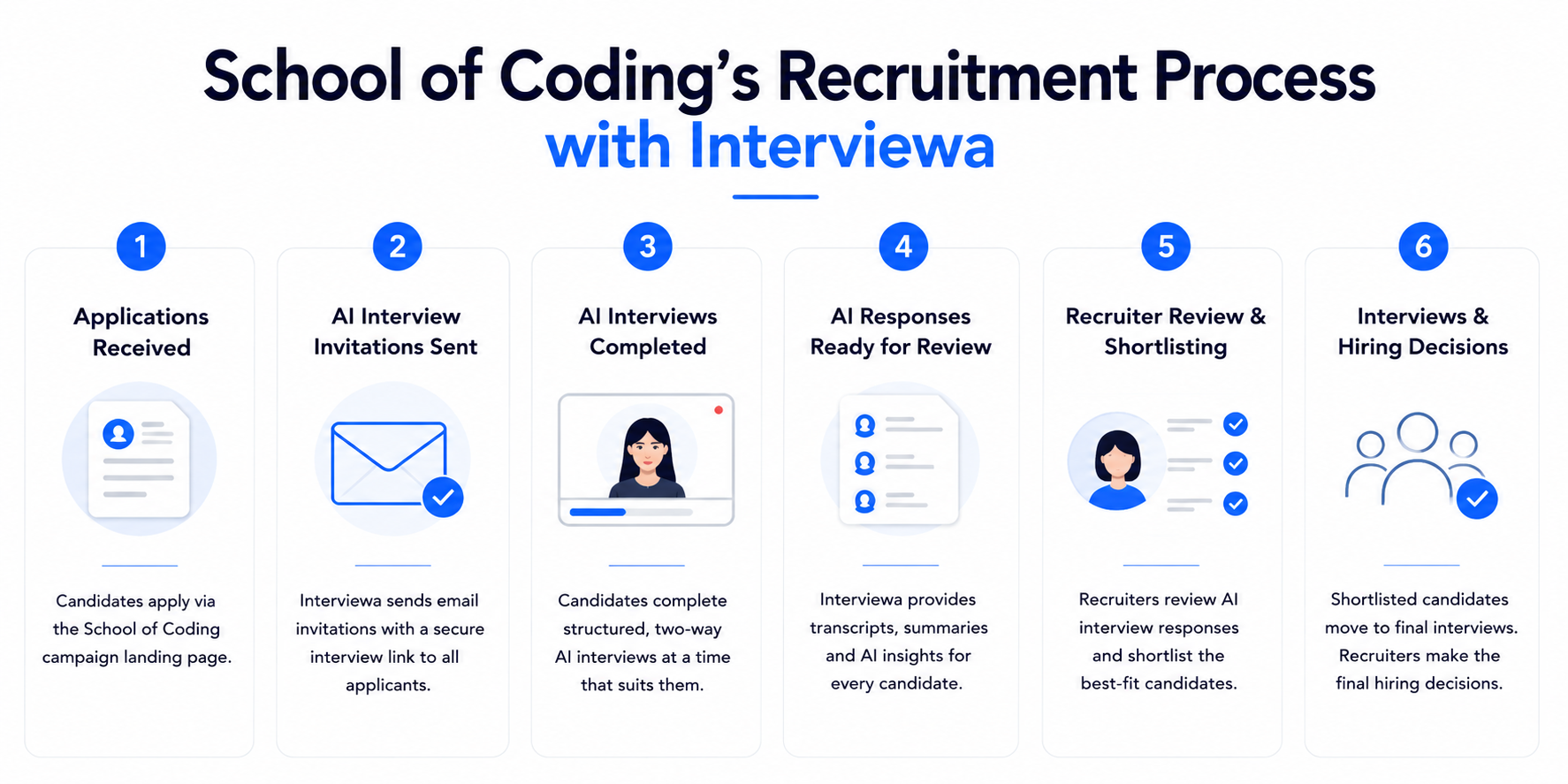
Step 1. Building the Recruitment Campaign
The first step was setting up the recruitment campaign in Interviewa. Using the campaign creation functionality, School of Coding configured the job title, job description, interview questions, other interview settings, candidate experience, and AI interviewer, “Interviewa”, in one place.
Interviewa then generated a structured interview based on the role requirements. Recruiters reviewed the suggested questions, edited them where needed, and added custom questions to assess role-specific skills. They also uploaded a Knowledge Base, allowing the AI interviewa to answer candidate questions using organisation-specific information.
By completing the setup once, School of Coding ensured every applicant experienced the same structured recruitment process from application through to interview, making candidates easier to compare later in the hiring process.
Beyond the interview itself, recruiters customised the candidate experience by configuring:
- Job title and description
- AI-generated interview questions
- Custom interview questions
- AI interviewa avatar
- Pre-interview application form
- Public job landing page
- Organisation careers page
- Knowledge Base
By completing this work once at the start of the campaign, recruiters ensured every applicant received the same structured experience from application through to interview.
Why School of Coding chose this approach
Instead of recruiters designing interviews individually, every campaign followed a consistent framework while still allowing flexibility for different apprenticeship roles.
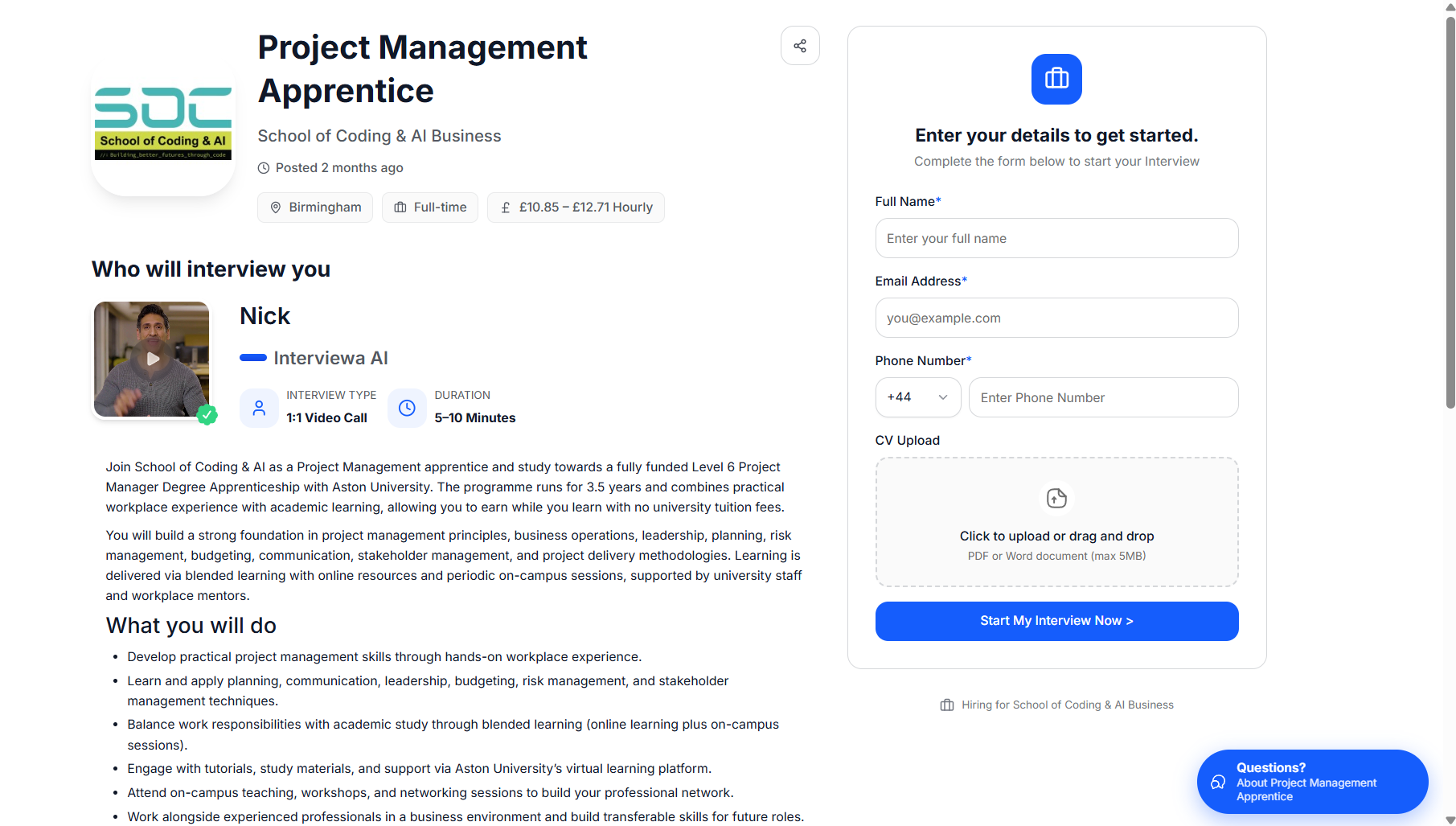
A branded interview landing page where candidates learn about the role, complete their application, and begin their AI interview.
Step 2. Inviting Candidates
Once the campaign was ready, School of Coding imported applicants directly from Workable, while additional candidates could be added by uploading CVs, making it easy to manage applications from multiple sources.
Interviewa also provided a branded application page with a customisable application form, allowing candidates to apply directly and submit details such as contact information, CVs, LinkedIn profiles, and other required information before their interview.
Candidates then received personalised interview invitations by email containing a secure interview link. For organisations that prefer to manage communications themselves, automatic invitation emails can be disabled, allowing interview links to be shared manually.
For this campaign, 250 candidates were invited, with 92 completing their interviews within four days.
Why School of Coding chose this approach
Rather than arranging hundreds of screening calls, every applicant could begin the interview process immediately after receiving their invitation.
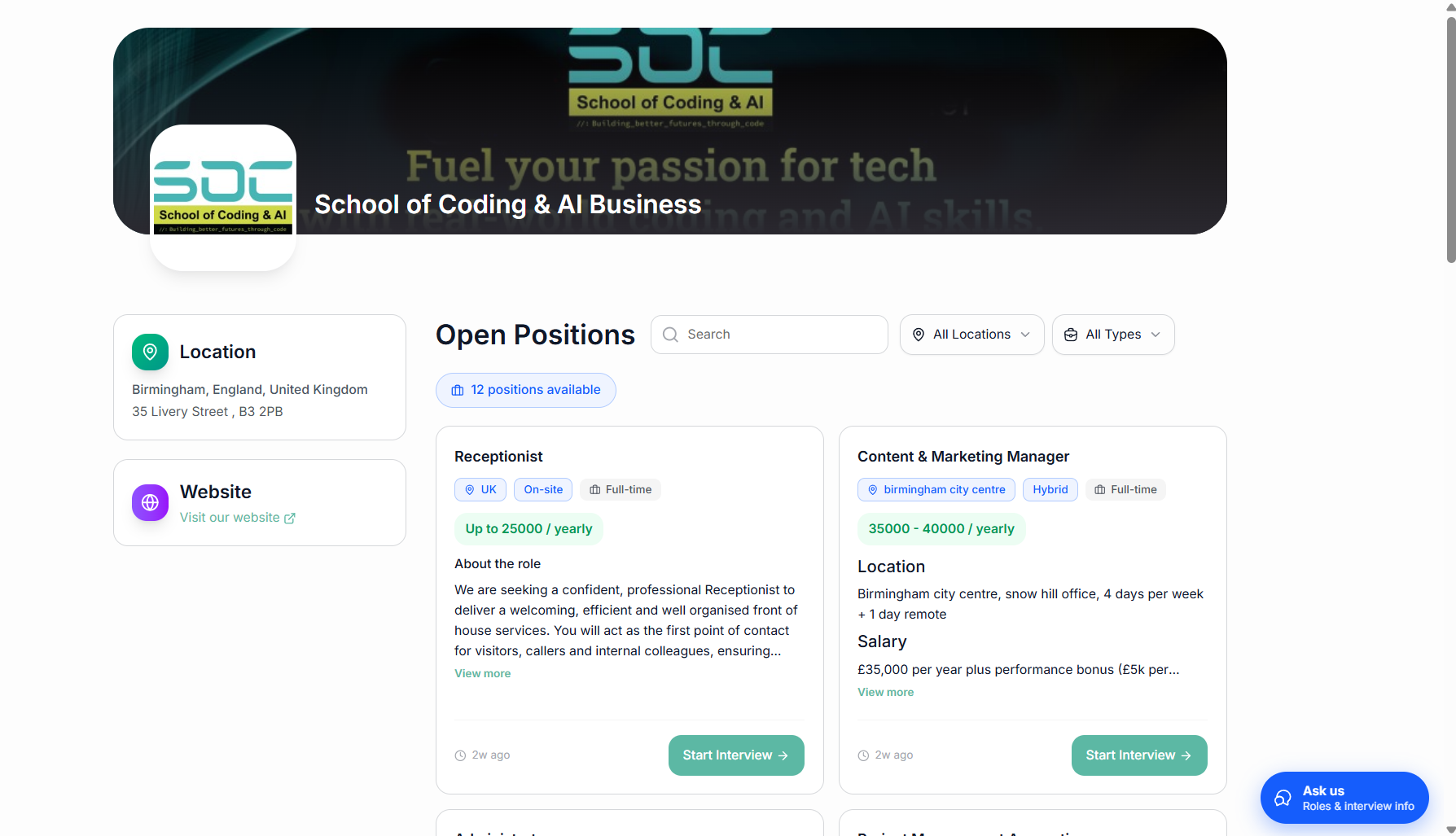
School of Coding managed multiple campaigns through one branded careers page, where candidates could apply and start their AI interview.
Step 3. Candidates Completed Interviews on Their Own Schedule
Instead of scheduling first-round interviews, candidates completed them whenever it suited them using a desktop or mobile device. There were no calendars to coordinate, no screening calls to arrange, and no waiting for recruiter availability.
Candidates spoke with Interviewa's AI interviewa in a natural two-way conversation. Every interview followed the same core structure, while dynamic follow-up questions adapted to each candidate's responses, creating a more natural conversation than traditional one-way video interviews.
Most interviews lasted 7 to 15 minutes and generated:
- Complete interview recording
- Full transcript
- Question-by-question responses
- AI-generated summary
- Behavioural perception observations
- Structured interview responses
Jordan noted that candidates became comfortable after the first few minutes, while candidate feedback suggested the experience felt far more conversational than they expected.
Why School of Coding chose this approach
Instead of judging candidates purely on their CVs, every applicant had the opportunity to demonstrate communication skills, motivation, and personality before recruiters made any decisions.
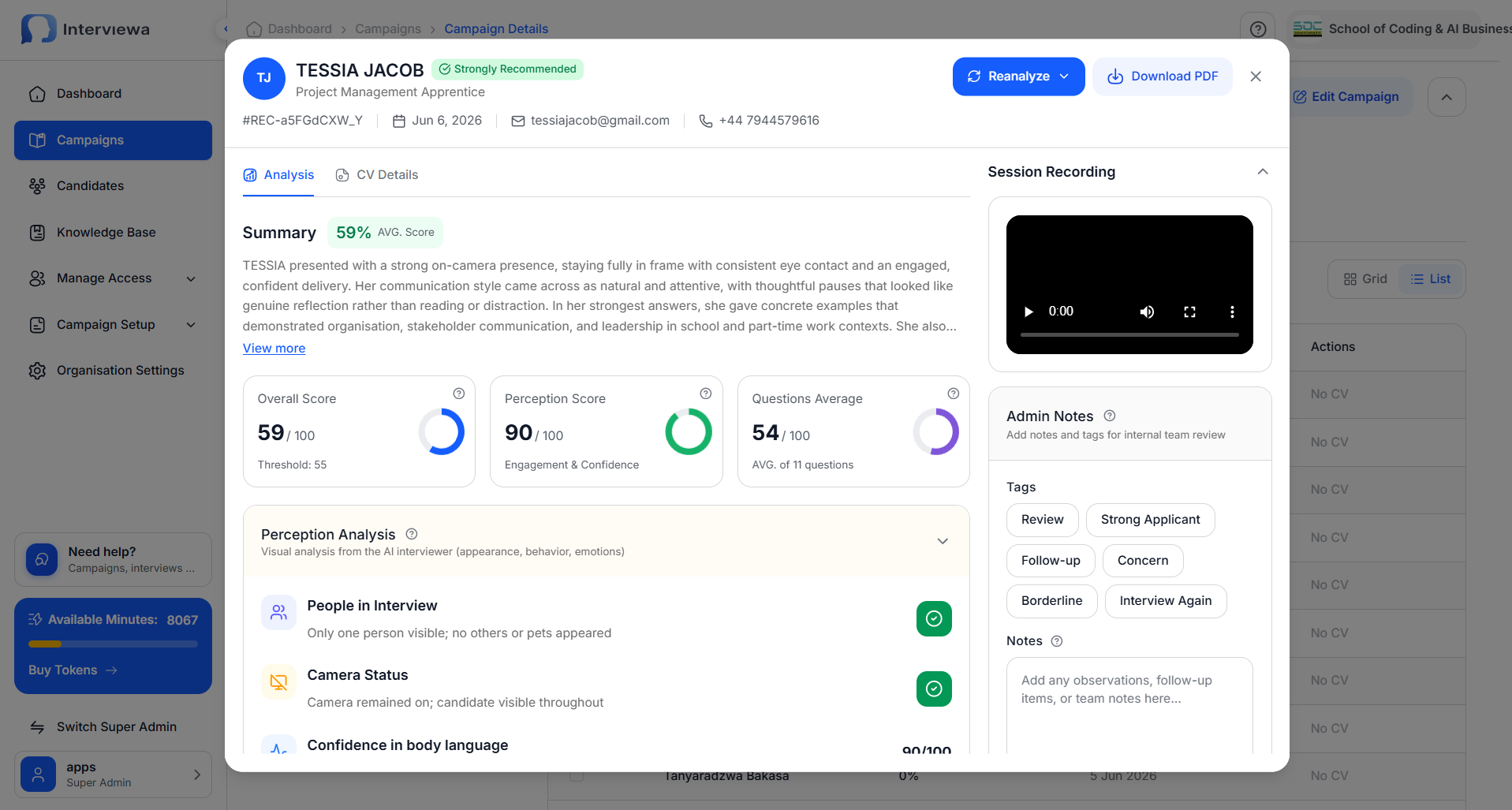
Recruiters could review interview summaries, transcripts, recordings, scores and CVs from one workspace, making it faster to compare candidates and progress the best fit.
Step 4. Recruiters Reviewed Structured Interview responses
Once interviews were complete, recruiters reviewed every candidate in Interviewa's central workspace, where all interview responses were organised in one place.
For each applicant, recruiters could access:
- AI-generated interview summary
- Complete interview recording
- Full transcript
- Parsed CV
- Question-by-question responses
- Behavioural perception observations
- Recruiter notes
- Pipeline status
Recruiters could search candidates using natural language, apply filters, compare applicants, review summaries first, and open full interview recordings whenever additional context was needed.
By bringing all candidate interview responses together in a single view, Interviewa made it easier for recruiters to compare applicants consistently while keeping every hiring decision in human hands. Jordan also noted that the platform surfaced strong candidates who might never have progressed through traditional CV screening alone.
That confidence was reinforced once candidates progressed through the hiring process. Reflecting on the shortlisted applicants, Romina, who led the recruitment campaign, said the interview summaries and candidate profiles closely matched what she later saw in person:
"It was really accurate. The percentage that it gives... I can now see that was completely true."
Why School of Coding chose this approach
Recruiters wanted to spend less time collecting information and more time evaluating candidates.
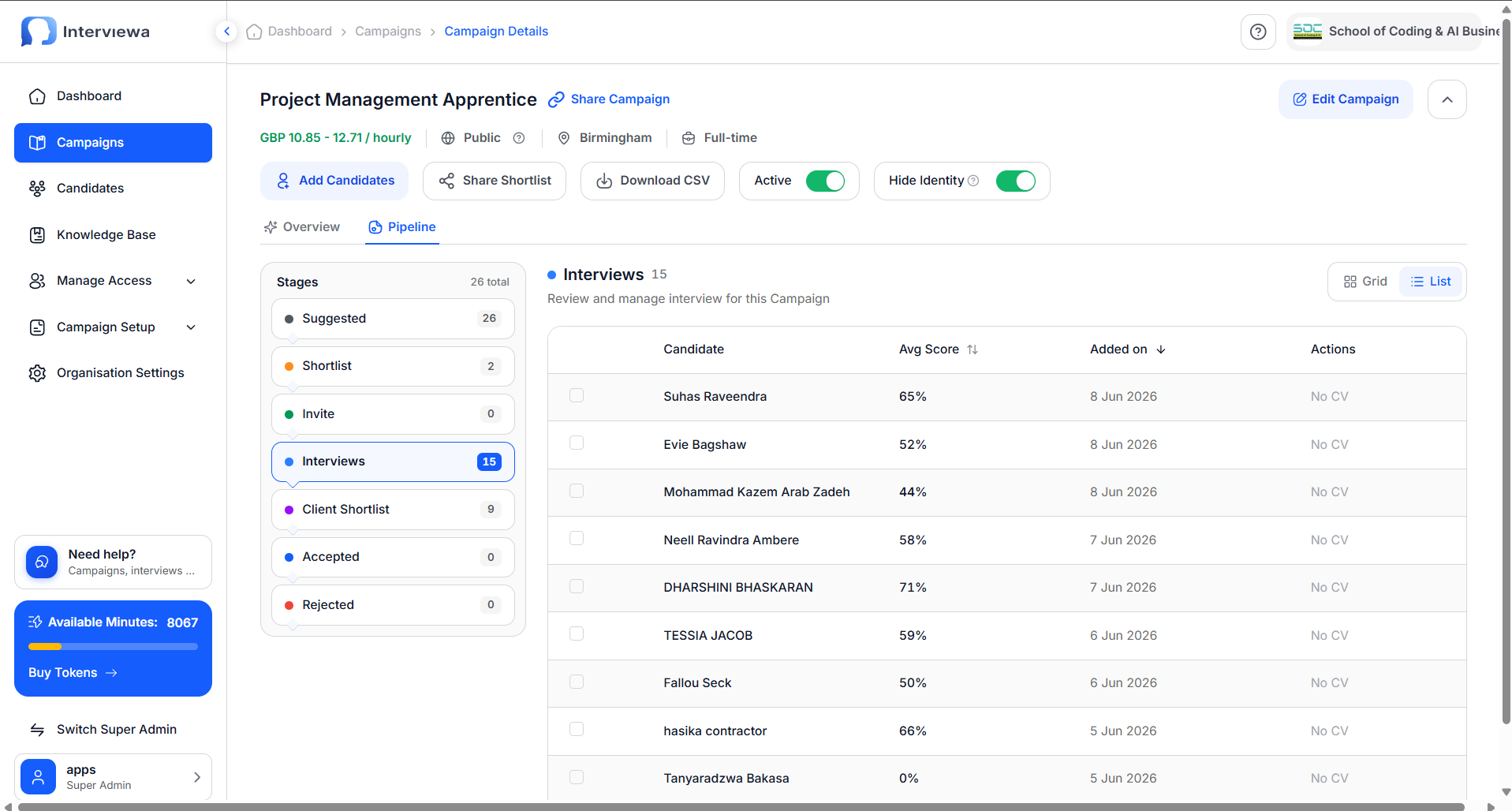
Recruiters managed every stage of the hiring pipeline from one workspace, tracking candidate progress, collaborating on shortlists and preparing finalists.
Step 5. Human Hiring Decisions
Although Interviewa streamlined the first stage of recruitment, every hiring decision remained with School of Coding's recruitment team.
After reviewing interview responses, recruiters compared candidates, added notes, moved applicants through the recruitment pipeline, and shortlisted the strongest candidates for an in-person assessment centre and open day.
Final hiring decisions were made by three hiring managers and one university board member, who evaluated candidates using both the interview responses and their performance during the assessment centre. The campaign resulted in 12 hires across three apprenticeship roles, exceeding the original hiring target because of the strength of the shortlisted candidates.
The quality of the shortlisted candidates also exceeded expectations. Looking back after meeting candidates in person, Romina said:
"They were really good candidates. When they came in, I was like this is even better than what we saw in the interview... I'm fascinated by this."
Why School of Coding chose this approach
AI handled the repetitive work of interviewing all the candidates at scale, allowing recruiters to focus on evaluating people rather than organising interviews.
What Changed After Implementing the Workflow?
The new recruitment process didn't just save time, it changed how School of Coding identified, evaluated, and hired candidates.
By replacing manual screening calls with structured AI interviews, recruiters were able to focus on reviewing interview responses and making hiring decisions rather than coordinating interviews. The result was a faster, more consistent recruitment process that still kept people firmly in control.
Faster Recruitment
School of Coding completed the entire recruitment campaign in 11 days, compared with a process that previously took more than 30 days. Candidates could interview immediately after receiving an invitation, while recruiters reviewed completed interviews instead of spending weeks scheduling screening calls.
Reduced Administrative Work
Much of the repetitive work associated with first-round recruitment was removed. Interview scheduling, initial screening calls, and manually collecting interview notes were replaced with structured interview responses, allowing recruiters to focus on evaluating candidates. Overall, recruiter administration was reduced by an estimated 70%.
More Consistent Interviews
Every applicant completed the same structured first-round interview, ensuring candidates were assessed against a consistent set of core questions. While follow-up questions adapted naturally to each conversation, recruiters could compare applicants using structured interview responses rather than inconsistent interview experiences.
Better Candidate Experience
Candidates completed interviews when it suited them, without waiting for recruiter availability. Jordan observed that most applicants became comfortable within the first few minutes, while candidate feedback described the interviews as more natural and conversational than expected.
Improved Recruiter Confidence
Perhaps the biggest change was the confidence recruiters had in their decisions. Instead of relying heavily on CVs, they reviewed interview summaries, transcripts, recordings, and structured interview responses before shortlisting candidates. Jordan also noted that Interviewa identified strong candidates who might never have progressed through traditional CV screening, helping the team make more informed hiring decisions.
Why these results mattered
The success of this campaign wasn't simply that SoC hired 12 people in 11 days. It was that they achieved it while giving every applicant the opportunity to demonstrate more than their CV and ensuring every hiring decision remained with the recruitment team. By reducing administrative work and standardising the first stage of recruitment, recruiters could spend more time doing what they do best, evaluating people and selecting the right candidates.
Features That Delivered the Biggest Impact
While the overall recruitment workflow transformed how School of Coding hired, several Interviewa features had a particularly significant impact on speed, consistency, and recruiter efficiency.
AI Interviewa
Instead of arranging hundreds of screening calls, every applicant completed the same structured first-round interview with Interviewa's conversational AI avatar. While each candidate answered the same core questions, dynamic follow-up questions adapted naturally to their responses, creating a more engaging interview without compromising consistency.
This allowed School of Coding to interview far more candidates while giving every applicant an equal opportunity to demonstrate their communication skills and potential.
Structured Reports
Every completed interview generated a structured report containing an AI summary, full transcript, interview recording, question-by-question responses, and supporting interview responses.
Rather than reviewing every interview from start to finish, recruiters could begin with concise summaries before exploring the full conversation when needed, helping them evaluate candidates more efficiently.
Knowledge Base
School of Coding uploaded role and organisation information into Interviewa's Knowledge Base before launching the campaign. This gave the AI interviewa additional context during conversations, allowing it to answer candidate questions consistently while keeping interviews aligned with the role and organisation.
The result was a more informative and consistent interview experience for every applicant.
Candidate Pipeline
Interviewa's candidate pipeline gave recruiters a clear overview of every applicant's progress throughout the recruitment process. Candidates could be reviewed, shortlisted, moved between stages, and prepared for the assessment centre from a single workspace.
This made collaboration between recruiters and hiring managers much simpler while keeping the recruitment process organised.
Search & Filters
With dozens of completed interviews to review, recruiters used Interviewa's search and filtering tools to quickly find, compare, and prioritise candidates.
Combined with Fit Scores, Match Scores, interview summaries, and structured interview responses, this helped School of Coding identify promising applicants faster without relying solely on CV screening.
That confidence extended beyond reviewing interviews. After meeting shortlisted candidates in person, Romina found that the interview summaries accurately reflected the people they eventually hired.
"It was really accurate... I can now see that was completely true."
One of the most telling outcomes wasn't simply that School of Coding hired 12 people in 11 days. It was that the team wanted to hire even more. After meeting candidates in person, Romina explained:
"We all loved them. We really wanted to have most of them. So we are trying to get more people in."
Hear It From the Team
Jordan shares why School of Coding chose Interviewa and how AI interviews transformed their recruitment process.
Limitations of AI Interviews
While AI interviews can significantly improve efficiency during the early stages of recruitment, they are not a complete replacement for a well-designed hiring process. Organisations should be aware of the following limitations:
- Final hiring decisions must always be made by people. AI can organise interview evidence and provide structured insights, but recruiters and hiring managers remain responsible for evaluating candidates and making hiring decisions.
- AI interviews should not replace later-stage assessments. Depending on the role, technical interviews, practical exercises, assessment centres, or panel interviews may still be required to validate a candidate's suitability.
- Interview quality depends on interview design. Poorly written questions, unclear job requirements, or incomplete role information can reduce the effectiveness of the interview. Well-structured questions remain essential.
- AI should support recruiter judgement, not replace it. The greatest value comes from reducing repetitive administrative work and providing consistent interview evidence, allowing recruiters to spend more time evaluating candidates rather than organising interviews.
- Not every role should follow the same process. Highly specialised, executive, or niche positions may require additional interview stages and bespoke assessment methods beyond a structured first-round AI interview.
- Human oversight remains essential. Recruiters should always review interview recordings, transcripts, summaries, and supporting evidence before progressing or rejecting candidates.
- AI is one part of a broader recruitment strategy. The best hiring outcomes come from combining structured AI interviews with experienced recruiters, thoughtful assessment methods, and informed human decision-making.
Frequently Asked Questions
What is Interviewa?
Interviewa is a two-way AI interviewing platform that helps organisations automate structured first-round interviews while keeping recruiters in control of every hiring decision.
Does Interviewa make hiring decisions?
No. Interviewa gathers and organises interview responses, but recruiters review candidates, shortlist applicants, and make all hiring decisions.
Can candidates complete interviews on their own schedule?
Yes. Candidates can complete interviews on desktop or mobile at a time that suits them, removing the need for interview scheduling.
What does a recruiter receive after an interview?
Recruiters receive an AI summary, interview recording, transcript, question-by-question responses, CV, and structured interview responses.
Can Interviewa integrate with our ATS?
Yes. Interviewa integrates with platforms such as Workable and also supports CV uploads and manual and automated candidate invitations.
How long did School of Coding's recruitment process take?
The campaign processed 250 applications, completed 92 interviews, and hired 12 candidates in just 11 days.
What types of organisations can use Interviewa?
Interviewa is suitable for organisations hiring at scale, including employers, training providers, apprenticeship programmes, universities, and education providers.
Can interview questions be customised?
Yes. Recruiters can edit AI-generated questions, add their own questions, and customise each interview to suit the role.
How long does an Interviewa interview take?
Most interviews take between 7 and 15 minutes, depending on the candidate's responses and follow-up questions.
How does Interviewa help recruiters save time?
By automating first-round interviews and organising candidate interview responses, recruiters spend less time on administration and more time evaluating candidates. In School of Coding's case, recruiter administration was reduced by an estimated 70%.
Conclusion
School of Coding's recruitment campaign demonstrates that when one wants to hire at scale, one doesn't have to sacrifice quality or fairness. By combining structured AI interviews with human decision-making, the team processed 250 applications, completed 92 interviews, and hired 12 candidates in just 11 days, reducing recruiter administration while giving every applicant a consistent opportunity to demonstrate their potential.
The biggest lesson wasn't that AI replaced recruiters, it didn't. It handled the repetitive work, organised interview responses, and helped recruiters spend more time evaluating people rather than managing the recruitment process. Every hiring decision remained firmly in human hands.
If your organisation is looking to hire faster while delivering a more consistent candidate experience, School of Coding's approach offers a practical example of what's possible when AI supports recruiters, rather than replacing them.