How to answer "tell me about yourself" in a job interview
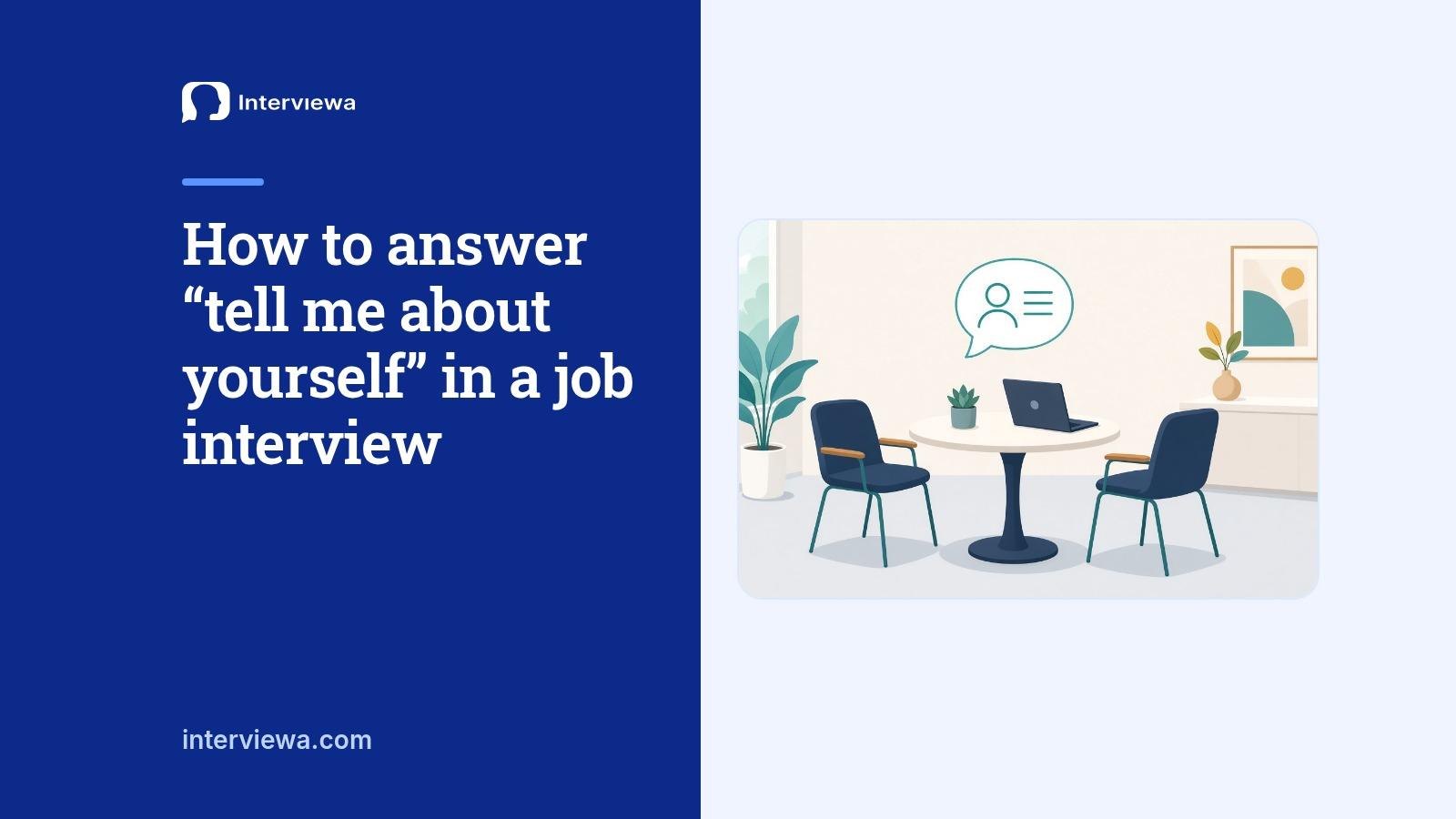
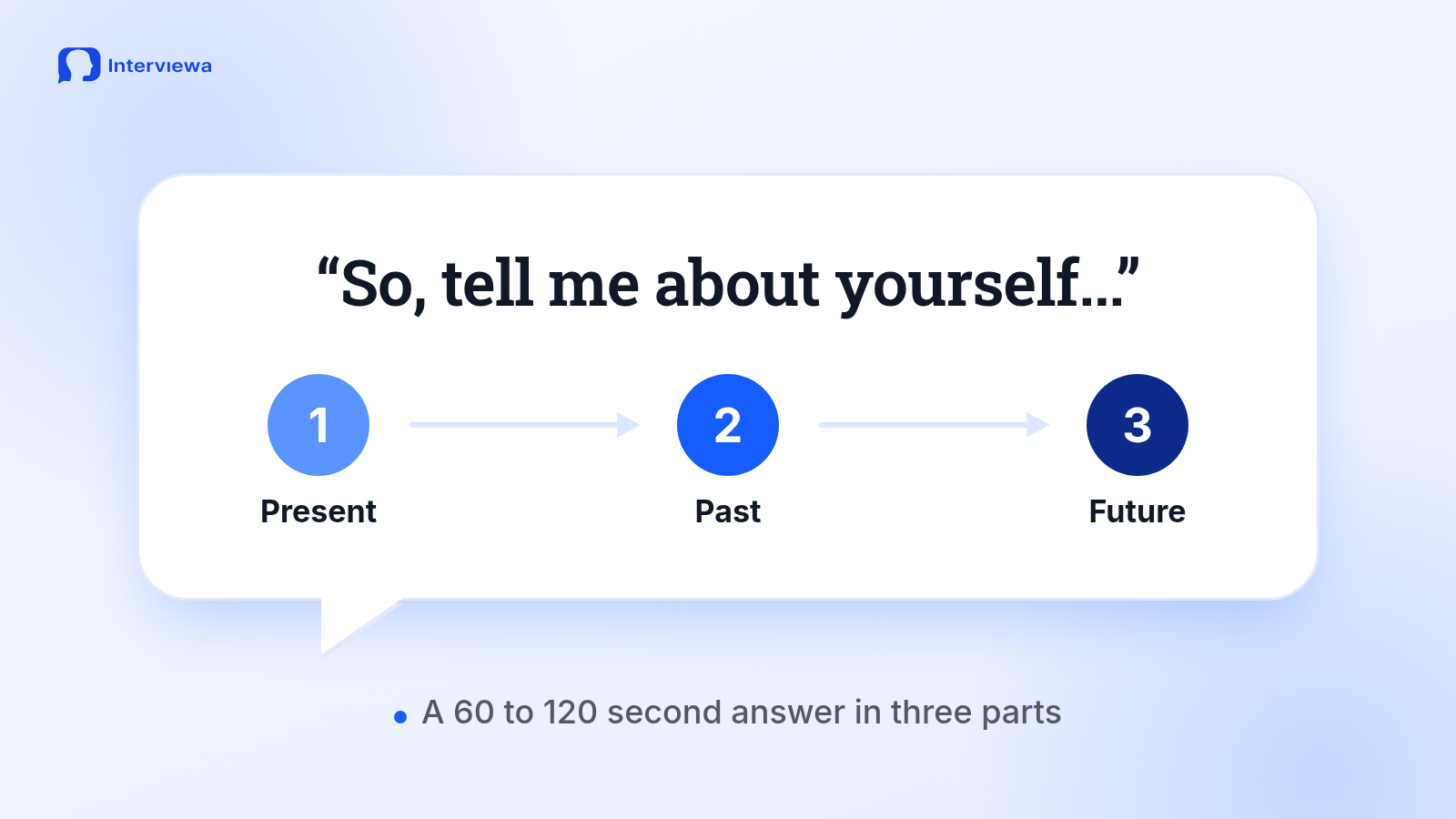
To answer "tell me about yourself", give a short, work-focused story in three parts: where you are now, how you got here, and why this role is your next step. Keep it to around 60 to 90 seconds, link it to the job description, and practise it out loud until you can say it with confidence.
This guide explains how to answer tell me about yourself with a formula you can reuse, sample answers and a simple way to practise.
Why do interviewers ask "tell me about yourself"?
Short answer: it is an open-ended opening question that breaks the ice, shows how you communicate and creates a first impression. They already have your CV and cover letter. They want to see which parts of your story you pick and how clearly you explain them.
Robert Walters, the UK recruitment firm, says the question helps interviewers understand how you describe your experience, what you think is most relevant to the role, how well you communicate and whether you seem prepared (Robert Walters). Bright Network adds that your answer often shapes the follow-up questions, so this opening question sets the direction of the whole conversation (Bright Network).
It also comes as "walk me through your CV". Either way, they want a brief introduction, not your entire life story.
How to answer "tell me about yourself": what is the best structure?
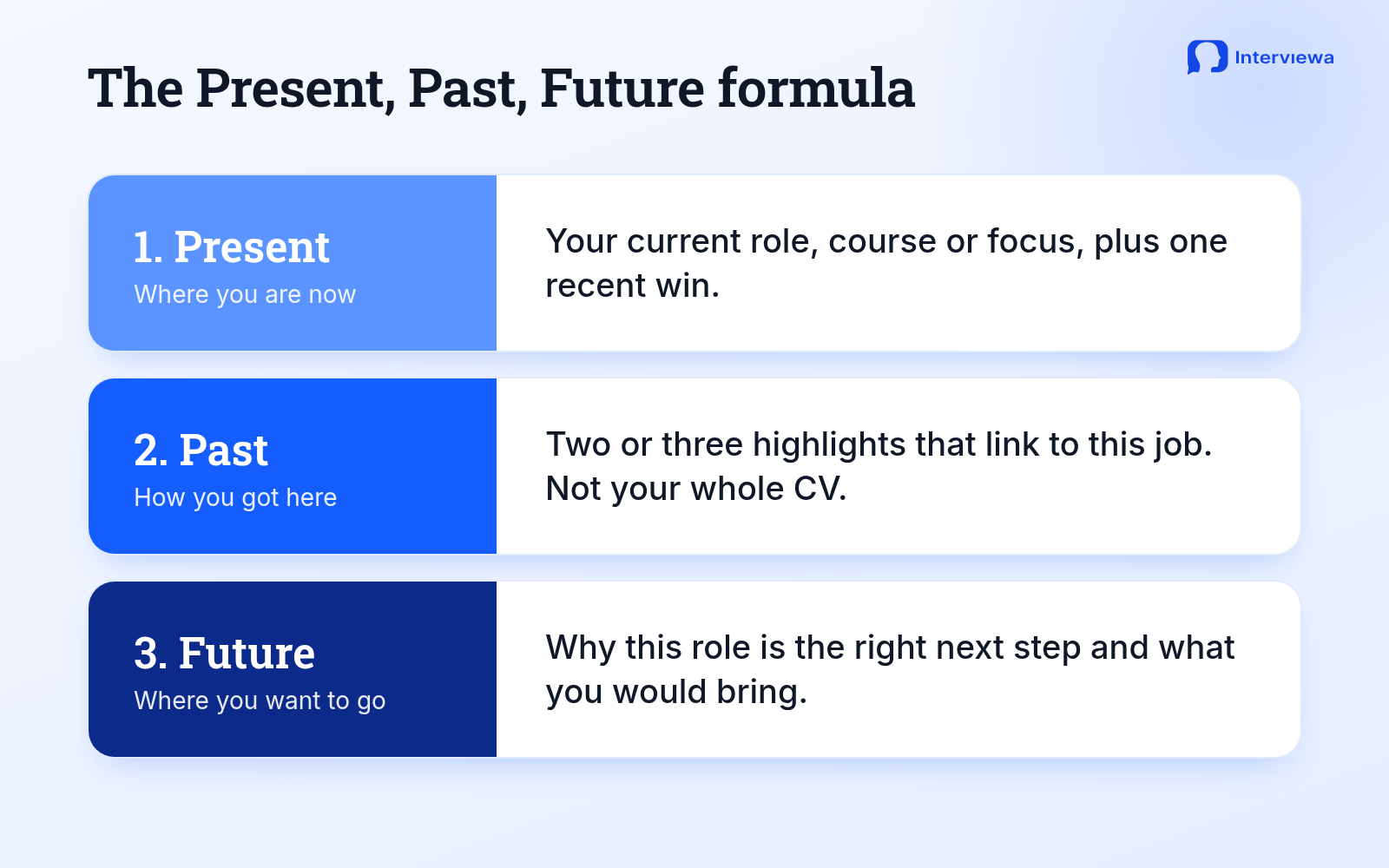
Short answer: use Present, Past, Future. It is easy to remember and easy for the interviewer to follow.
Robert Walters, Indeed UK and Bright Network all recommend a version of this approach (Indeed UK):
- Present. Begin with your current role, course or focus, plus one recent achievement that matters for this job.
- Past. Pick two or three highlights from previous roles, a placement or a qualification. Only include what links to the job.
- Future. Explain why this position is the right next step and why you are a good fit.
A strong answer stays directly relevant. If a sentence would work for any company, swap it for something tied to this job.
How long should your answer be?
Short answer: about 60 to 90 seconds, and no more than two minutes.
Robert Walters recommends 60 to 90 seconds. Indeed UK suggests no more than two minutes. Talking for longer usually means you are listing jobs rather than telling a story, and you lose the interviewer's interest.
If you run over, cut the Past section first.
Which relevant experience and key skills should you include?
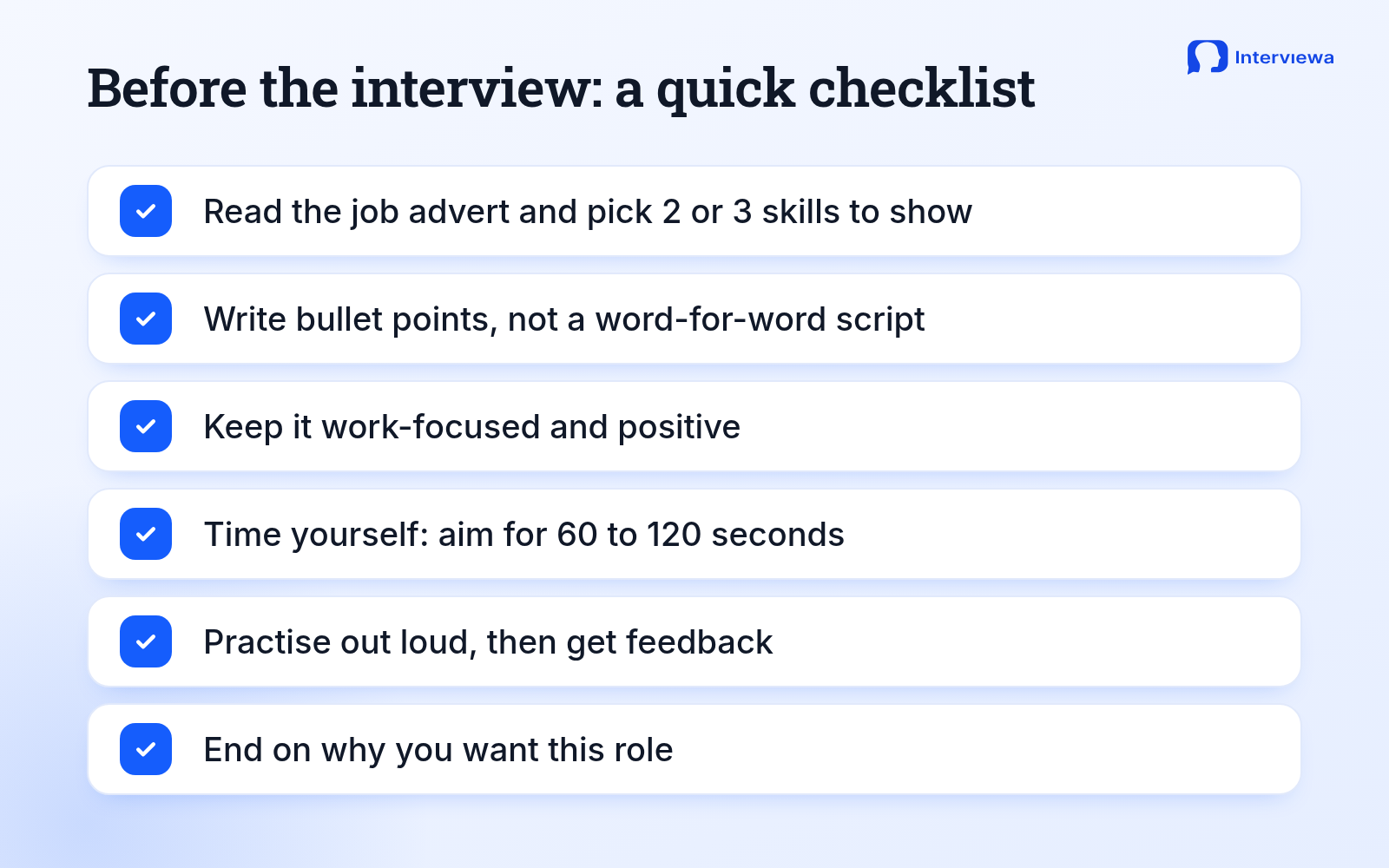
Short answer: two or three relevant skills from the job advert, one proof point for each, and a genuine reason for wanting the role. Pick the achievements that matter most for this job.
Focus on:
- Key skills from the advert. Back each one with a quick example from your current role or previous experience.
- One professional achievement. Briefly mention it and let the interviewer ask for more.
- Soft skills. Indeed UK suggests that because this question is about getting to know you, soft skills such as communication skills and teamwork can matter as much as technical ones.
- Research. One line that shows you understand the company, its work or its company culture.
What are the common mistakes to avoid?
Short answer: rambling, negativity, personal details and reading out your CV.
- Reading out your CV in order. The interviewer already has it.
- Complaining about a past employer. Keep reasons for moving positive.
- Sharing personal details. Indeed UK advises leaving out topics such as marital status, children, religion or politics, as these relate to protected characteristics.
- Rambling. Talking without a clear point makes it hard to follow you.
- Memorising a script. Word-for-word answers sound flat and fall apart if you lose your place. Learn your key points instead.
What does a good sample answer sound like?
Short answer: it is specific, short and ends with why you want the job. Adapt these examples so every detail is true for you.
If you are currently employed
"I'm a customer service team leader at a regional energy supplier, where I look after a team of eight. Over the last year I've rewritten our call scripts and coached new starters. I'm now looking for an operations role where I can shape how service is designed, which is why this position caught my eye."
If you are a recent graduate
"I've just finished a business management degree. In my final year I did a six-month placement in a marketing team, where I ran the company's LinkedIn page and helped plan two product launches. I'd like to start my career on a graduate scheme that rotates across teams, and your focus on hands-on projects is exactly what I'm looking for."
If you are changing career
"I spent eight years as a primary school teacher, and the part I enjoyed most was designing lessons and training other staff. This year I completed a course in instructional design and built e-learning modules for two local charities. I'm now moving into learning and development full time, and this role lets me use both my teaching background and my new digital skills."
None of these mention age, family or salary, and each one ends on the job.
How do you tailor your answer to the job description?
Short answer: match your highlights to the advert and add one detail about the employer.
The National Careers Service recommends reading the job description carefully, researching the company's website and preparing examples from your past experience (National Careers Service). Then:
- Pick the two or three skills that appear most often in the advert.
- Choose one example for each from your Present or Past.
- Add a line in your Future section that links to the organisation.
Interviewing for several jobs? Keep the structure and swap the examples.
How should you prepare for follow-up questions?
Short answer: expect the interviewer to dig into anything you mention, so only include what you are happy to expand on.
If you mention a project, be ready to explain your part in it. The National Careers Service suggests using the STAR method (Situation, Task, Action, Result) to answer questions fully, which works well when the interviewer asks "tell me more about that". Think of your opening answer as a menu of topics for the rest of the job interview, and a chance to make a great impression early.
How can you practise before your next job interview?
Short answer: the best way to learn how to answer tell me about yourself is to say it out loud several times, time it, and practise with someone who will ask follow-up questions.
Try this routine:
- Write five or six bullet points, not full sentences.
- Say your answer out loud three times using only the bullets.
- Record one version and cut anything that sounds like filler.
- Ask a friend to interview you. The National Careers Service suggests practising with someone you trust.
If you have no one to practise with, an AI mock interview lets you rehearse whenever you like. Interviewa's AI interviewer, Eve, asks common interview questions in a two-way spoken conversation and is available 24/7, so you can try your opening answer as often as you need. For harder conversations, such as explaining a career gap, try interview role-play. If you are still deciding on direction, an AI career coach can help you shape the story behind your answer.
What if your mind goes blank?
Short answer: pause, breathe and start with the present. "I'm currently..." is an easy way in.
Robert Walters suggests a short pause rather than rushing. A two-second pause feels long to you but normal to the interviewer, and it leaves a better impression than rushing.
FAQs: more interview questions about this answer
How long should my answer to "tell me about yourself" be?
Aim for 60 to 90 seconds, and no more than two minutes. That leaves room for follow-up questions.
Should I mention hobbies?
Only briefly. A hobby can show a little personality, but only include it if it supports your story, for example by showing teamwork or leadership.
Is it OK to use a script?
Use bullet points, not a full script. Know your key points and say them in your own words.
How do I answer "tell me about yourself" with no experience?
Focus on studies, projects, volunteering or part-time work and the skills they gave you. Then say why this role is the right first step.
Should my answer change for a video interview?
The content can stay the same, but slow down slightly.
Get started free
Knowing how to answer tell me about yourself comes from practice, not luck. Write your three-part answer today, say it out loud, then test it in a realistic interview. Get started free with an AI mock interview and practise your opening with Eve before your next job interview. For more interview questions and guides, visit the Interviewa insights hub.