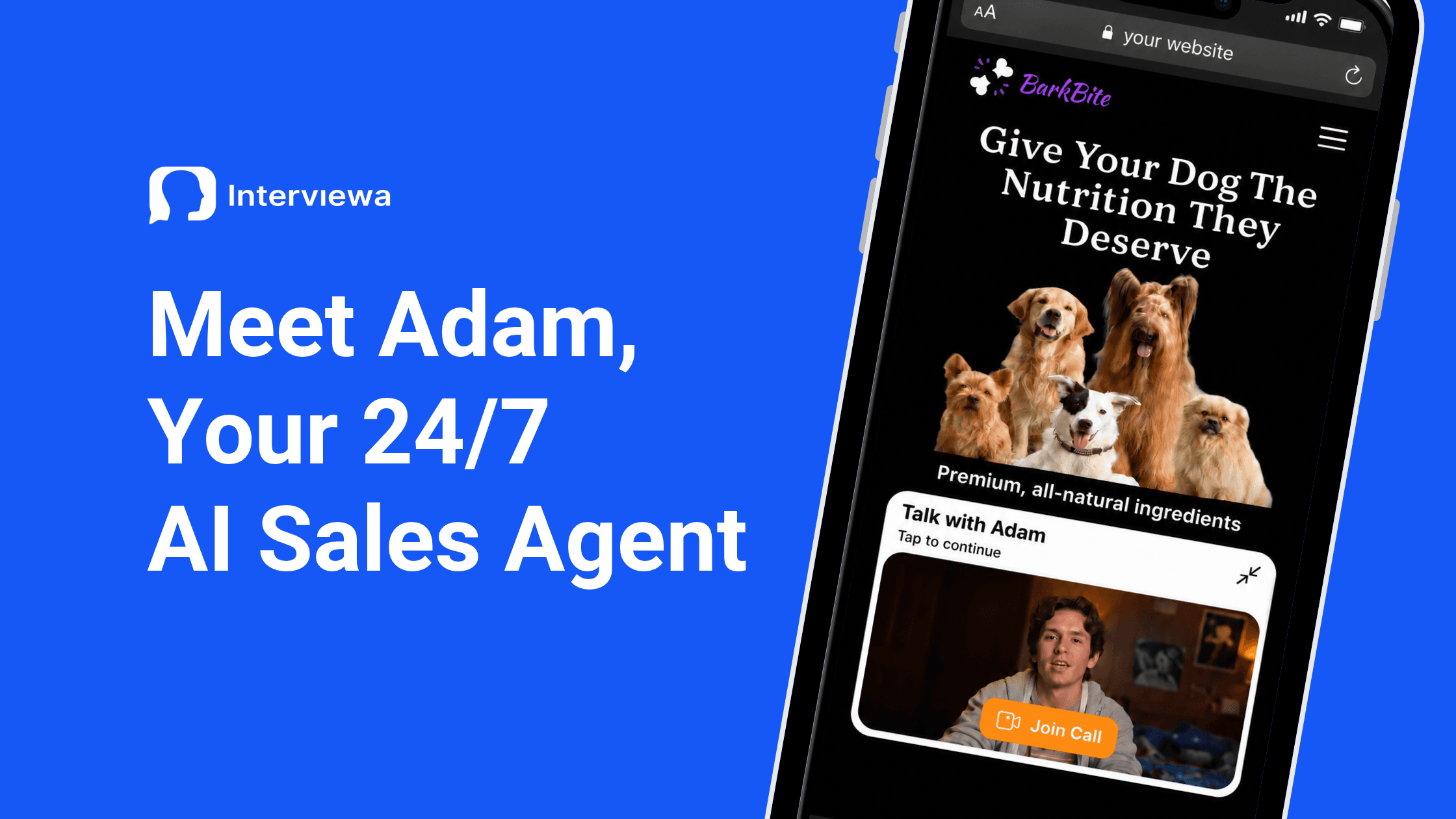
Meet Adam, Interviewa's AI Sales Agent for 24/7 Website Conversations
Your best leads don't arrive at 10 a.m. on a Tuesday. They land on your website at midnight, on a Saturday, or during a bank holiday - and if nobody's there to greet them, they bounce. An AI sales agent changes that equation entirely.
Here's how AI sales agents work and why they matter
Let's start with what we're actually talking about. To use an AI sales agent, you add it on high-intent pages, connect it to your knowledge base, calendar, configure how it qualifies and responds within your broader sales workflow, and let it greet visitors, ask questions, book meetings, and log outcomes automatically.
An sales agent is an autonomous system that owns a defined sales job. It doesn't just answer questions in a chat window; it reads context from your knowledge base, decides the next step, by booking meetings. That's what separates it from a chatbot (scripted, reactive, limited to a chat window), and AI copilots (which suggest but never act independently).
For sales teams at mid-sized to large companies it matters because the same system can handle lead qualification, candidate screening, and engagement without adding headcount, especially as AI powered platforms and sales tools reduce repetitive work across the team. Sales teams spend only 28% of their time actually selling, according to Salesforce's research. The rest? Admin, manual data entry, chasing updates, and automating repetitive tasks that don't move the needle off your team's plate. AI agents can automate up to 70% of sales tasks, which means your people can focus on relationship building, navigating complex deals, and the high value deals that require human expertise.
Here's how AI sales agents work at a high level:
- Connect to your website, brochure knowledge base, calendar
- Act greet, ask questions, book meetings
- Decide the next step using qualification logic (scoring, routing, escalation)
- Log outcomes - transcripts, summaries, sentiment, follow up tasks
From there, this guide walks through how AI sales agents work, where they beat chatbots and traditional automation, inbound and outbound use cases, deployment steps, conversation design and how to get started with Interviewa's Adam.
The numbers back this up. In a survey of 100 sales leaders, 89% reported positive impact on sales growth from agentic AI, and 87% saw improved productivity. Companies using AI agents report 2-3x pipeline growth. AI can free up about 20% of a sales team's capacity. And AI-powered lead scoring improves conversion rates by 40–60%.

How to Use Adam, Your Sales Agent
It's 10:43 p.m. A prospective student lands on a UK university's admissions page. The office closed five hours ago. Without Adam, that visitor browses for ninety seconds, finds no one to talk to, and leaves - probably for good. With Adam, AI sales agent avatar appears, greets them by context, and starts a real conversation.
Here's what Adam actually does - he appears as a video avatar on your website, reads from your company's website content and uploaded PDF brochures, answers visitor questions in real time and captures lead details as usable lead records - all without a single human needing to be online.
After every interaction, Adam delivers:
- Full call recording
- Searchable transcript
- Sentiment analysis
- Conversation summary
- Recommended follow ups for the human team
That means when your sales team opens their inbox the next morning, they've got everything they need - context, qualification data, and suggested talking points - to pick up the conversation without asking the visitor to repeat themselves.
Plans range from a free starter tier up to custom enterprise options with SLA and SSO - so you can test before you commit.
What is an AI sales agent and how is it different from a chatbot?
An AI sales agent is an autonomous agent that owns a defined sales job - and acts across tools, not just in a chat window. It reasons about what to do next, takes action, and learns from outcomes.
Here's how they compare:
- AI sales agent: Decides next step autonomously, accesses calendar to book meetings. Owns outcomes (meetings booked, leads qualified). Adapts based on context.
- Chatbot: Responds to user inputs within a fixed flow or FAQ. Limited tool access. No autonomous decision-making.
Concrete tasks an AI sales agent typically performs - greeting website visitors, asking qualification questions (role, company size, budget), scheduling meetings to the right sales representative or team, and, in the case of outbound prospecting agents, researching target accounts before outreach. They can also support cold outreach across email, phone, messaging, and social channels with personalized follow-up.
Some agents also handle early sales calls to qualify interest and book meetings before handing strong opportunities to human reps.
For Interviewa, think of Adam as an outreach sales agent sitting on your website page. He can explains your business on your website, answer questions and books a demo call with your sales team friction required.
Turning anonymous visitors into booked meetings
Sales agents are the AI-powered front door to your website. They matter in 2026 because speed determines conversion: leads contacted within five minutes of an enquiry are dramatically more likely to convert. Most organisations respond in 14+ hours. AI sales agents can streamline the entire process from first contact through qualification and routing, closing that gap to seconds.
Here's what inbound qualification agents actually do:
- Greet visitors on high-intent pages
- Answer questions using your knowledge base
- Ask qualifying questions, use customer data and company data to qualify leads, score lead quality, and prioritize high-potential leads before handoff; repeated visits to a pricing page can be treated as a high-intent signal for faster follow-up
- Book meetings or route leads to the right sales representative based on rules
This improves pipeline quality by surfacing qualified prospects for human follow-up. It also strengthens lead generation by showing which inbound leads deserve immediate sales outreach.
For Interviewa's context, Adam acts as a front-door sales agent on your most important pages. Customers get immediate responses rather than waiting for a call back. AI can also automate repetitive follow-up work like meetings booked after the first interaction, so reps can focus on qualified prospects and close deals.
24/7 coverage is the quiet multiplier. Your website visitors don't operate on your schedule. Global time zones, weekends, and late nights account for a significant share of traffic. Some teams use Signal Agents to monitor 1,000+ public sources for buying signals and surface target accounts worth fast follow-up. AI can automate lead qualification tasks, saving 60–70% of time your team currently spends on initial triage - and capturing promising leads that would otherwise vanish overnight, while helping prevent active deals or warm prospects from going idle outside business hours. This helps teams surface high value leads faster for human follow-up.

Step-by-step: how to deploy an AI sales agent on your website
Here's the practical setup for getting an AI sales agent live on your site.
1. Choose your pages. Don't deploy everywhere at once. Start with high-intent pages these are the pages where website visitors are most likely to convert - and where delayed responses cost you the most. That can include pricing, demo, and contact pages, especially when someone has just submitted a web form or shown another strong buying signal.
2. Install the script. Adam can be added in under a minute by pasting a single link and widget into your site template. No complex integrations on day one. Deeper deployment usually comes next, when you connect the agent to CRM systems and other sales tools in your stack.
3. Connect knowledge sources. Upload your website URL, brochure PDFs and FAQ documents. This is what grounds the agent - it pulls answers from your verified content, not from the open internet. The better your source material, the better the conversations, and data quality matters because the agent's answers depend on the accuracy of that material.
4. Configure brand voice, language, and greeting. Set the tone (formal, friendly, or somewhere in between), choose supported languages - AI can support video interviews in over 25 languages - and write an opening greeting that fits your brand.
5. Test, review, and refine. Run sample conversations internally. Review the transcripts. Check that questions and fallback responses work as expected before full rollout. Adjust before going fully live. This step catches 90% of awkward interactions before a real visitor encounters them.
AI agents are becoming standard infrastructure, with 40% of enterprise applications expected to include them by 2026.
Configuring prompts and conversation flows for your AI sales agent
"Prompting" in this context means system prompts, instructions, and example dialogues that shape how the AI agent behaves. Think of it as writing the agent's playbook. Many teams start with specialized agents or assistive setups, then move low-risk work to autonomous agents as confidence grows. Prompt design should also reflect your sales operations rules for qualification, routing, and escalation.
Best practices:
- Be explicit about tone. "You are a friendly, professional sales agent for [Company]. Use British English. Never use slang." Also note that wording that works in one market can fall flat in another, so prompts should reflect local tone and context.
- Define what to ask first. Prompts that capture specific pain points and key details.
- Set handoff rules. "If the visitor asks about custom pricing or legal terms, say you'll connect them with a specialist and capture their email." Routing should also pass context to human sales reps so the entire team can see clear next steps.
- Handle uncertainty. "If you don't know the answer, say you'll pass their question to the team and capture the visitor's contact details."
Prompts should always include fallback instructions for edge cases, especially when the agent is part of a broader sales workflow spanning multiple tools and teams. AI sales agents can support email outreach as part of broader sales automation, but unlike rule-based tools, they may also make limited decisions inside the workflow while still needing clear rails for conversations that require human judgement.
Key metrics: how to measure whether your AI sales agent is working
You can't improve what you don't measure, and the best AI sales agent is the one you can measure against your entire sales process from first touch through handoff, alongside your own KPIs, with key takeaways from conversations measured alongside funnel metrics because they improve rep follow-up quality.
Companies using AI agents see 2–3x growth in qualified pipeline. Sales teams can see a 65% reduction in manual prospecting costs. AI agents can improve sales pipeline growth by 2–3 times. AI-driven sales forecasting can use CRM data, opportunity stages, and engagement signals to improve pipeline visibility, helping sales managers adjust strategy and resource allocation earlier.
Track the percentage of website visitors who engage with Adam and how many progress to meetings booked. The agent should capture key takeaways such as decisions, action items, and next steps so the entire team can review conversations quickly. Hold weekly transcript reviews - read 10–15 conversations, check whether qualification rules and talk tracks are driving the right outcomes, and adjust.
Interviewa customers can export or visualise agent performance data alongside interview analytics for a full-funnel view from first touch to final decision. In weekly reviews, also check whether handoffs from [transactional sales] versus more complex opportunities are going to the right sales reps.
Getting started with Adam, Interviewa's AI sales agent
If you've read this far, you're already thinking about where an AI sales agent could transform your sales efforts, admissions process, or candidate screening. Here's how to start today:
- Sign up for a free plan or join a call to see Adam in action
- Choose your initial pages - start with your highest-intent landing pages and make sure the first rollout supports how your sales teams operate today, rather than forcing a brand-new process.
- Upload a PDF - a programme guide, product brochure, or FAQ document as knowledge sources
- Go live - in under one minute, you'll have a 24/7 AI sales agent greeting visitors on live video, handling the initial contact and qualification across the entire process before handing qualified prospects to sales reps to close deals, and feeding your team complete context for follow ups
From there, Interviewa's broader platform takes over with structured AI video interviews, scorecards, and analytics to move qualified leads or applicants through the rest of your funnel.
The organisations that win in 2026 aren't the ones with the biggest sales teams - they're the ones that put AI where it creates the most leverage.
Test Adam on your own site and measure how AI powered agents can scale capacity without adding headcount proportionally by increasing qualified conversations. AI can also support customer retention as well as new-pipeline growth by keeping follow-up and renewal outreach consistent. Your next best lead might arrive at 2 a.m. The only question is whether anyone's there to greet them.