AI Has Increased Application Volume And CV Noise: How Recruiters Can Cut Through The Chaos
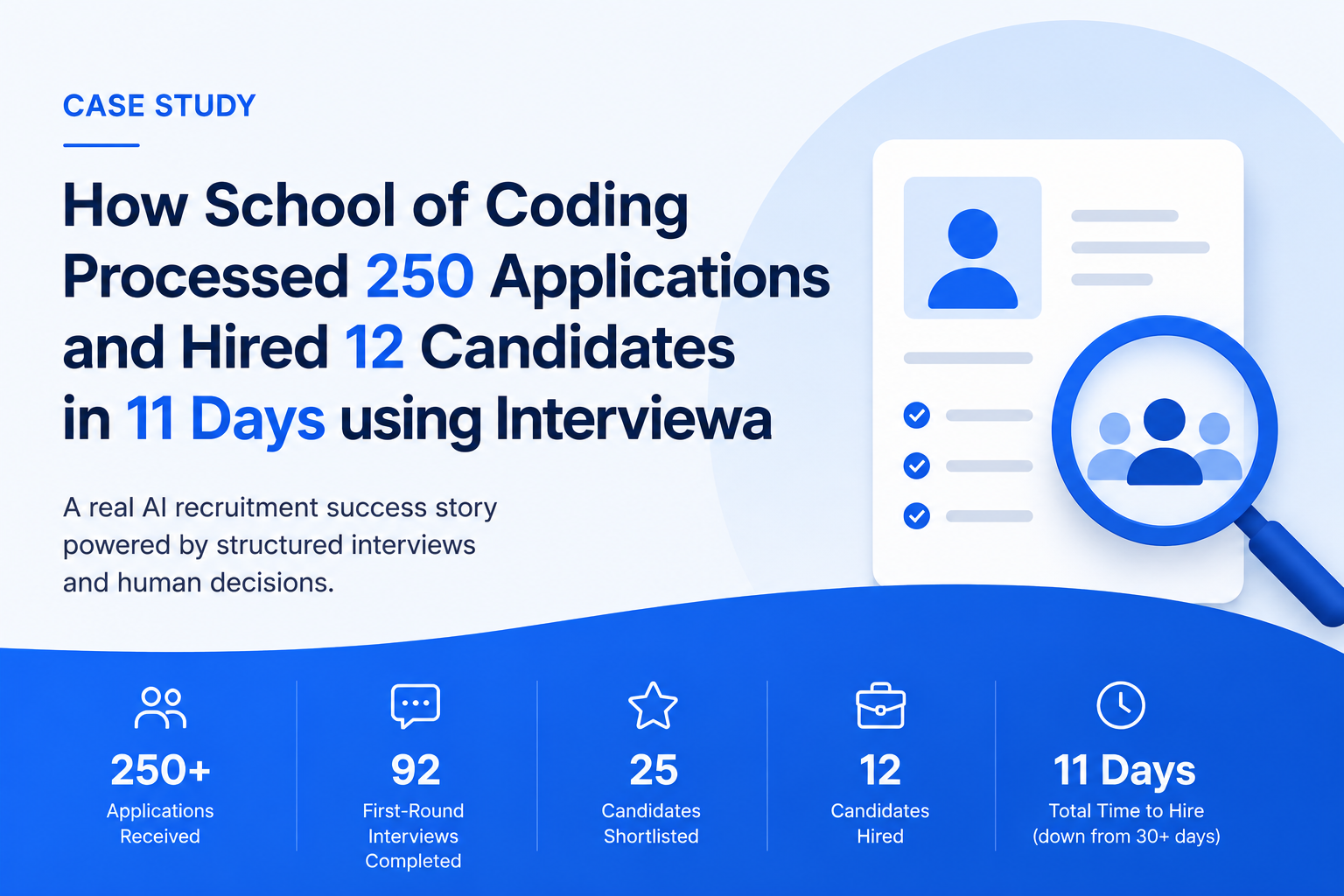
The hiring team sends each applicant a link to complete a structured video interview on Interviewa, an AI-powered video interviewing platform. Ninety-two candidates finish their first round interviews and twelve get hired in four days.
That ratio tells you something important about the recruitment market in 2026. The number of job applications has increased because AI tools make it effortless to produce polished CVs and cover letters in minutes. AI impacts hiring efficiency, but it complicates the identification of genuinely qualified candidates. Most people now apply to dozens of roles per week; the friction that once slowed a job search down to a handful of thoughtful applications has vanished.
This article is practical guidance for TA leaders, hiring managers, and recruiters trying to cope with a new reality: AI has increased application volume and CV noise to the point where traditional screening breaks down.
- The volume problem: roles that once attracted 60 CVs now pull 200+.
- The noise problem: CVs look better than ever, but say less than ever.
- The cost: longer time-to-hire, more false positives, and strong candidates lost in the pile.
What We Mean By "Application Volume" And "CV Noise" In 2026
Application volume is the raw count of applications per vacancy. For entry-level or remote customer service roles, that number regularly lands between 200 and 400 CVs within a single week. The candidate pool for a single position can balloon to a size that no human team can review with any depth.
CV noise refers to the influx of generic applications that clog recruitment pipelines. It isn't only about unqualified candidates. Noise includes applications where the person might be a good fit, but their CV gives no clear, job-related evidence to confirm it. AI-generated content tends to be more generic, reducing the reliability of applications as a screening signal.
Concrete examples of CV noise in practice:
- Professional summaries that open with identical, related words and phrases: "results-driven professional," "dynamic team player with proven track record." Dozens of CVs in the same batch use the same line.
- Skills sections listing tools and platforms without specifying when, where, or how they were used; responsibilities copied from job descriptions with no metrics or outcomes.
- Homogenization leads to applications sounding identical because candidates use the same AI tools to draft them.
How Generative AI Has Supercharged Job Search Volume
Between 2022 and 2025, tools like ChatGPT, Claude, and CV-builder platforms became standard parts of the job search toolkit. Generative AI tools allow candidates to draft tailored CVs and cover letters quickly, sometimes in under five minutes per application. According to Bryq's research, 49% of job seekers report using AI to assist in writing resumes; in white-collar segments, that figure rises to 75%.
AI increases applicant volume by allowing candidates to apply for multiple jobs simultaneously. The effort required to produce applications has decreased to the point where a single person can submit 20 or more per day. AI also reduces the psychological barriers to job applications, encouraging volume-based strategies: if it costs nothing to try, why not apply everywhere?
Key behavioral shifts recruiters should be aware of:
- Job boards with easy-apply options and AI automation let candidates submit numerous applications effortlessly. One-click apply on LinkedIn or Indeed, in conjunction with AI-written documents, compounds volume.
- Many candidates use AI to tailor applications, leading to a rise in standardized CVs that look customised but aren't substantively different.
- Employers who used to see roughly 60 CVs per role now report 180+ in 2025 and 2026, especially for remote support and customer service roles.
Why AI-Polished CVs Make Screening Harder, Not Easier
Applicants face a paradox: increased volumes yet decreased differentiation. When every CV has perfect grammar, clean layout, and optimised keywords, those factors stop being signals of competence or commitment. A Tilburg University study found that while AI improves the formal quality of cover letters, it does not increase the likelihood of hire. The polish goes up; the matching to the role gets worse.
AI can result in superficial customization of CVs to pass initial ATS filters without reflecting genuine ability. The use of AI in applications can also lead to exaggerated or fabricated candidate qualifications; inflated titles, overstated proficiency, broadened responsibilities. AI-driven tools cause hiring managers to spend more time validating candidate claims on CVs, because without that validation, teams risk backing the wrong candidate when the truth about what a person actually did is buried under layers of generated prose.
Consider two candidates for a customer service role:
- Candidate A: Flawless CV. Professional summary reads "passionate about delivering world-class customer experiences." Lists 14 skills. No metrics, no context, no specific examples. In the interview, they can't describe how they handled a real escalation.
- Candidate B: Older CV template, a minor typo. But the experience section reads: "Resolved 150 customer complaints per week, reducing average response time by 30%." They speak with depth about the process. That person gets the job.
For customer service roles especially, CV polish tells you nothing about empathy, conflict resolution, or resilience. Those skills surface in life, in practice, and in interviews; not in words on a page.
Impact On Recruiters, Hiring Managers, And Candidates
The operational burden is real. In many cases, paying for better screening up front is cheaper than wasting team time on avoidable noise. Recruiters spend 30 to 60 additional minutes per vacancy when volume doubles and every CV looks equally polished. Effective screening can save organisations time and money, but recruiters often lack tools to assess candidate competence accurately at scale.
- Recruiters: more hours sifting through near-identical CVs. Burnout rises. Agents and professionals on TA teams report feeling like they're guessing rather than evaluating.
- Hiring managers: they hear the same vague answers echoed from the same vague CVs. Trust in the recruitment process erodes when irrelevant candidates keep reaching their inbox. Opinions expressed in post-process surveys point to frustration with shortlist quality.
- Candidates: strong applicants get lost. Employers experience increased challenges in filtering out CV noise from genuine candidates. Candidates submitting more applications often do not meet the core requirements of roles, which means the quiet, prepared person who invested real effort competes against dozens of AI-optimised personas.
- Metrics: time-to-fill lengthens. Cost-per-hire rises. Candidate experience scores drop. By the offer stage, everyone involved has spent more and gained less.
Why Traditional CV-First Screening Breaks Down Under AI Noise
Keyword-based ATS filters were built for an era when most CVs were imperfect. When every CV is keyword-optimised by AI, the filters lose discriminative power. More candidates pass; many are false positives. You could argue the system now does the opposite of what it was designed for.
Relying on years of experience, job titles, or brand-name employers as proxies for skill is equally fragile. Those signals are easy to assume but hard to verify from a CV alone.
- High false-positive rate: "matching" CVs that crumble at interview when candidates can't back up their answers with specifics.
- High false-negative rate: atypical profiles (self-taught professionals, career changers, candidates from non-traditional groups) get filtered out because their CVs don't match standard templates.
- Hiring processes are shifting to value additional signals like work samples and assessments because CVs alone no longer represent real capability.
- Candidate screening reduces the risk of bad hires, but only when it tests what matters. High-quality candidate screening improves team effectiveness because it catches the factors that predict success in the role, not just the factors that predict a good-looking CV.
For high-volume roles, CVs should no longer be the primary first filter. Capability-based assessments need to move earlier in the hiring process.
Using Structured AI Video Interviews To Cut Through CV Noise
Interviewa moves structured, standardised video interviews to the first stage of the process. Every applicant responds to the same set of questions, scored against defined criteria. The result: comparable, evidence-based data instead of unstandardised CV content.
Return to the opening example. From 250 applications, 92 completed on-demand AI avatar interviews within four days. The hiring team identified 12 strong hires. Structured interviews standardize questions for all candidates and allow for better comparison of candidate responses across the entire candidate pool.
- Hiring managers define questions, scoring criteria, and weightings before any applications arrive. Questions focus on observable behaviours: handling an angry customer, explaining a complex refund policy, de-escalating a complaint.
- Candidates receive a unique link and record answers on their own time. No scheduling friction. No phone-tag with recruitment agents.
- Interviewa automatically creates scorecards, summaries, and analytics. AI video interviews support over 25 languages for global recruitment.
- Automated summaries streamline candidate evaluations in recruitment and reduce time spent on candidate assessments; human review focuses on the moments that matter.
- AI video interviews can reduce hiring time from weeks to days. AI can enhance candidate evaluation through structured scoring criteria that are in line with role requirements.
Designing Assessments That Prioritise Signal Over Polish
The key is asking questions that force candidates to show, not tell. Candidate screening should include technical capability testing where relevant, and situational prompts where the job demands judgment.
For customer service and similar roles:
- Scenario-based questions: "A customer demands a refund but has no proof of purchase. Walk us through how you'd handle it." This tests problem-solving and empathy in real time.
- Behavioural questions: "Tell us about a time you managed conflicting priorities under pressure." This surfaces past behaviour, not hypothetical attitude.
- Short role-play prompts: simulate an escalation or a difficult conversation. Watch how the person handles it.
With Interviewa, organisations assign weightings: 40% communication clarity, 30% problem-solving, 20% empathy, 10% language skills. Structured interviews often use scoring criteria for evaluation, and this approach improves candidate evaluation consistency across interviews. Standardised rubrics mean every candidate is judged on the same criteria. CV polish becomes irrelevant. What matters is whether the person can do the job, honestly and under pressure.
Avoid vague prompts. "Why do you want this job?" rewards performance theatre. "How would you explain a billing error to a frustrated client?" rewards competence.
Balancing Automation With Fairness And Bias Reduction
More AI in the recruitment process can introduce or magnify bias if left unchecked. Structured interviews can reduce bias in hiring decisions because they remove reliance on irrelevant signals: CV aesthetics, writing style, name-brand employers. Bias reduction techniques improve fairness in recruitment processes, and AI tools can assist in minimizing bias during candidate selection when paired with consistent scoring frameworks.
Interviewa's support for 25+ languages means candidates can perform in their strongest language, reducing disadvantage for non-native speakers. Structured interviews can help reduce bias in candidate evaluations by ensuring every person answers the same questions under the same conditions. AI-generated summaries enhance decision-making in hiring processes by giving reviewers consistent data rather than subjective impressions.
Governance matters. Companies should:
- Document screening criteria, interview questions, weightings, and scoring rubrics before the process begins.
- Monitor outcome data by demographic group (gender, ethnicity, disability status) to detect adverse impact. Recently, regulations like the EU AI Act have classified automated screening as "high risk," requiring transparency and oversight.
- Involve HR and Legal teams. Be honest with candidates: disclose that AI is used, explain how it works, and respect privacy and consent. That relationship between company and candidate depends on transparency.
- Treat fairness as a commitment, not a comment in a policy document.
Practical Playbook: From 250 Applications To Shortlist In Under A Week
Here's a concrete, step-by-step flow for high-volume hiring. It works for recruitment, admissions, and scholarship selection alike.
Day 0 to 1: Publish the role. Enable auto-invite to Interviewa the moment an application lands. Contact every applicant with a clear message: the first step is an on-demand AI video interview. Include privacy information and estimated timelines. Set expectations so candidates come prepared.
Day 1 to 3: Candidates complete video interviews at their convenience. The platform collects responses, scores them automatically against your pre-defined rubric, and generates automated summaries.
Day 3 to 4: Recruiters review scorecards and summaries. Narrow down to the top 10 to 15 candidates. CVs play a secondary, confirmatory role; they don't drive the hiring decisions.
Day 4 to 5: Run human panel interviews with finalists. Focus on depth: job-specific scenarios, culture fit, questions that test whether the person can do the work in real life.
Day 5 to 7: Select candidates, make offers. Extend to backup candidates if needed.
This model turns overwhelming volume into a structured funnel. Clients across sectors (from contact centres to university admissions) have used it to fairly evaluate hundreds of applicants without sacrificing quality. The hope behind this approach is simple: let the best people rise to the top, regardless of how polished their CV looks.
Key Takeaways: Building A Recruitment Process Fit For The AI Era
- AI has permanently changed application behaviour. Volume per role has roughly doubled. The market rewards spray-and-pray, and candidates who don't use AI risk falling behind those who do.
- CV-first screening is no longer fit for purpose. When every CV is polished by AI, the hiring process needs evidence-first screening: structured video interviews, work samples, scenario-based assessments.
- Structured AI video interviews surface genuine capability earlier. With Interviewa, 250 applications became 92 completed interviews and 12 hires in four days. High volume doesn't have to mean slow or low-quality hiring.
- Fairness is non-negotiable. Standardised scoring, multilingual support, and governance frameworks keep the process fair and legally defensible. Ultimately, the point of automation is to help humans make better decisions, not to replace human judgment.
- The professionals and employers who talk about this problem openly, who advocate for better screening and argue for process changes at the senior level, are the ones whose companies will hire well in this market.
The recruitment process that wins in 2026 isn't the one that reads the most CVs. It's the one that watches candidates solve real problems. If you're spending money and effort on a screening flow that still starts and ends with a CV, this is the moment to rethink it.