How Interviewa Works With Workable to Streamline First-Round Interviews
How Interviewa Works With Workable to Streamline First-Round Interviews
Discover how recruitment teams can combine candidate management in Workable with structured, conversational interviews in Interviewa, reducing screening administration while keeping every hiring decision in human hands.
Why can first-round screening become time consuming?
Workable gives recruitment teams a central place to create vacancies, receive applications, and manage candidates through the hiring pipeline.
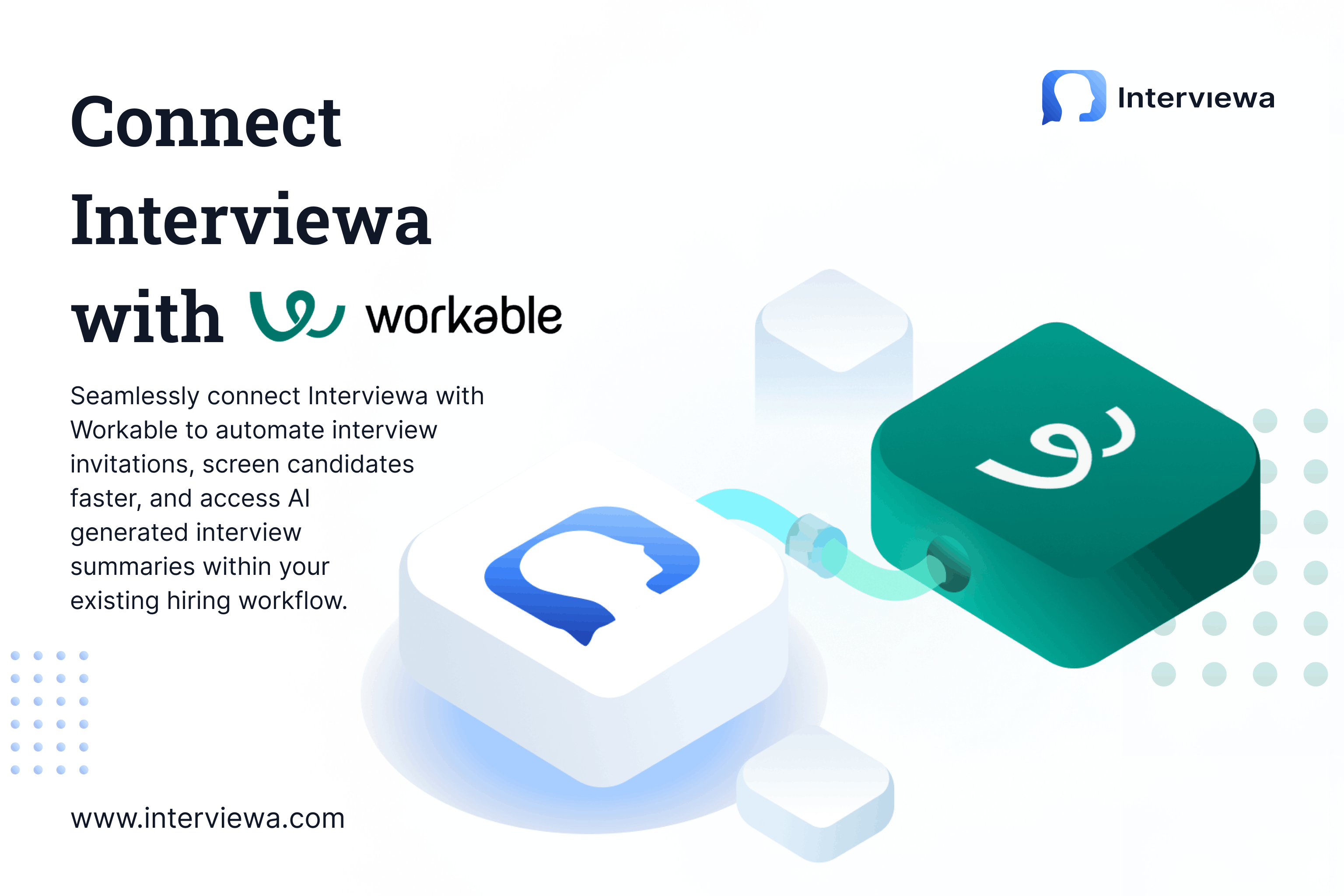
Interviewa is a platform that integrates with Workable to conduct structured, AI-supported video interviews for first-round candidate screening, helping recruitment teams, hiring managers, and admissions offices handle high-volume applicant pools with less admin and more consistent evidence.
When a role attracts hundreds of applicants, that first screening stage can still demand significant recruiter time. This article explains how the Workable–Interviewa workflow handles vacancies and candidates, from importing selected applicants and generating interview questions to reviewing summaries, scorecards, and interview results for fair, efficient decisions.
Recruiters often need evidence that a CV or written application does not clearly reveal for a first job interview decision, including relevant experience, skills, knowledge, motivation, and a candidate’s ability to communicate in a way that matches the role and the employer’s expectations. Gathering that evidence through individual screening calls adds job interview preparation pressure for both the employer and applicants, while repeated scheduling can still slow the hiring process.
Interviewa works alongside Workable to make this stage easier to manage without removing human accountability. Selected applicants can be brought from Workable into Interviewa and invited to complete a structured first-round interview, then recruiters review the summaries and scores to decide who should progress. Interviewa supports the process. People make the decisions.
What does Interviewa add to a Workable recruitment workflow?
Workable helps teams organise their vacancies, applicants, and recruitment stages. Interviewa complements this workflow by supporting different types of structured early-stage interviews, including video workflows alongside formats such as phone screens and behavioral interviews.
Recruiters can:
- Configure an interview for a specific vacancy
- Use AI-generated questions and add their own
- Import selected applicants from Workable
- Invite candidates to complete interviews that fit common first-round formats employers use, whether in-person, phone, or video
- Review structured responses and interview summaries
- Use Fit Scores and Match Scores as supporting information
- Decide which candidates progress to the next stage
Each candidate can be asked the same core questions, providing recruiters with a more consistent evidence base than unstructured initial conversations.
The scores and summaries do not make the hiring decision. Recruiters and hiring managers remain responsible for reviewing candidates in context.
How does the Interviewa and Workable workflow operate?
1. Manage the vacancy in Workable
The recruitment team creates and publishes the vacancy through its existing Workable process. Applications enter the organisation’s established recruitment pipeline, allowing the team to continue using Workable as its candidate management system.
2. Configure the interview in Interviewa
The team creates an Interviewa campaign for the role. Recruiters can add the vacancy information, research the company and role, review AI-generated questions, and include custom questions based on the role’s requirements and what a potential employer wants to assess. This allows the team to define what relevant evidence it wants candidates to provide, including what detail and what point it wants candidates to cover.
3. Bring selected applicants into Interviewa
Applicants can be imported directly from Workable into Interviewa. Recruiters can also add candidates through CV uploads when required. This connects the applicant-management and first-round interview stages without requiring the team to rebuild its recruitment process.
4. Invite candidates to complete a structured interview
Selected candidates receive an invitation to complete a conversational interview with Interviewa, which can include practical interview tips and advice on what to do before and after interviews so they know what to expect before they start. Candidates can prepare in advance by checking the date, planning how to present, deciding what to write down, preparing questions to ask at the end of the interview, and bringing their CV and application letter if later stages are in person; dress appropriately, as it is usually better to be overdressed. Good body language, including eye contact, affects how candidates are perceived in interviews. The initial interview does not depend on the candidate and recruiter finding matching diary space. This can help reduce scheduling delays, with phone or in-person follow-up arrangements added later if helpful, particularly during high-volume campaigns or when applicants have different working, caring, or location requirements. Candidates should send a thank-you note within 24 hours after an interview. If appropriate, they can also follow up with an email or call after the interview.
5. Review the interview information
After candidates complete their interviews, recruiters and interviewers can review their responses, summaries, and supporting scores in Interviewa, along with how clearly candidates explain impact, answers, and qualifications. Stronger responses often include quantifiable outcomes and a clear STAR-style structure. Because applicants have answered the same core questions, the hiring team has a more consistent basis for comparing role-relevant evidence, including strengths, weaknesses, and how a person handles pressure, for a fairer basis of comparison.
6. Decide who progresses
Recruiters apply their own judgement and decide which candidates move forward. Successful applicants can continue through the organisation’s existing selection process, which often runs across two or three rounds, such as a phone screen followed by a hiring manager interview before final decisions, including live interviews, an assessment centre, a presentation, and final-stage conversations; in those live settings, ask about team culture or what success looks like in the role, avoid too much talk, and don’t use silence to fill before your answer is complete.
How can this workflow help recruitment teams?
Reduce repetitive administration
Recruiters do not need to arrange an individual first-round screening call with every selected applicant. This can release time for reviewing evidence and speaking with candidates who reach later stages.
Gather evidence beyond the CV
Candidates can explain their experience, motivation, and approach in their own words, including teaching, project, or other role-relevant examples when their employment history is limited. This can be particularly valuable when recruiting apprentices, graduates, students seeking an internship, college opportunity, or university pathway, and career changers whose potential may not be fully represented by their employment history. If they are not selected, they can request feedback from the interviewer, a careers adviser, or careers support to better understand how to develop.
Create a more consistent first stage
Using the same core questions gives each candidate a clearer and more consistent opportunity to demonstrate their suitability for the role, support fairer preparation, and improve their chances of success. Practice matters too, especially because preparation and practice predict interview success, and saying answers aloud to common questions such as "Tell me about yourself" or "What are your strengths" helps candidates sound natural rather than scripted. Consistency should support human judgement, while still creating a more positive and balanced candidate experience, not turning recruitment into a mechanical scoring exercise.
Give candidates greater flexibility
Candidates can complete their first-round interview following their invitation without arranging a live screening appointment. This removes an avoidable source of delay for candidates and recruitment teams.
Keep people accountable for decisions
Interviewa collects and organises interview information. It does not make hiring decisions; the employer remains responsible for every decision and for judging candidate fit from both the employer and employee perspective.
You can find out more about how to revolutionise your interview process with us on our website. Feel free to book a demo, you can also send an email.