How to run role play training: a practical step by step guide
To run role play training, pick one real situation your staff struggle with, write a short scenario with clear roles, brief everyone, let participants practise in small groups, then give specific feedback against a simple rubric and repeat. The repetition matters most: one session builds awareness, but several short rounds of practice and feedback are what change behaviour at work.
What is role play training?
Role play training is a learning method where two or more people act out a realistic work situation, such as handling an angry customer or running a sales call, so they can practise the skills in a safe space. An observer or trainer gives feedback afterwards.
Short definitions you will see in this guide:
- Scenario: a short written description of the situation, the goal and the characters involved.
- Brief: the instructions each person gets before the role play starts.
- Rubric: a simple scoring sheet that describes what good looks like for each skill.
- Debrief: the feedback conversation straight after the practice round.
Why does role play work for staff training?
Role play works because people learn workplace skills such as problem solving and dealing with conflict by doing them, not by watching slides or sitting through a course. The CIPD evidence review on leadership development says effective training programmes should clearly include opportunities for practice linked to real-world situations or trainee-generated scenarios, and that experiential learning tends to beat traditional learning for practical and soft skills.
Peer-reviewed research points the same way. A meta-analysis of 117 studies on behaviour modelling training (Taylor, Russ-Eft and Chan, 2005) found that skills gains held steady or grew over time. Transfer to the job was greatest when practice included trainee-generated scenarios, when learners set goals, and when they saw both good and poor examples.
The same CIPD review adds two cautions: the benefit depends on people feeling psychologically safe, and spaced sessions work better than one-off training.
How do you run role play training, step by step?
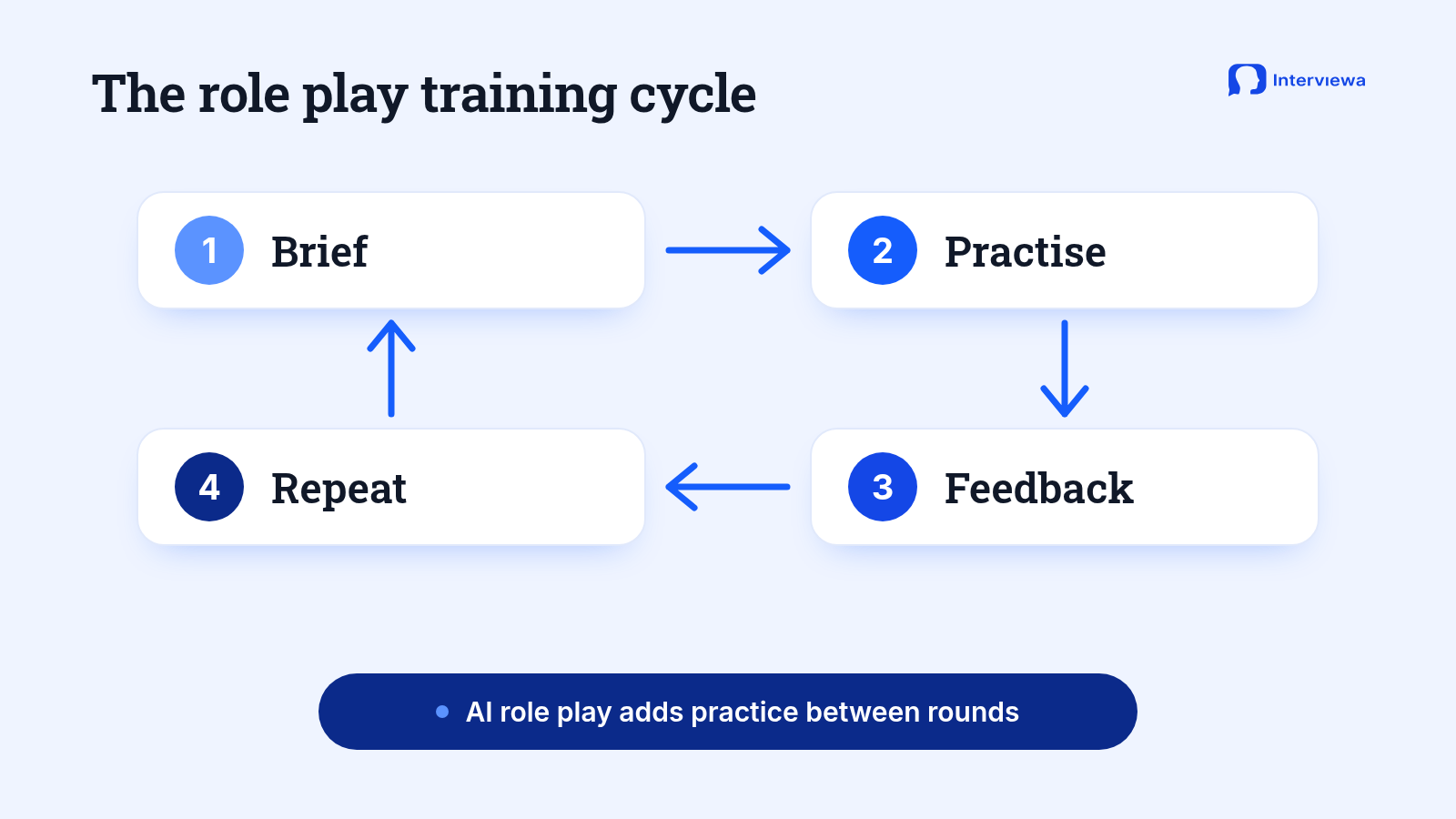
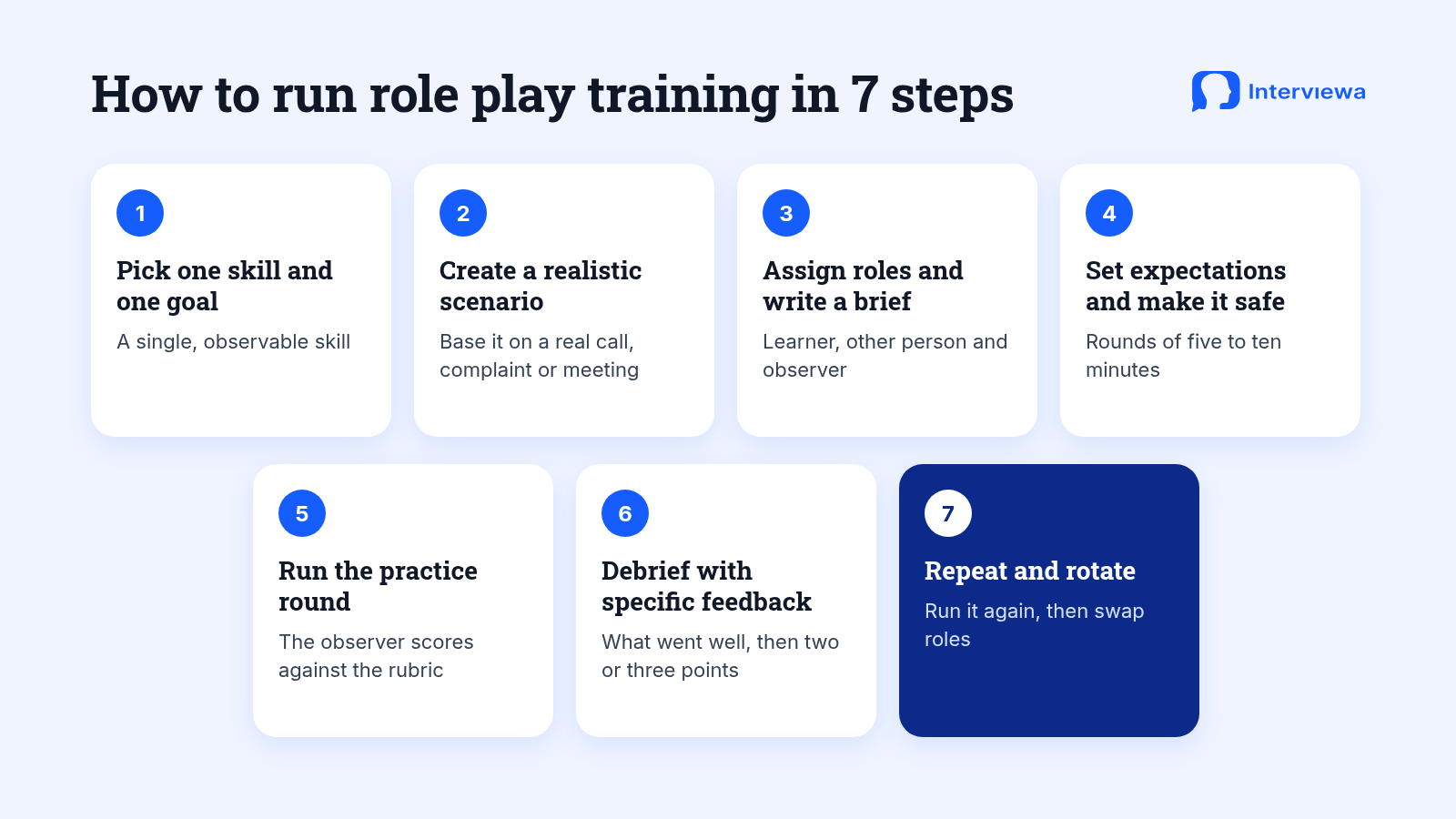
Run it as a short, repeatable cycle: plan the skill, write the scenario, brief, practise, give feedback, then repeat. Here are the seven steps.
- Pick one skill and one goal. Choose a single, observable skill, for example "calm an angry customer and agree a next step". If you try to cover five skills at once, nobody improves at any of them.
- Create a realistic scenario. Base it on a real call, complaint or meeting your team has had. Ask participants for the challenges they find hardest, since trainee-generated scenarios transfer better to the job.
- Assign roles and write a brief for each. Usually three roles work well: the learner, the "other person" (customer, client or colleague) and an observer. Give the other person enough detail to act consistently.
- Set expectations and make it safe. Explain the purpose, how long each round lasts and that mistakes are expected, so it feels like a learning experience, not a test. Give everyone time to prepare. Keep rounds to five to ten minutes.
- Run the practice round. Let the conversation play out without interrupting. The observer scores against the rubric and notes exact words or moments, not general impressions.
- Debrief with specific feedback. Ask the learner what went well first and discuss it, then share two or three specific points from the rubric. End with one thing to try next time.
- Repeat and rotate. Run the same scenario again straight away so the learner can apply the feedback, then rotate roles. Come back to the skill in a later session with a harder version.
What makes a good role play scenario?
A good role play scenario is short, realistic and has a clear goal the learner can reach in under ten minutes. It should name the characters involved, the situation, what each person wants and one twist that tests the skill.
Keep it to half a page. Too much detail and people read rather than act.
Role play exercises for customer service training
These role play scenarios suit customer service teams:
- The angry customer: a customer's order is late for the second time and they want a refund today. Goal: acknowledge the problem, stay calm and agree a clear next step.
- The policy "no": a customer asks for something your policy does not allow. Goal: explain the reason simply and offer an alternative.
Sales role play scenarios
These sales role play scenarios work for new and experienced sales staff:
- The discovery call: a prospect agreed to a call but is vague about their needs. Goal: uncover one real business problem using open questions.
- The price objection: the prospect says a competitor is cheaper. Goal: explore what matters to them before talking about price.
How do you provide feedback after a role play?
Give feedback that is specific, focused on the task and limited to a few points. Start with what worked, then pick the two or three changes that would make the biggest difference.
This is backed by the CIPD evidence review on performance feedback. It describes a review of 607 feedback cases where the overall impact was positive, but over a third of studies found performance got worse after feedback. Specific, constructive and fair feedback matters more than lots of it.
So the observer should quote real moments, such as "you paused and repeated their concern back", rather than "good empathy".
How do you score role play training with a simple rubric?
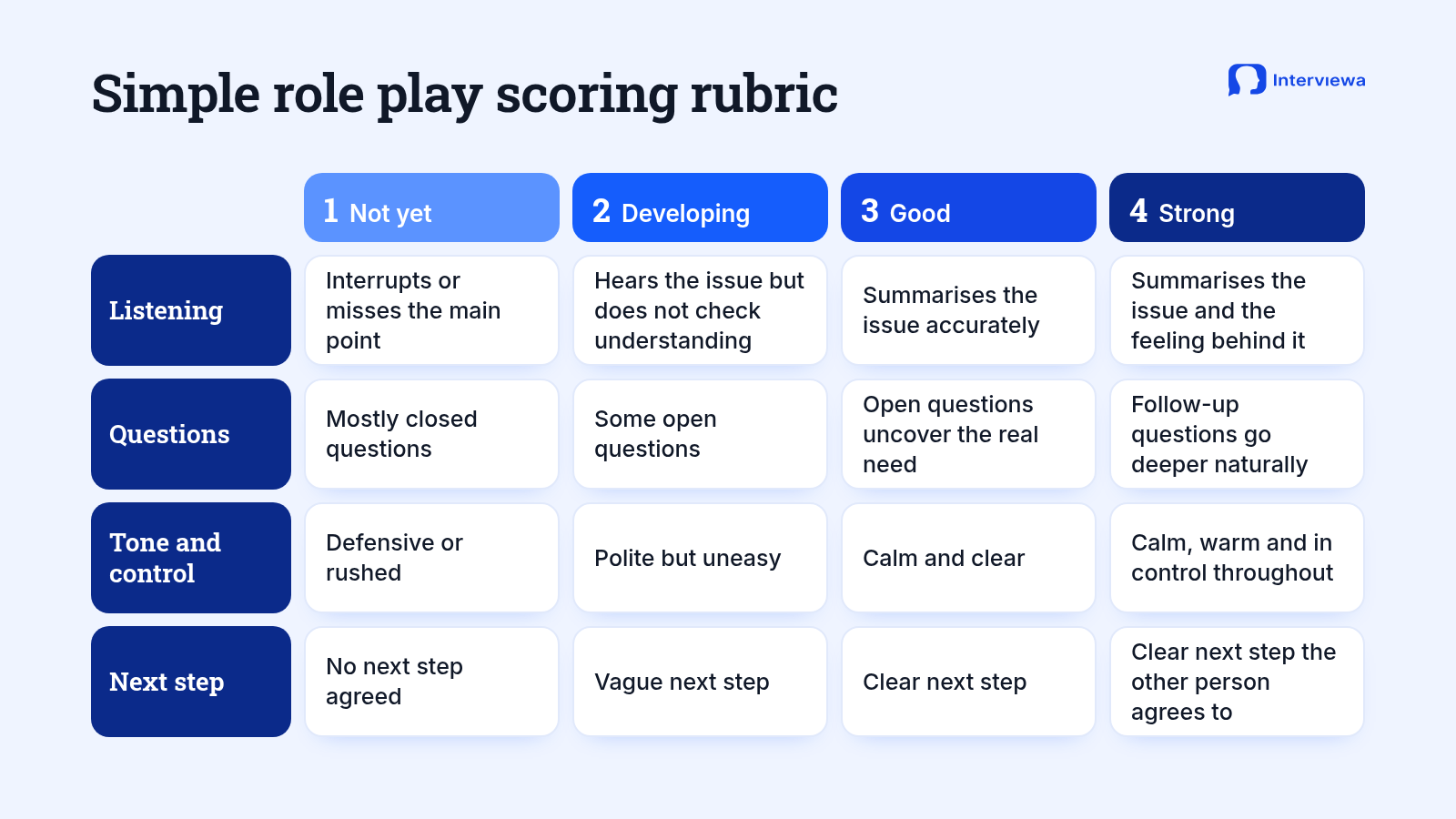
Score each round on three or four skills using a 1 to 4 scale, where each number has a short description of what it looks like. A rubric makes feedback fair, keeps observers consistent and shows progress over repeated sessions.
Here is a simple rubric you can adapt for most customer service and sales role play exercises:
- Listening. 1: Not yet: Interrupts or misses the main point. 2: Developing: Hears the issue but does not check understanding. 3: Good: Summarises the issue accurately. 4: Strong: Summarises the issue and the feeling behind it.
- Questions. 1: Not yet: Mostly closed questions. 2: Developing: Some open questions. 3: Good: Open questions uncover the real need. 4: Strong: Follow-up questions go deeper naturally.
- Tone and control. 1: Not yet: Defensive or rushed. 2: Developing: Polite but uneasy. 3: Good: Calm and clear. 4: Strong: Calm, warm and in control throughout.
- Next step. 1: Not yet: No next step agreed. 2: Developing: Vague next step. 3: Good: Clear next step. 4: Strong: Clear next step the other person agrees to.
Track scores across sessions. The aim is a steady rise as people repeat the scenario, not a perfect 16 on day one.
How can AI role play help staff practise between sessions?
AI role play lets staff practise realistic conversations on their own, at any time, with an AI character that responds to what they say. It does not replace a trainer, but it solves the biggest problem with live role play: never enough time to repeat.
Live sessions need a trainer, a colleague or paid actors, and a booked room, and many staff feel awkward performing in front of peers. AI role play gives people a private way to rehearse the same scenario several times, which fits the CIPD finding that spaced practice beats one-off training.
Interviewa is a 24/7 AI conversation agent with two-way AI avatars. With AI role play on Interviewa, learners hold a spoken conversation with an avatar that plays the customer, client or interviewer, and get feedback on strengths and areas to work on afterwards. Trainers can set up practice for a whole team through Interviewa Training and see how learners are progressing. The same approach powers AI mock interviews for job seekers, and it is useful for building confidence in new employees too.
A simple way to combine the two:
- Before: staff try the scenario once with the AI.
- During: live practice and rubric-based feedback.
- After: staff repeat the scenario with the AI to lock in the changes.
What are common role play training mistakes?
The most common mistakes are covering too many skills, using unrealistic scenarios and giving vague or overwhelming feedback. Watch out for:
- No clear goal: people do not know what success looks like, so feedback feels random.
- Feedback overload: listing ten points at once means none of them stick.
- One and done: a single training session without repetition rarely changes behaviour.
FAQ
How long should a role play training session be?
Plan for 60 to 90 minutes for a group, with each practice round lasting five to ten minutes followed by a short debrief. Short rounds with several repetitions beat one long performance.
How many people do you need for role play?
You need two or more people: one learner and one person playing the other role. A third person as observer makes feedback better, which is why groups of three work well.
What if staff do not like role play?
Explain the purpose, keep groups small and let staff rehearse privately first, for example with AI role play tools, to build confidence.
Is AI role play as good as practising with a real person?
AI role play is best used alongside practice with a real person, not instead of it. It adds extra repetitions and private practice at any time, while live sessions add coaching and human judgement.
How do you measure if role play training worked?
Compare rubric scores across repeated sessions and look for changes in real work, such as fewer escalated complaints.
Get started free
Want your team to practise realistic conversations between training sessions? Get started free and try AI role play with two-way AI avatars, available 24/7.
Sources
- CIPD (2023), Leadership development: an evidence review, scientific summary. cipd.org
- CIPD (2022), Performance feedback: an evidence review, practice summary and recommendations. cipd.org
- Taylor, P.J., Russ-Eft, D.F. and Chan, D.W.L. (2005), A meta-analytic review of behavior modeling training, Journal of Applied Psychology, 90(4), 692 to 709. PubMed