Admissions interviews: how to make them fairer with structure
The fairest admissions interview is a structured one: every applicant gets the same questions, in the same order, scored against the same rubric. Structure will not remove bias on its own, but it gives your admissions team consistent evidence to compare, and it makes each decision easier to explain.
This guide is for universities, colleges and schools that interview applicants. It covers why loose interviews let bias creep in, how to build a structured admissions interview, and where AI can help without taking the decision away from your staff.
Why do admissions interviews need structure?
Short answer: Unstructured interviews depend on who is in the room and how the conversation happens to go. Structure makes every applicant's interview comparable.
Picture two lecturers interviewing for the same nursing course. One asks about motivation and a placement the applicant did. The other spends 15 minutes on a hobby they share. Both write "strong candidate". Neither note can be compared with the other, and neither tells the admissions tutor much.
That is how bias gets in. It is rarely deliberate. It shows up as warmth towards people who remind us of ourselves, confident speakers getting more credit than careful ones, and the last interview of the day getting less attention than the first.
A structured admissions interview narrows those gaps. It does three things:
- Sets the same questions for every applicant to a course.
- Defines what a weak, good and excellent answer looks like before anyone is interviewed.
- Records the evidence, so a second person can check the score.
What should a structured admissions interview assess?
Short answer: Only what matters for success on the course. For most programmes that means motivation, communication, understanding of the subject and readiness for the way the course is taught.
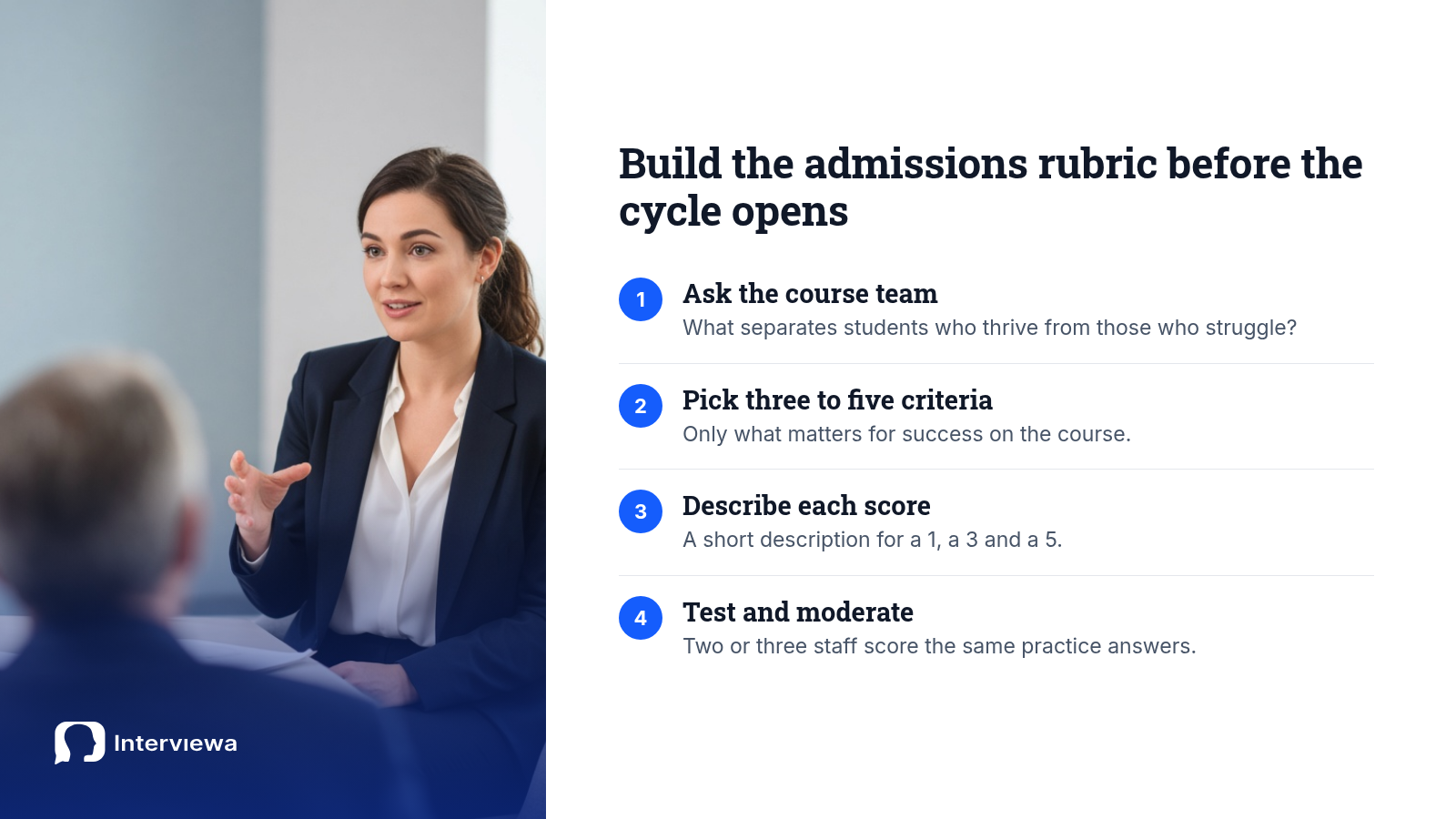
Start with the course, not the applicant. Ask the programme team: what separates students who thrive here from those who struggle in the first term? Turn the answers into three to five criteria.
For a computer science course, that might be:
- Motivation. Why this subject, and why now?
- Problem solving. Can they talk through how they would approach an unfamiliar problem?
- Communication. Can they explain an idea clearly to someone outside the subject?
- Readiness. Do they understand the workload and how the course is taught?
For nursing, you would swap problem solving for values, empathy and an understanding of patient care. The method is the same; the criteria change.
Avoid criteria that reward background rather than potential. "Has done relevant work experience" can favour applicants with family contacts. "Can reflect on any experience, paid or unpaid, and what they learned" measures something closer to what you want.
How do you build a fair scoring rubric?
Short answer: Write a short description for each score on each criterion, test it on sample answers, and train everyone who marks to use it the same way.
A rubric is only as good as its descriptions. "Communication: 1 to 5" invites everyone to use their own scale. Compare that with:
- 1: Answer is hard to follow, with no clear point.
- 3: Answer is clear and relevant, with one example.
- 5: Answer is clear, well organised and backed by specific, thoughtful examples.
Before the cycle opens, ask two or three staff to score the same handful of practice answers. Where they disagree, tighten the wording. This takes an afternoon and saves weeks of arguing later.
How do structured interviews help minimise bias in admissions?
Short answer: They remove the biggest sources of variation, the questions and the marking, so differences in scores are more likely to reflect differences between applicants.
Structure helps in a few specific ways:
- Same questions. No applicant gets an easier or friendlier interview.
- Pre-set criteria. Interviewers judge answers against the rubric, not against each other or against a gut feeling.
- Recorded evidence. Scores can be moderated by a second reviewer, and you can check patterns across applicant groups.
- Flexible timing. Applicants who work, care for family or live overseas can interview when it suits them, rather than competing for a few fixed slots.
Fairness also means making room for people. Under the Equality Act 2010, you should plan for reasonable adjustments, such as extra time or a different format for an applicant with a disability. Build a simple route for requesting them into your invitation.
Structure is not a guarantee. You still need to review outcomes by group each cycle and ask whether any criterion is screening out people who would do well.
Where does AI fit in admissions interviews?
Short answer: AI can run the same structured interview for every applicant, at any hour, and score answers against your rubric. Your admissions team should still review the evidence and make every decision.
An AI admissions interview is a two-way video conversation. The AI interviewer asks your questions, follows up when an answer is thin and produces a score, a summary and a recording for each applicant. Interviewa's AI admissions interviews work this way, with questions and scoring set per course, from nursing to computer science.
This is where AI genuinely helps:
- Consistency at volume. The 300th applicant gets exactly the same interview as the first.
- No scheduling. Applicants interview 24/7, in any time zone.
- Staff time back. Lecturers review scored summaries instead of running every first-round call.
- Anti-cheat. On-camera checks look for AI tools being used to answer, answers being fed by someone else and second screens.
Look out for how the tool treats the decision. AI scores should be a guide, not a verdict. Staff should always be able to see the transcript and recording, and the decision should always be theirs. The ICO's guidance on automated decision-making explains the extra rules that apply if a decision is made solely by automated means.
You should also be open with applicants. Tell them the interview is run by AI, what it assesses and that a person makes the decision. Most applicants are comfortable with this when it is explained plainly.
How do you get started without disrupting the cycle?
Short answer: Pilot one course, run the structured interview alongside your current process, and compare the results before you scale.
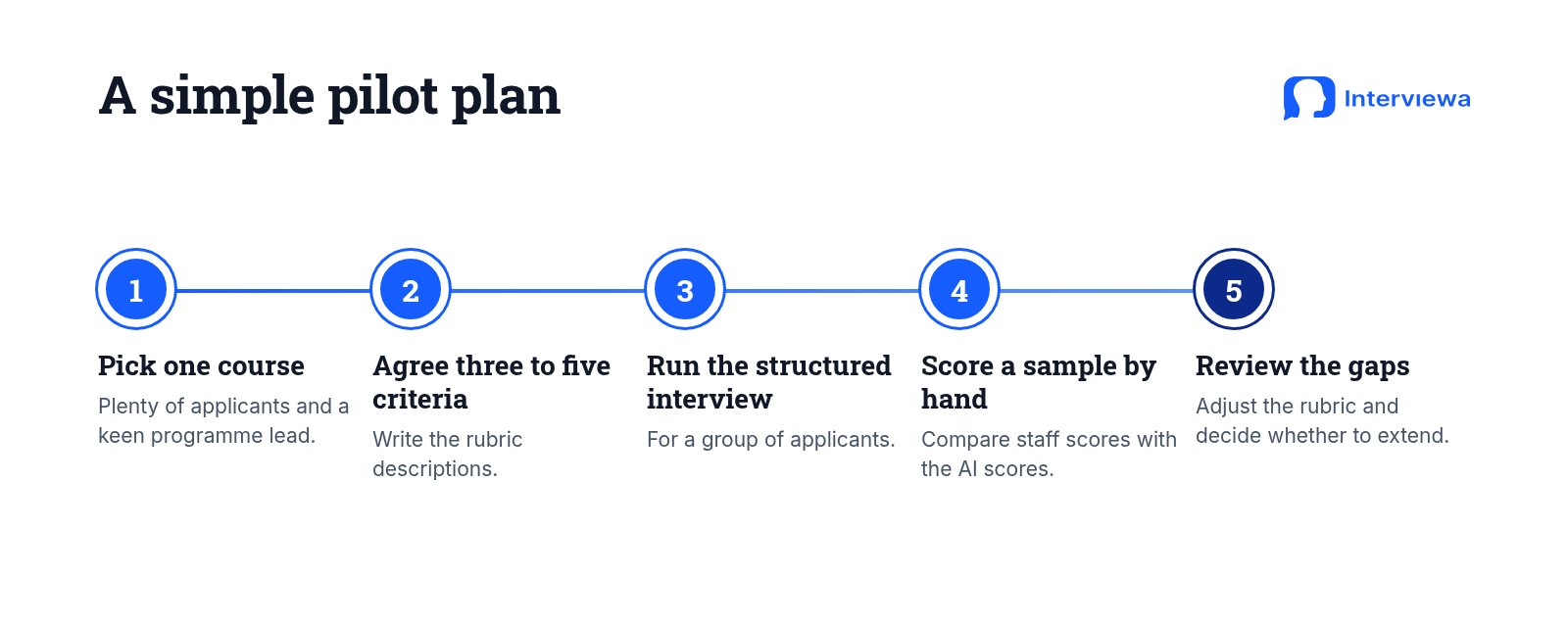
A simple pilot plan:
- Pick one course with plenty of applicants and a programme lead who is keen.
- Agree three to five criteria and write the rubric descriptions.
- Run the structured interview for a group of applicants.
- Have staff score a sample by hand, and compare with the AI scores.
- Review the gaps, adjust the rubric and decide whether to extend.
Interviewa is GDPR compliant and Cyber Essentials certified, and works with Workable plus custom integrations for your own systems. If you are an applicant reading this, our AI mock interviews let you practise university interview questions out loud.
Frequently asked questions
What is an admissions interview?
An admissions interview is a conversation that helps a university, college or school understand an applicant beyond their written application. It usually explores motivation, communication and readiness for the course.
What is a structured admissions interview?
A structured admissions interview asks every applicant to a course the same questions, in the same order, and scores the answers against a rubric agreed in advance. It makes interviews comparable and easier to moderate.
Can AI make admissions decisions?
It should not make them alone. AI can run the interview and suggest scores, but your admissions team should review the evidence and make every decision. UK GDPR adds extra rules for decisions made solely by automated means.
Can we set our own questions for each course?
With Interviewa, yes. You set the questions and scoring for each course, so the interview measures what matters to that programme.
How do you stop applicants using AI to answer?
On-camera interviews with built-in anti-cheat help. Interviewa checks for AI tools being used to answer, answers being fed by someone else and second screens, so honest applicants are not outscored by those taking shortcuts.
See a structured admissions interview in action
If your team spends weeks on first-round interviews, try a structured AI admissions interview on one course. Every applicant gets the same interview, your staff get consistent scores and recordings, and your team makes every decision.
Get started free, or read more on the admissions interviews page.