Training needs assessment: a simple guide, with AI skills assessments
A training needs assessment is the process of finding the gap between the skills your people have and the skills their work needs, so you train the right people in the right things. The simplest way to run one is to define the skills that matter, assess everyone the same way, then plan training around the gaps you find.
Many teams skip the middle step. They send everyone on the same course and hope it sticks. This guide shows how to run a training needs assessment that gives you real evidence, and where AI skills assessments can take the slow parts off your plate.
What is a training needs assessment?
Short answer: It is a structured look at what your people need to learn to do their jobs well. You compare the skills a role needs with the skills people actually have, and the difference tells you where to train.
You will also hear it called a training needs analysis, a TNA or a learning needs analysis. The CIPD's factsheet on learning needs analysis is a good primer if you want the wider theory.
A TNA usually works at three levels:
- Organisation. What does the business need to be able to do next year that it cannot do well today?
- Team or role. What skills does each role need to meet that goal?
- Individual. Which people have those skills, and who needs support?
Most of the hard work, and most of the guesswork, sits at the individual level. That is where assessment comes in.
Why do most training needs assessments miss the mark?
Short answer: They rely on what people say about their skills rather than what they can show. Self-rating surveys and manager hunches are quick, but they are often wrong.
Ask a team to rate their own customer service skills from 1 to 5 and you will mostly get 4s. Confident people rate themselves high. Careful people rate themselves low. Neither tells you who would handle an angry caller well on a Monday morning.
Manager opinions help, but they vary too. One manager sees a gap where another sees a strength, and busy managers tend to judge on recent, memorable moments.
The fix is to add a direct check. Ask people to show the skill, score what they do against clear criteria, and use the same check for everyone. That turns a TNA from a list of opinions into evidence you can act on.
How do you run a training needs assessment step by step?
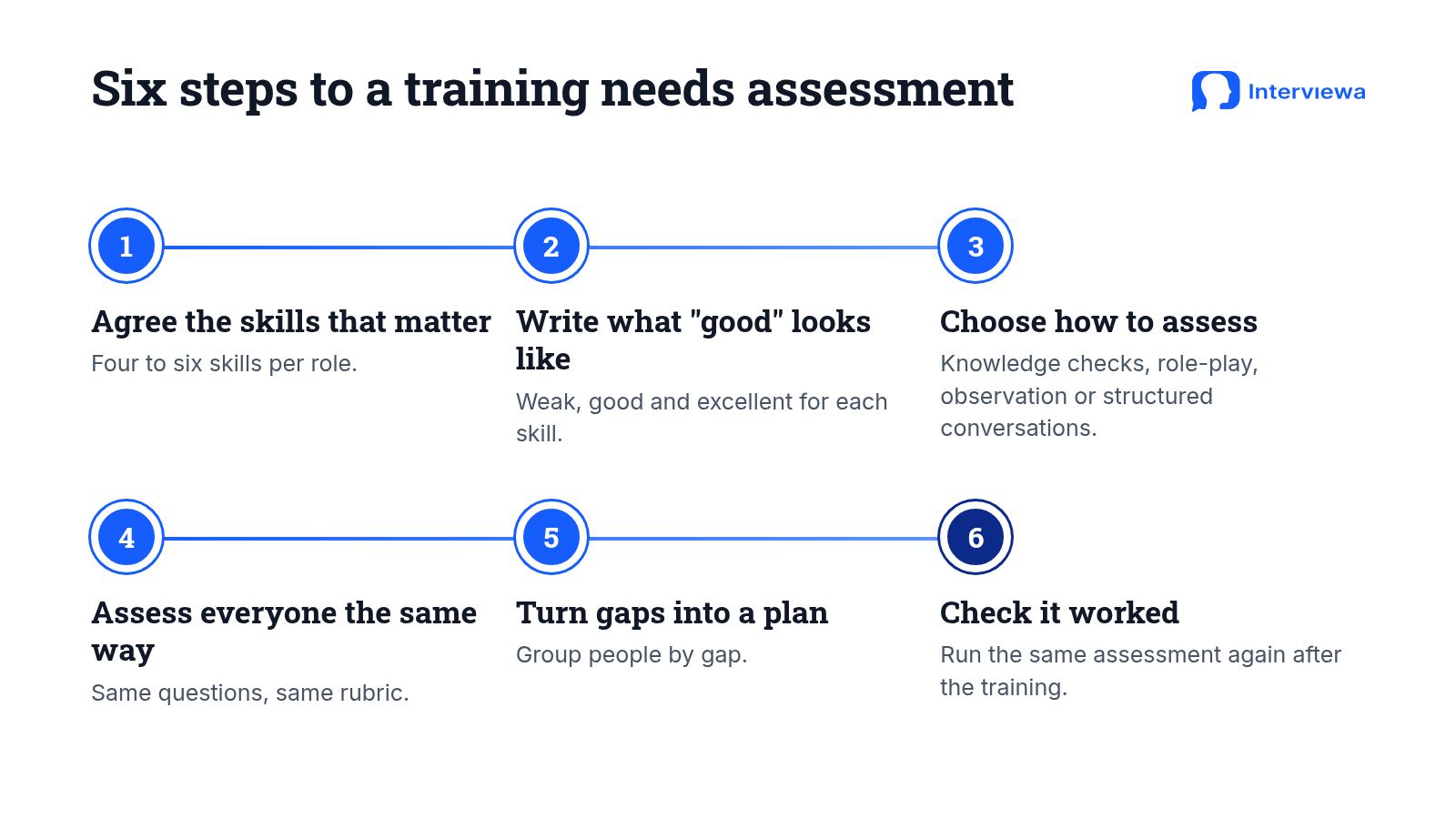
Short answer: Define the skills, choose how to assess them, assess everyone the same way, then group the gaps into a training plan. Review it after the training.
Step 1: Agree the skills that matter
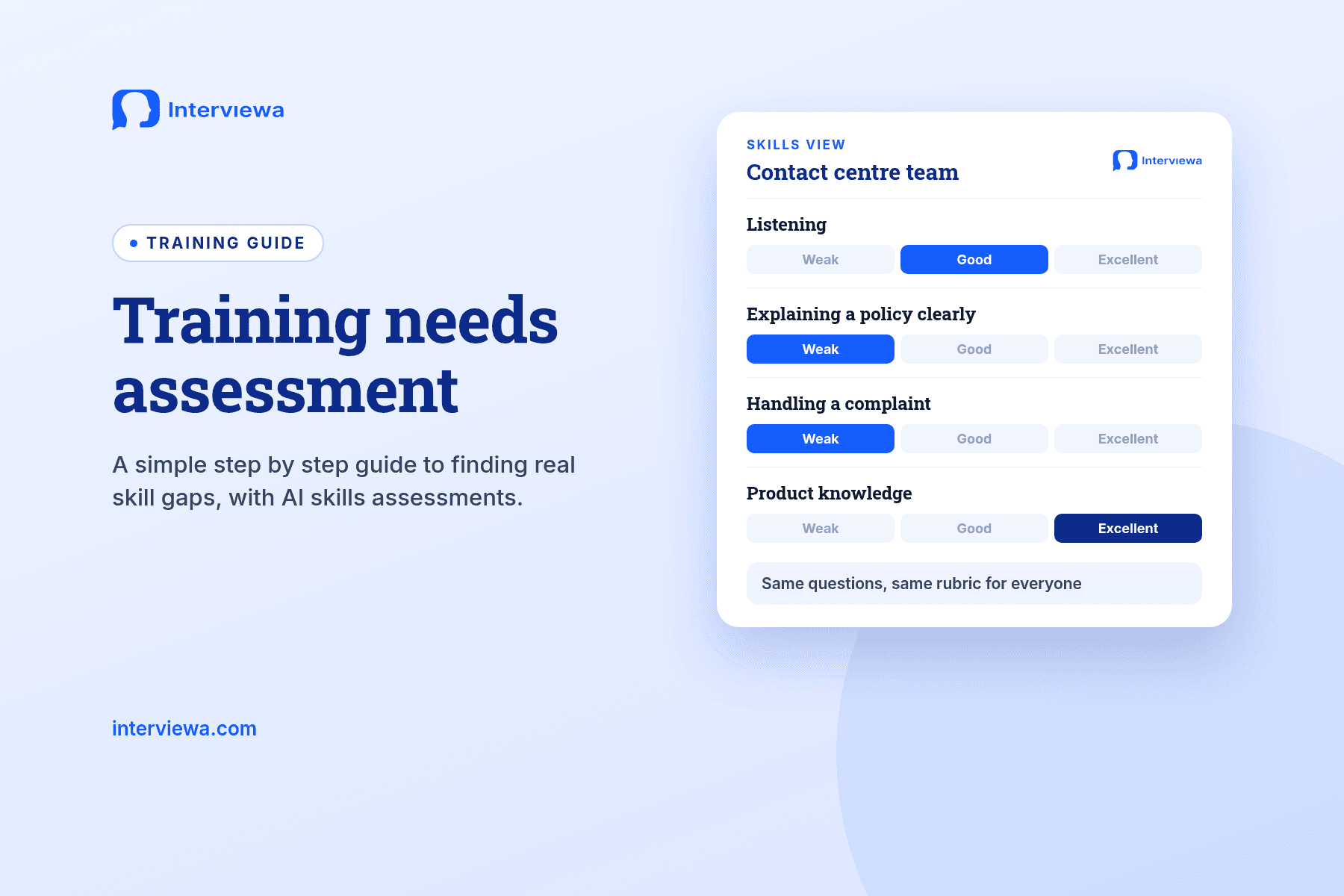
Start with the work. For a contact centre role, that might be listening, explaining a policy clearly, handling a complaint and knowing the product. Keep it to four to six skills per role. A list of 20 helps nobody.
Step 2: Write what "good" looks like
For each skill, write a short description of weak, good and excellent. For example, on "explaining a policy clearly":
- Weak: Reads the policy out, or gets key details wrong.
- Good: Explains the policy accurately in plain words.
- Excellent: Explains it accurately, checks the customer understood and handles the follow-up question.
This is your scoring rubric. It matters more than any tool you choose.
Step 3: Choose how to assess
Pick the method that shows the skill:
- Knowledge checks for facts, rules and product detail.
- Role-play or scenario questions for skills such as handling complaints or giving feedback.
- Observation of real work, where that is practical.
- Structured conversations where people explain their thinking out loud.
Step 4: Assess everyone the same way
Use the same questions and the same rubric for everyone in the role. Otherwise you are comparing different tests.
Step 5: Turn gaps into a plan
Group people by gap. If most of the team scores low on complaint handling, that is a team workshop. If three people struggle with product knowledge, that is a short targeted module. Strong performers might become peer coaches.
Step 6: Check it worked
Run the same assessment again after the training. If scores do not move, the training needs to change, not just the people. The CIPD's guide to evaluating learning covers this in more depth.
How can AI help with training assessments?
Short answer: AI can run a structured skills assessment as a conversation, score answers against your rubric and show strengths and gaps for a person or a whole group. It saves the time it would take a trainer to assess everyone one to one.
The slowest part of a good TNA is step 4. Assessing 60 people one to one takes a trainer weeks. That is why so many teams fall back on surveys.
An AI skills assessment changes the maths. Here is how it works with Interviewa:
- Choose the topic. Pick the skill or knowledge area, from customer service to technical topics.
- Hold the conversation. An AI avatar asks structured questions and follows up, so people explain what they really understand, rather than picking from multiple choice.
- Review the results. See strengths, gaps and areas for further training, for one person or a whole group.
Because the questions and rubric are the same for everyone, the results are comparable. Because it runs 24/7, people can take it between shifts. Built-in anti-cheat checks for AI tools being used to answer, answers being fed by someone else and second screens, so results reflect the person's own ability.
AI scores should support your judgement. Use them to spot patterns and start conversations, then let trainers and managers decide what each person needs.
What makes a good AI training assessment tool?
Short answer: Look for your own rubric, follow-up questions, group reporting and checks that the answers are genuine. Simple beats clever.
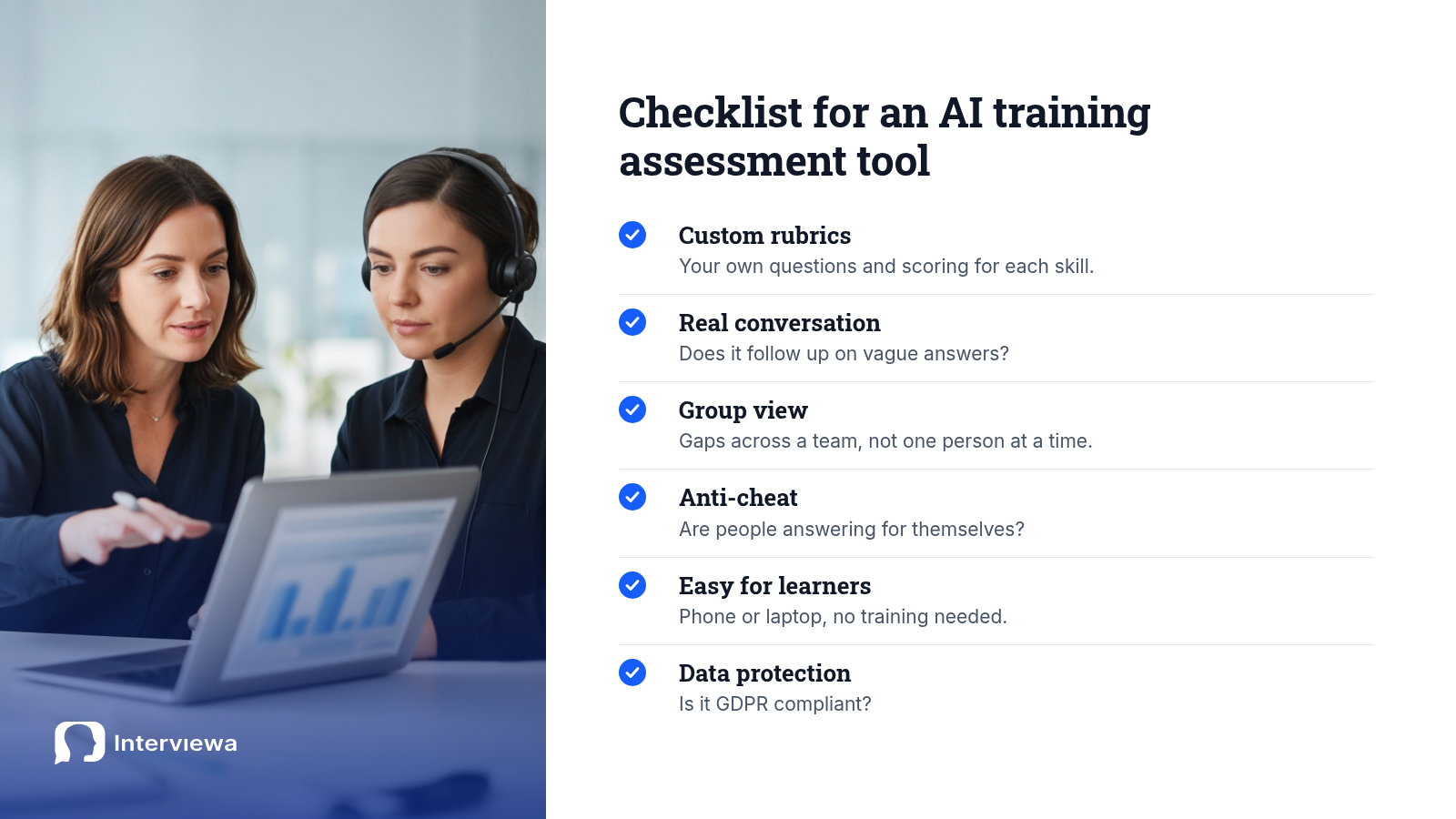
A quick checklist when you compare tools:
- Custom rubrics. Can you set your own questions and scoring for each skill?
- Real conversation. Does it follow up on vague answers, or just record them?
- Group view. Can you see gaps across a team, not just one person at a time?
- Anti-cheat. Does it check that people are answering for themselves?
- Easy for learners. Can people take it on a phone or laptop without training?
- Data protection. Is it GDPR compliant? Interviewa is GDPR compliant and Cyber Essentials certified.
If your team is also practising for real conversations, such as job interviews, AI mock interviews use the same approach for interview practice.
Frequently asked questions
What is the difference between a training needs assessment and a training needs analysis?
In practice, most people use the terms to mean the same thing. Some use "assessment" for gathering the evidence and "analysis" for making sense of it. Either way, the aim is to find skill gaps and plan training around them.
How often should you run a training needs assessment?
Once a year is common, plus whenever something changes, such as a new system, a new product or a new role. Running a short skills assessment before and after training also shows whether it worked.
What are the main methods of training needs assessment?
The main methods are surveys, manager reviews, observation, knowledge tests, role-play and structured skills assessments. Combining a direct assessment with manager input gives the most reliable picture.
Can AI assess soft skills?
AI can assess how people explain, reason and respond in a structured conversation, scored against a rubric you set. It works best as one source of evidence alongside trainer and manager judgement, not as the only one.
Is there a simple AI tool for training assessments?
Yes. Interviewa's AI skills assessments let you choose a topic, run the same structured conversation for everyone and see strengths and gaps in one view, with your own scoring rubric.
Start with one team
You do not need a big programme to get value from a training needs assessment. Pick one team, agree the four to six skills that matter, assess everyone the same way and see where the gaps really are.