How can career coaches use AI mock interviews with clients?
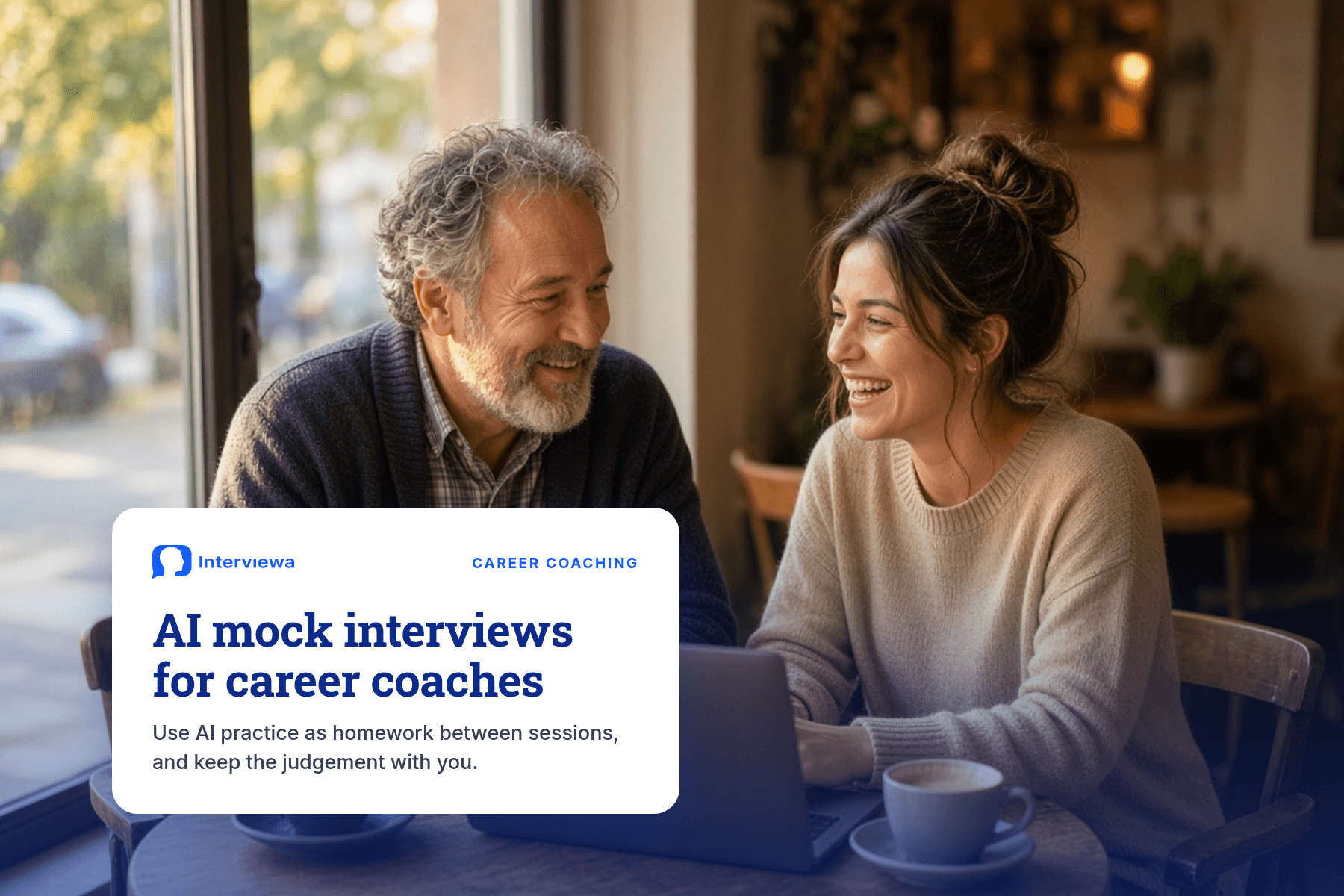
Career coaches can use AI mock interviews as homework between sessions: the client practises real interview questions out loud with an AI interviewer, then brings what they learned back to you to work on together. The AI adds practice time; you keep the judgement, encouragement and tailored advice that help job seekers get from interview to job offer.
That split matters. The UK's Career Development Institute (CDI) says digital tools should support a human-centred approach, not replace it. Used that way, AI tools can help clients build interview skills and arrive at each job interview far better prepared.
Why use AI interview practice in career coaching?
Because most job seekers do not practise enough out loud, and you cannot be available every evening before their next interview. An AI mock interview gives them unlimited, low-pressure practice sessions at any time.
Clients often know what to say but struggle to say it clearly when nervous. Only spoken practice fixes that. An AI interviewer that asks questions for the job role and follows up on vague answers gives them reps without using your session time, so their interview preparation keeps going between appointments.
It also changes what your coaching sessions are for. Instead of spending half an hour working through a question bank, you can review what went well, work on the stories that fell flat and talk about confidence, motivation and strategy, which is where a career coach adds the most value.
What can an AI career coach tool do, and what can't it?
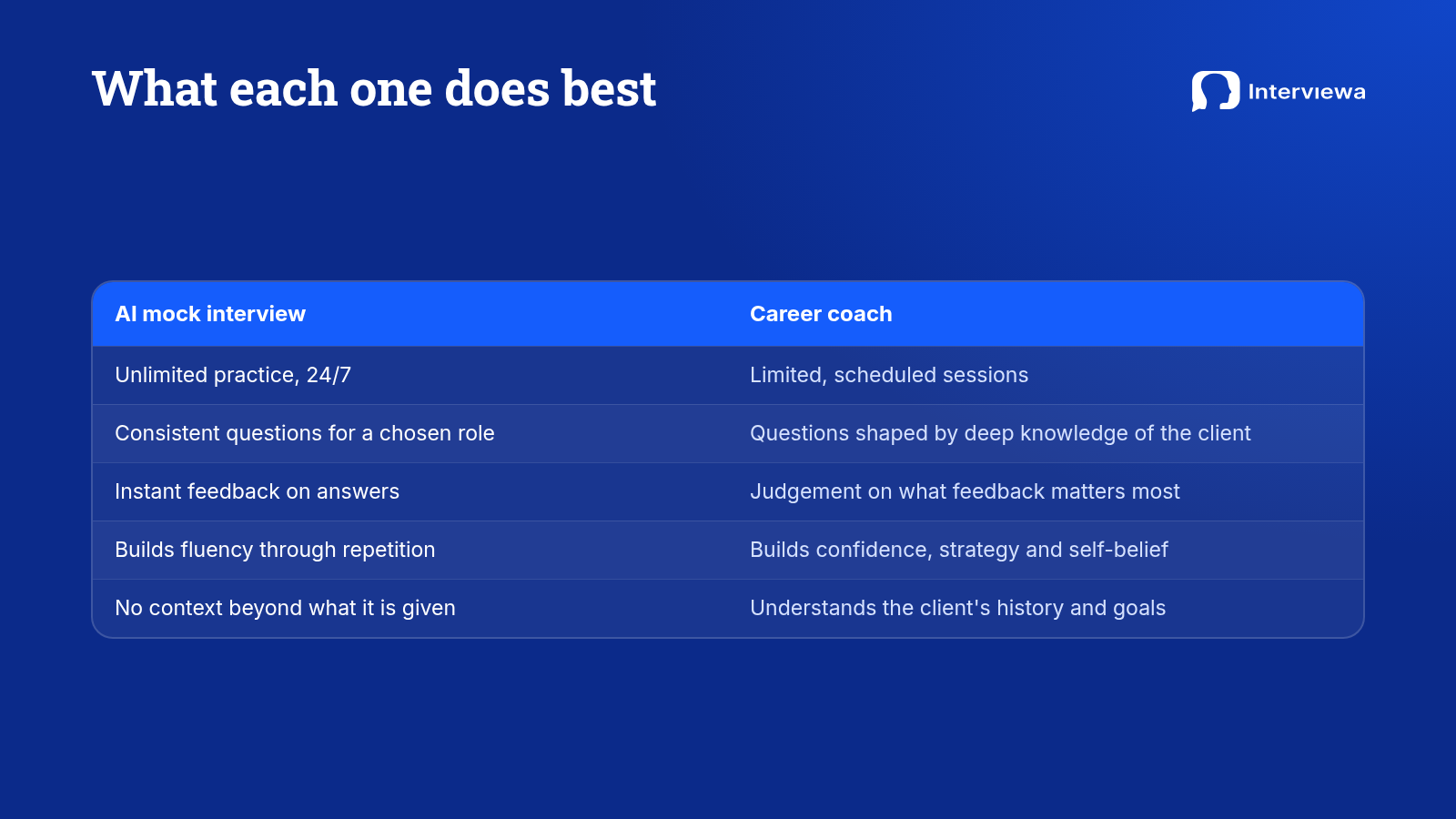
An AI career coach tool can ask realistic questions, follow up and give instant feedback at any hour. It cannot understand a client's full story, spot quiet anxiety or make career decisions with them. In the actual interview, confidence matters as much as content.
- Unlimited practice, 24/7. Career coach: Limited, scheduled sessions.
- Consistent questions for a chosen role. Career coach: Questions shaped by deep knowledge of the client.
- Instant feedback on answers. Career coach: Judgement on what feedback matters most.
- Builds fluency through repetition. Career coach: Builds confidence, strategy and self-belief.
- No context beyond what it is given. Career coach: Understands the client's history and goals.
The CDI's background paper on AI and careers work also warns about bias and inaccuracy in AI tools. Treat AI feedback as a prompt for discussion, not a verdict.
How do you build AI practice into a coaching programme?
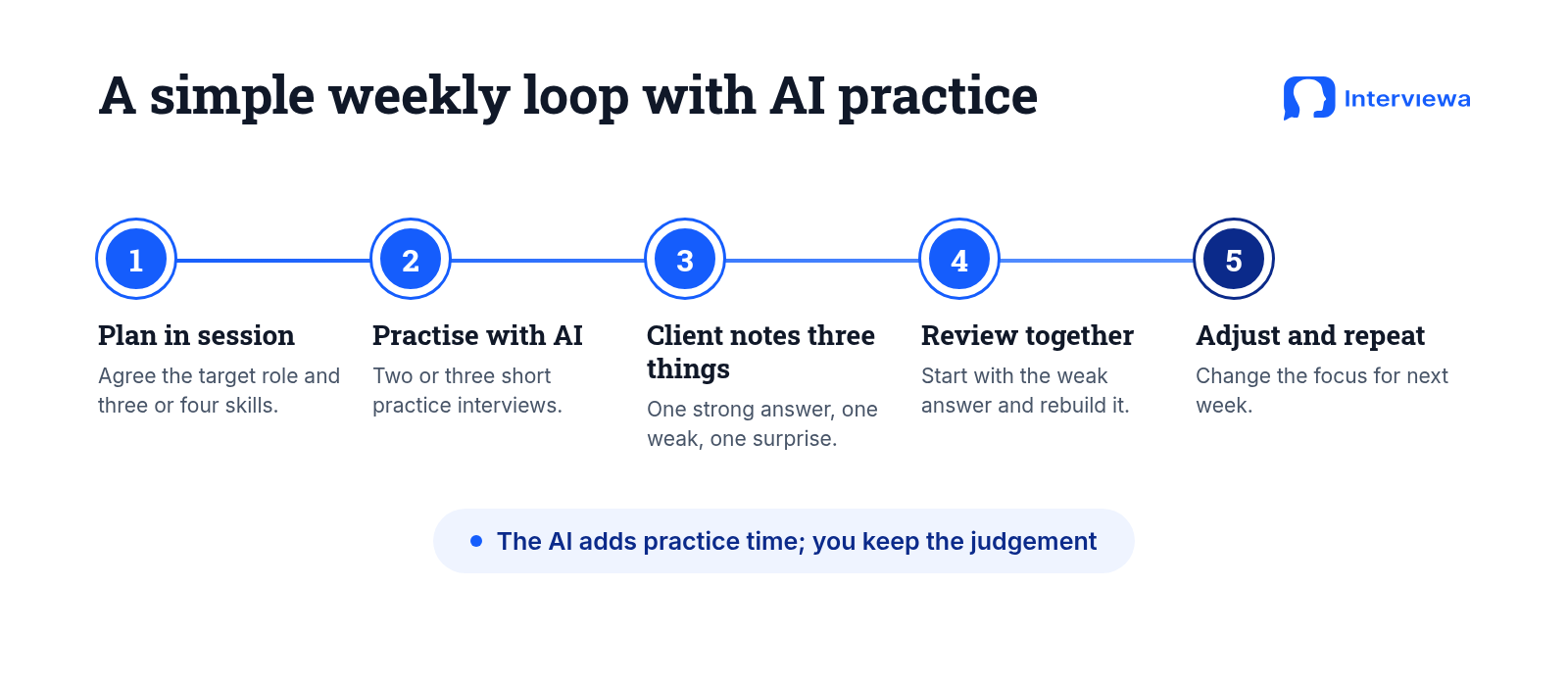
Use a simple weekly loop: plan in session, practise with AI, review together, then adjust. It works for one-to-one career coaching, university careers services and employability programmes, and builds interview skills week by week.
- Plan in session. Read the job description together. Agree the target position and the three or four skills the company is likely to test, and check the CV tells the same story. Help the client draft STAR stories for each. Our guide to the STAR interview method is a useful handout.
- Practise with AI between sessions. Ask the client to run two or three short practice interviews for the role. Set a clear focus each time, such as "keep the situation to two sentences".
- Client notes three things. One answer that felt strong, one that felt weak and one question they did not expect.
- Review together. Start with the weak answer. Rebuild it, then ask the client to say it out loud to you.
- Adjust and repeat. Change the focus for next week, or move on to a harder interview type.
Keep it light: two short practices beat one skipped long one.
What does this look like with a real client?
Here is an illustrative example. A client is preparing for a team leader interview in retail. In your first session you agree three skills the advert stresses: handling conflict, motivating a team and hitting targets. You help her draft a STAR story for each.
That week she runs three short AI practice interviews for a team leader role. She notices her conflict story drifts and she forgets to give a result. In the next session you rebuild that answer together, practise it twice out loud, and set a new focus: finish every answer with what changed. By the interview she has three tight stories and has said each one many times.
Which job seekers benefit most?
Job seekers with a real interview coming up, those returning to work and those changing careers or industry tend to benefit most, because they need lots of practice in a short time.
- Career changers. They need to explain transferable skills convincingly in a job interview. Our post on career change at 40 covers the wider move; mock interviews help with the final step.
- Graduates and school leavers. A first job interview is nerve-racking. Repetition builds confidence.
- People returning after a break. Practice rebuilds confidence and fluency.
- Clients who are anxious. Practising with an AI first, with no audience, can feel safer before rehearsing the real thing with you or a friend.
Not every job seeker will want to use AI, and the CDI highlights that access and confidence with digital tools vary. Offer it as an option, alongside practice with you.
What else can AI do in a client's job search?
Beyond interview practice, AI tools can help with several time-consuming parts of the job search journey. Each still needs a coach's eye.
- Generate likely interview questions from a job posting and the client's background, so practice matches the real interview.
- Spot transferable skills when a client is moving into a new industry, giving you a starting list to challenge and refine.
- Tailor a CV (or resume) to a job description, highlighting relevant projects and results. Check every claim is true.
- Break the job search into manageable daily steps, which helps clients who feel overwhelmed.
- Offer ongoing access between sessions, so clients are not stuck waiting a week for an answer.
The CDI warns that AI can generate false information, sometimes called hallucination, so treat these outputs as drafts. Your insights into the client, the local labour market and their performance under pressure are what turn a draft into a plan.
How do you use AI ethically with clients?
Be open about it, protect client data and keep your professional judgement as a coach in charge. The CDI's guidance on AI lists principles including transparency, confidentiality, accountability and supporting, rather than replacing, human decisions.
A short checklist before you start:
- Tell clients when and how AI is used, and that it is optional.
- Check the tool's data protection. Ask where data goes and how long it is kept. Interviewa is GDPR compliant and Cyber Essentials certified, and is working towards ISO 27001.
- Do not paste sensitive client details into general chatbots. Use tools built for the job.
- Sense-check AI feedback. Much AI training data is not UK-specific, as the CDI points out, so make sure advice fits UK employers.
- Keep decisions with the client. AI can help them rehearse; it should not decide which career they pursue.
What should coaches look for in an AI interview practice tool?
Look for realistic spoken practice, role-specific questions, follow-up questions and feedback you can discuss with your client. Ease of use matters too. If a client cannot start a session on the platform in a minute or two, they will not do it.
Questions to ask any AI tool provider:
- Does the platform hold a real two-way conversation, or just show questions on screen?
- Can clients choose or describe the role they are preparing for?
- Is it available whenever the client wants to practise?
- What feedback does the client get after each session?
- How is client data protected?
Interviewa's Job Consultant product is built to help prepare and place candidates with consistent, guided interviews. Eve, our AI interviewer, holds two-way spoken interviews through an AI avatar, 24/7, and clients can practise mock interviews for different roles. You can find more on our page for career coaches.
AI career coach FAQ
Can AI replace a career coach? No. An AI career coach tool can provide practice and information, but the CDI is clear that empathy, ethics and professional judgement remain human work. AI works best as support between sessions.
How often should clients practise with AI? Two or three short sessions a week before a real interview is a sensible starting point. Short and regular beats long and rare, and it makes improvement easier to see.
Is AI mock interview practice suitable for anxious clients? Often, yes, because there is no live audience, which helps nervous job seekers build interview skills at their own pace. Start with easy questions and build up, and check in with the client about how it feels.
Do I need technical skills to use AI interview practice? No. Clients usually need a device with a camera and microphone and a quiet space. Try a session yourself first so you can explain it.
Should I tell clients I am using AI? Yes. Transparency is one of the CDI's principles for AI use in careers work, and it builds trust.
Get started free
Try a practice interview yourself first, so you know exactly what your clients will experience. Get started free with Interviewa and see how AI practice could fit your coaching.