STAR interview method: how to answer with clear, honest examples
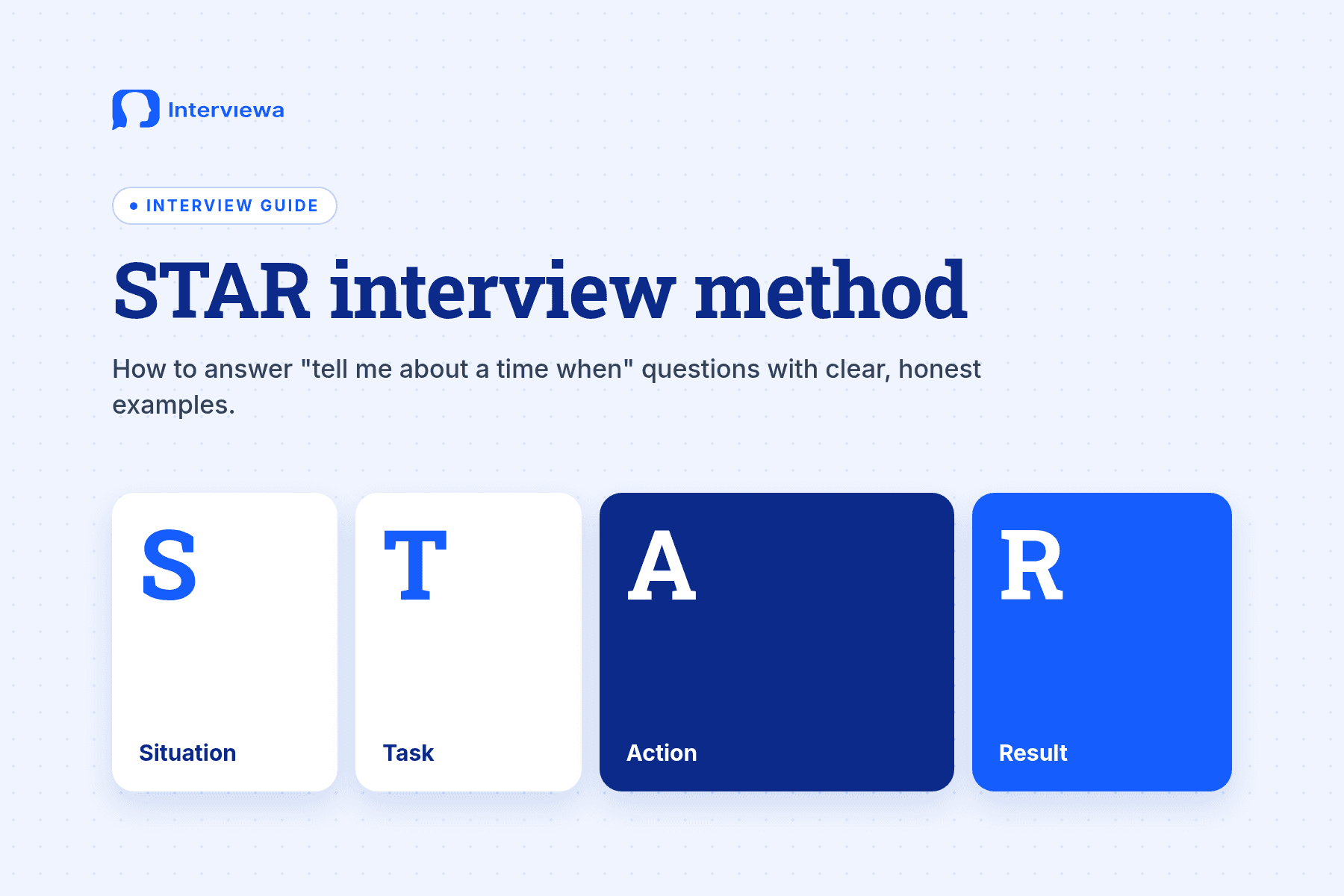
The STAR interview method is a simple way to answer "tell me about a time when" interview questions: describe the Situation, the Task, the Action you took and the Result. Keep the set-up short, spend most of your answer on what you did, and finish with a clear outcome and what you learned.
The hard part is choosing the right story and saying it in a clear and concise manner. This guide shows you how.
What does STAR stand for?
STAR stands for Situation, Task, Action and Result. The National Careers Service describes the STAR method the same way and suggests using it in job interviews, CVs, cover letters and application forms.
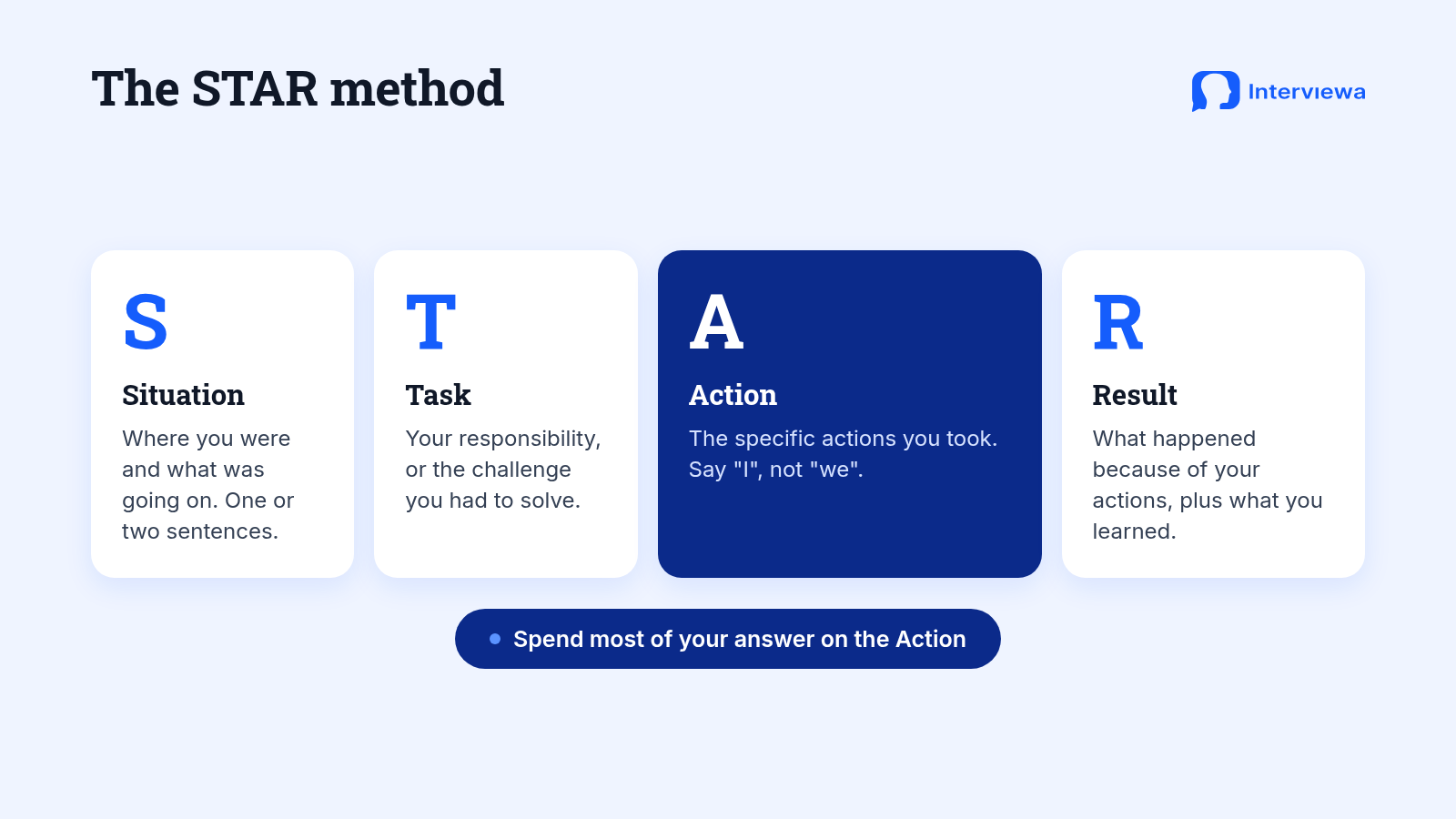
- Situation: where you were and what was going on. One or two sentences.
- Task: your responsibility, or the challenge you had to solve.
- Action: the specific actions you took. Say "I", not "we".
- Result: what happened because of your actions, ideally with a clear change, plus what you learned.
When should you use the STAR method?
Use the STAR method whenever interview questions ask for evidence from your past experiences. These are often called behavioural or competency questions, and they usually start with "Tell me about a time", "Give me an example of" or "Describe a situation where".
In the UK you will meet them a lot. The Civil Service, for example, recruits using Success Profiles, and its candidate guide tells applicants to consider the STAR method when giving examples of behaviours in application forms and supporting statements.
You do not need STAR for every question. "Why do you want this job?" needs a direct answer, not a story. Our guide to answering "tell me about yourself" covers a different structure for openers like that.
How do you answer interview questions using the STAR method?
Start with the job description, not your memory. Hiring managers have already listed the job requirements and specific skills they will test, so adequate preparation means building stories around those.
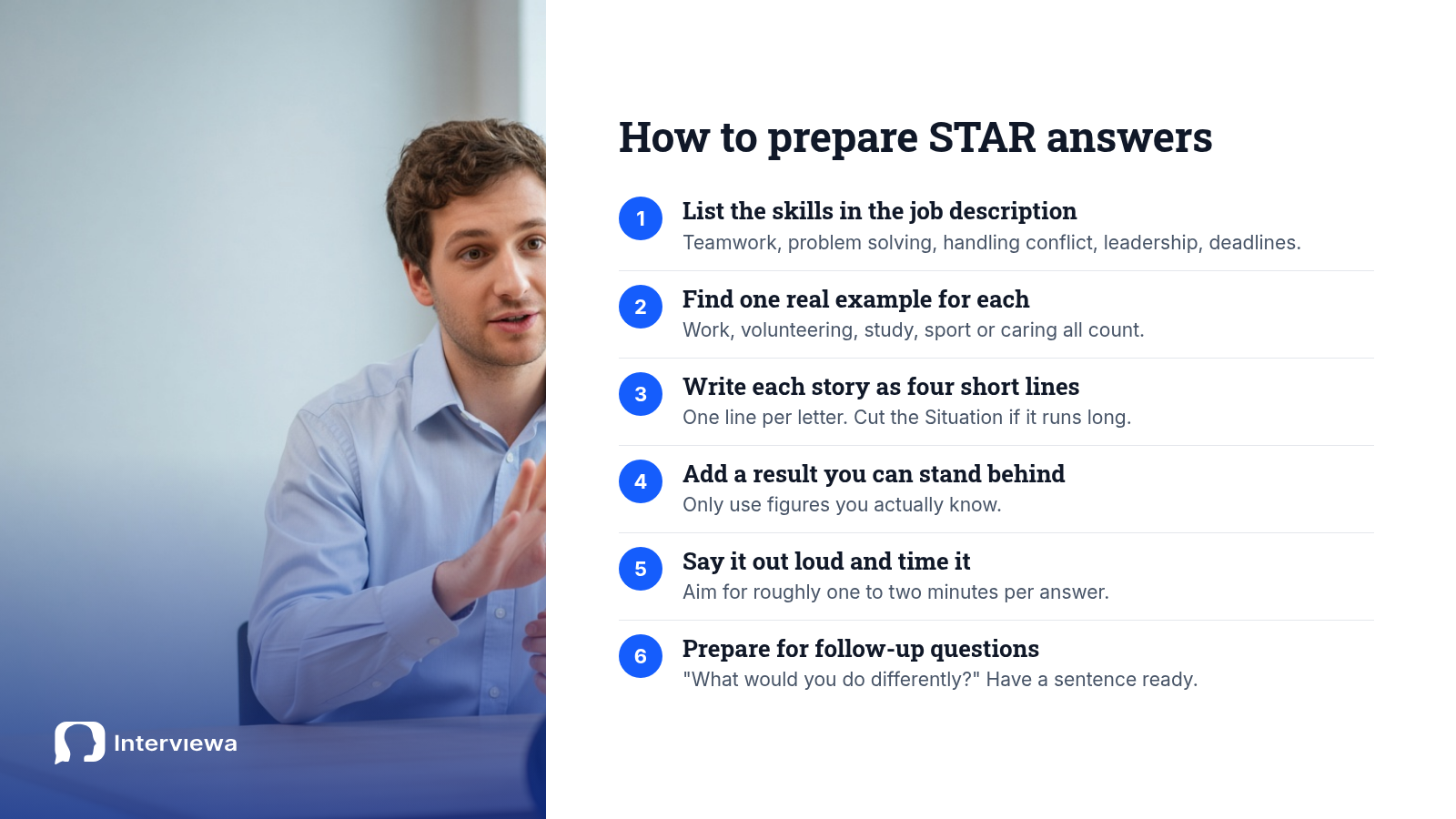
- List the skills in the job description. Teamwork, problem solving, handling conflict, leadership and working to a tight deadline are common. Note soft skills as well as hard skills.
- Find one real example for each. A previous role is ideal, but volunteering, study, sport or caring for a family member all count. The National Careers Service says examples from home or volunteering are fine.
- Write each story as four short lines. One line per letter. If the Situation line is longer than the Action line, cut it.
- Add a result you can stand behind. A number is good, but only use figures you actually know. A clear change, such as a new process the team adopted, works too.
- Say it out loud and time it. Aim for roughly one to two minutes per answer. Much longer and the interviewer may lose the thread.
- Prepare for follow-up questions. Interviewers often ask "What would you do differently?" Have a sentence ready.
A good test: could someone who was not there get the complete picture of what you did and why it mattered? The Civil Service guide makes the same point. Do not assume the interviewer knows the situation you faced.
What does a good STAR answer sound like?
A good answer is short on background and gives concrete examples of action. Here are two sample answers using the STAR method, one from a previous role and one from study.
Question: Tell me about a time you dealt with a difficult customer.
Situation: I worked weekends at a phone shop. A customer came in angry because his repaired phone had come back with the same fault.
Task: The manager was out, so it was my responsibility to calm things down and find a fix that day.
Action: I let him explain without interrupting, then repeated the problem back so he knew I had understood. I checked the repair notes, saw the wrong part had been logged and called the repair centre while he waited. I arranged a priority repair and lent him a spare handset.
Result: He left calm and later posted a positive review naming me. I also suggested a test step before repaired phones went back to customers, and the manager added it to the checklist.
Question: Tell me about a time you worked to a tight deadline.
Situation: In my final year at college, our team of four had a group project deadline moved forward by a week.
Task: I was responsible for the research section and for pulling everyone's work together.
Action: I split the remaining work into daily tasks, set up a shared document and suggested a ten-minute check-in each evening to discuss progress. When one teammate fell ill, I took on part of her section.
Result: We submitted on time and got positive feedback for clear structure. I learned to plan backwards from a deadline.
Both work because the set-up is brief, the action is all "I" and the result shows an outcome and a lesson.
What are common STAR method interview questions?
Most STAR method interview questions test a handful of skills. These sample questions cover the ones that come up most in UK job interviews. Prepare a specific situation for each and you will be ready for much of an actual interview:
- Teamwork: Tell me about a time you worked with a team to reach a goal.
- Conflict: Describe a time you disagreed with a colleague.
- Problem solving: Give an example of a significant challenge you solved in a new way. This shows your problem solving abilities.
- Pressure: Tell me about a time you had a tight deadline.
- Leadership: Describe a time you took the lead without being asked.
- Mistakes: Tell me about a time something went wrong.
- Customer focus: Give an example of going beyond a customer's expectations.
One story can often answer two questions if you change the focus. Questions about strengths and weaknesses also work well with a short STAR example as proof; our post on strengths and weaknesses interview questions shows how.
What mistakes do candidates make with STAR?
The most common mistake is spending too long on the situation. Interviewers want to hear what you did, so get to the key points quickly.
Other mistakes to watch for:
- Saying "we" all the way through. Team credit is fine, but the interviewer is assessing you.
- No result. Stories that stop at the action feel unfinished.
- Inventing or stretching details. Follow-up questions will expose it. Use relevant experiences, even small ones.
- Sounding scripted. The National Careers Service advises a conversational tone. Learn the four points, not a script.
- A story that does not match the question. A busy shift is not a conflict story.
Is the STAR method outdated?
No. The STAR method is still widely recommended because it gives a clear and structured response that matches how many interviews are scored: interviewers look for evidence of what you did and what happened. Some people add a reflection step, sometimes called STARR, where you explain what you learned. You can fold that into your Result line.
What has changed is how you can practise. Answering out loud to someone who asks follow-up questions is much closer to the real interview process than notes on paper.
How can you practise STAR answers before the interview?
Practise using the STAR method out loud, with follow-up questions, until each story feels natural and your answers concise. Reading notes silently does not build the same fluency.
You can ask a friend to play interviewer, record yourself, or use an AI mock interview. With Interviewa, Eve, our AI interviewer, holds a two-way spoken conversation, asks competency questions for the role you choose and follows up on your answers. It is available 24/7, so you can practise the night before your next interview. Our guide on how to practise with an AI mock interview walks through a simple routine.
If you support job seekers in their job search, see our page for career coaches.
STAR interview method FAQ
How long should a STAR answer be? Around one to two minutes when spoken. Keep Situation and Task brief and give most of the time to Action.
Can I use the same STAR example twice in one interview? Try not to. Prepare five to eight stories so you can choose a fresh one for each question.
What if I do not have work experience? Use examples from school, college, university, volunteering, sport or caring for family. The National Careers Service says these all count.
Should I use STAR on application forms too? Yes. Many UK application forms, including Civil Service forms, ask for examples of behaviours. STAR keeps written answers clear and within word limits.
What is the difference between STAR and STARR? STARR adds Reflection: what you learned or would do differently. You can include it in one sentence at the end of your Result.
Do interviewers know I am using STAR? Often, yes, and that is fine. A clear structure makes your evidence easier to find and shows you understood the question posed.
Get started free
Pick three questions from this guide and answer them out loud today. When you want realistic practice with follow-up questions, get started free with Interviewa and run a mock interview with Eve whenever it suits you.