Strengths and weaknesses interview questions: how to answer well
The best way to answer "what are your strengths and weaknesses" in a job interview is to pick one real strength that matters for the role and back it with evidence, then pick one real weakness and explain what you are doing about it. Keep it short, honest and linked to the job description, and practise out loud before the big day.
Why do interviewers ask about strengths and weaknesses?
Interviewers ask because your answer shows self awareness, honesty and whether you are the ideal candidate for the job. How you talk about yourself matters more than the exact strength or weakness.
A hiring manager is checking:
- Fit. Do your key strengths and soft skills match the strengths required in the job listing?
- Self awareness. Can you see your own flaws without getting defensive?
- Growth mindset. When you find a gap, do you focus on self improvement?
The National Careers Service says the strengths employers look for depend on the job role, and that you should be honest about weaknesses and say how you are working to improve them.
What is a simple structure for your answer?
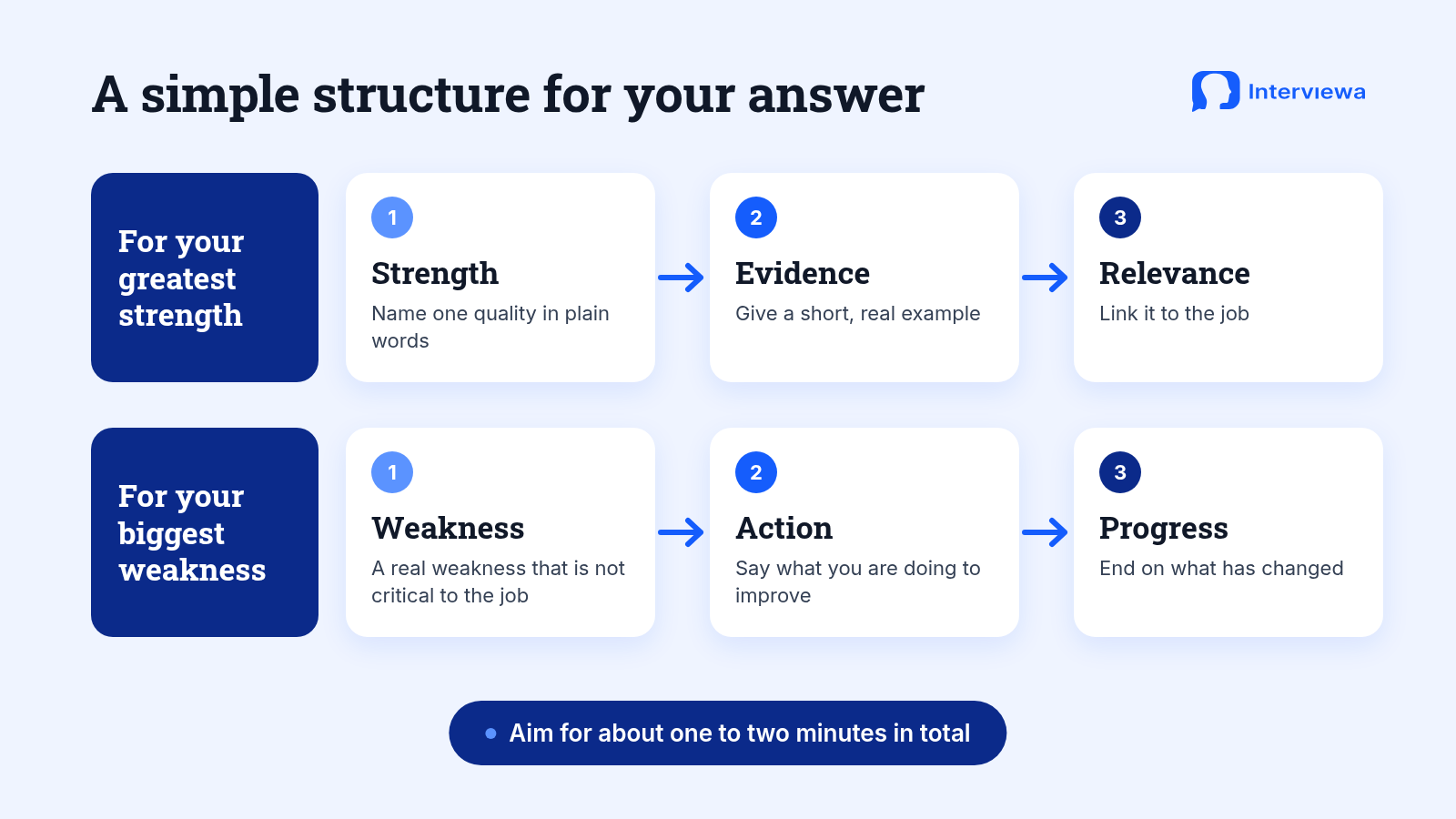
Use three steps for each half: strength, evidence, relevance, then weakness, action, progress.
For your greatest strength
- Strength. Name one quality in plain words, such as "I stay calm under pressure" or "I explain complex ideas clearly".
- Evidence. Give a short example. If you need more than two sentences, the STAR method (National Careers Service) of situation, task, action, result keeps it in order.
- Relevance. Link it to the job. "That matters here because the role involves..."
For your biggest weakness
- Weakness. Name a real weakness that is not critical to the job or company.
- Action. Say what you are doing to improve: training, a habit, a tool, feedback from a mentor.
- Progress. End on what has changed. This keeps the answer positive without pretending the weakness has gone.
How do you choose the right strength?
Choose a strength that the job needs and that you can prove with a real example. Start with the job description, not with a list of nice words.
Prospects suggests picking three or four attributes the employer asks for in the person specification, such as teamwork, leadership or initiative, and says you must be able to evidence whichever strengths you pick.
A quick way to find yours: highlight the skills that come up more than once in the job listing, note two or three moments when you used them, and pick the one with the clearest result.
Warwick's careers service makes a useful point: when you talk about something that is genuinely a strength, you naturally look and sound energised (University of Warwick Careers). So pick something you enjoy.
How do you choose your biggest weakness without hurting your chances?
Pick a real, professional weakness to discuss that will not stop you doing the core job, and that you are already working on. Avoid anything that is a must-have skill for the position.
Good professional weaknesses tend to be skills you can learn, such as:
- public speaking or presenting to large groups
- delegating tasks rather than doing everything yourself
- saying yes to too many projects
- limited experience with a specific tool or piece of software
- giving direct feedback to colleagues
For your greatest weakness, Prospects suggests choosing one you have taken steps to improve, or talking about the downside of your greatest strength, such as a strong team player who had to learn to handle conflict. Its guide to strength-based interviews adds that you should explain what you are doing to overcome the weakness and end on an upbeat note.
What are some strengths and weaknesses examples for different jobs?
Below are example answers for common roles. They are written examples to show the structure, not real people. Swap in your own details.
Example: customer service adviser
"One of my strengths is staying calm with frustrated customers. In my last retail job the team often passed difficult complaints to me, because I listen first and then explain the options. That fits this role, which is mostly first contact on the phone.
A weakness is that I used to spend too long on each call trying to solve everything myself. I have started using the knowledge base and escalating sooner, and my calls are now shorter without customers feeling rushed."
Example: graduate or entry level role
"My key strength is organisation. In my final year I ran a student society while finishing my dissertation, and I kept both on track with a shared calendar and weekly task lists. This role has a lot of moving parts, so I think that would help from day one.
My weakness is public speaking. I get nervous presenting to big groups. I joined a presenting workshop and volunteered to give our society updates every term, and my confidence has grown, though I still prepare carefully."
Example: software developer
"A strength is breaking big problems into small, testable steps. On a recent project I split a slow reporting feature into smaller tasks that were easier to review and ship. Your job description mentions working in small increments, so I think that is a good match.
A weakness is that I can go quiet when I am stuck, rather than asking for help. I now set myself a time limit, and if I have not made progress I raise it in stand-up. It has made me faster."
Example: team leader or manager
"My strength is coaching. In my last team two people I mentored moved into senior roles. That matters here because this position is about building a new team.
My weakness was delegation. I held on to tasks I enjoyed. I now plan the week with my team and hand over work early, which frees me up for the bigger picture."
What mistakes should you avoid?
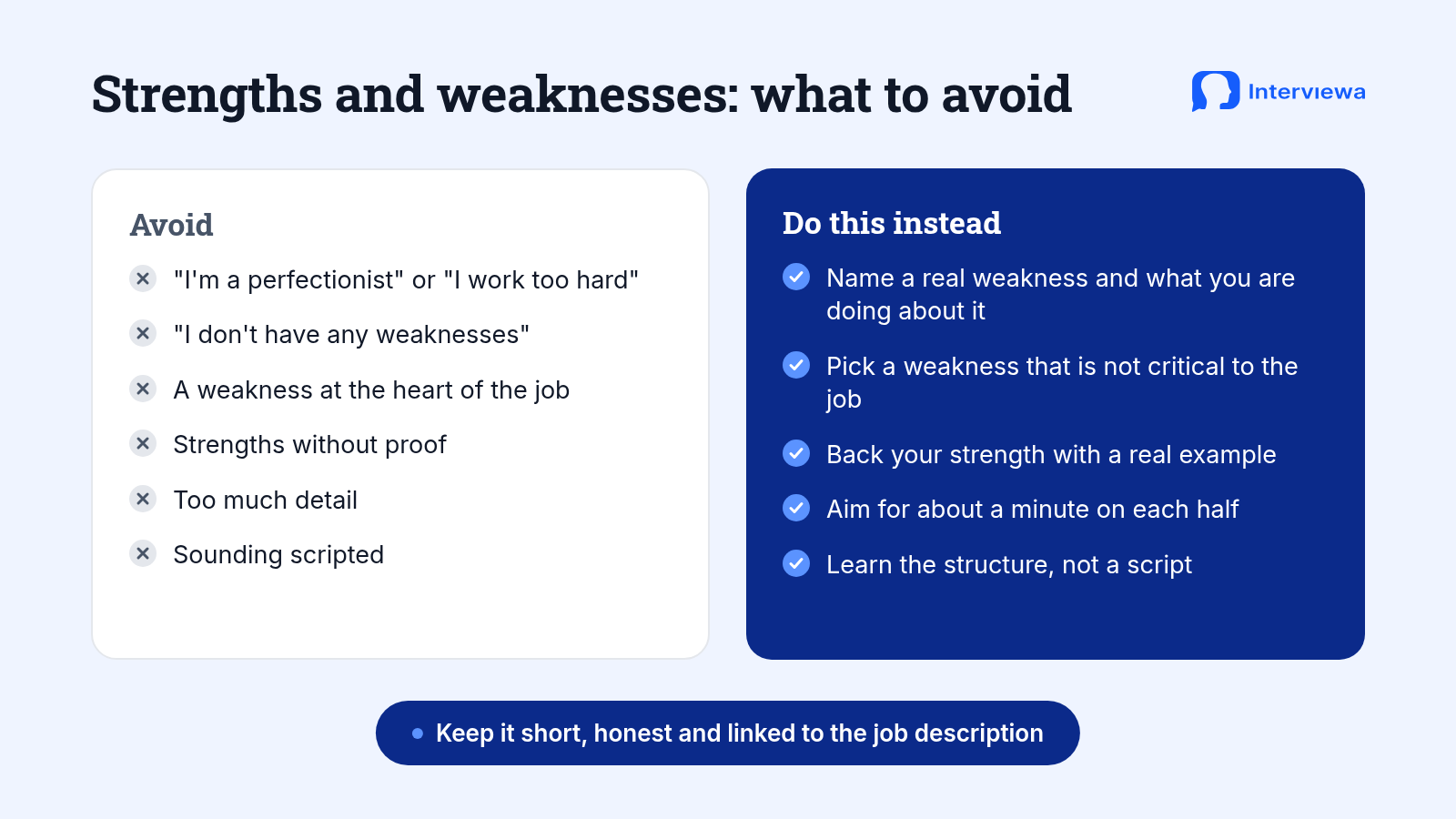
The biggest mistakes are cliché answers, weaknesses that disqualify you, and strengths with no evidence.
- "I'm a perfectionist" or "I work too hard." Prospects says these clichéd responses can make you look arrogant, dishonest or lacking in self awareness.
- "I don't have any weaknesses." Everyone has some.
- A weakness at the heart of the job. An accountant who is "not good with numbers" has a problem.
- Strengths without proof. "I have a strong work ethic" means little without an example.
- Too much detail. Aim for about a minute on each half.
- Sounding scripted. The National Careers Service advises getting your points across in a conversational way so you do not appear too rehearsed.
How can you practise your answer out loud?
Say your answer out loud several times, ideally to someone who will ask follow-up questions.
A hiring manager will often dig deeper with a follow-up such as "can you give me another example?". Prospects notes you could face as many as 30 questions in an hour-long strength-based interview, so you need to be ready to discuss it from various angles, not just recite one paragraph.
Ways to practise:
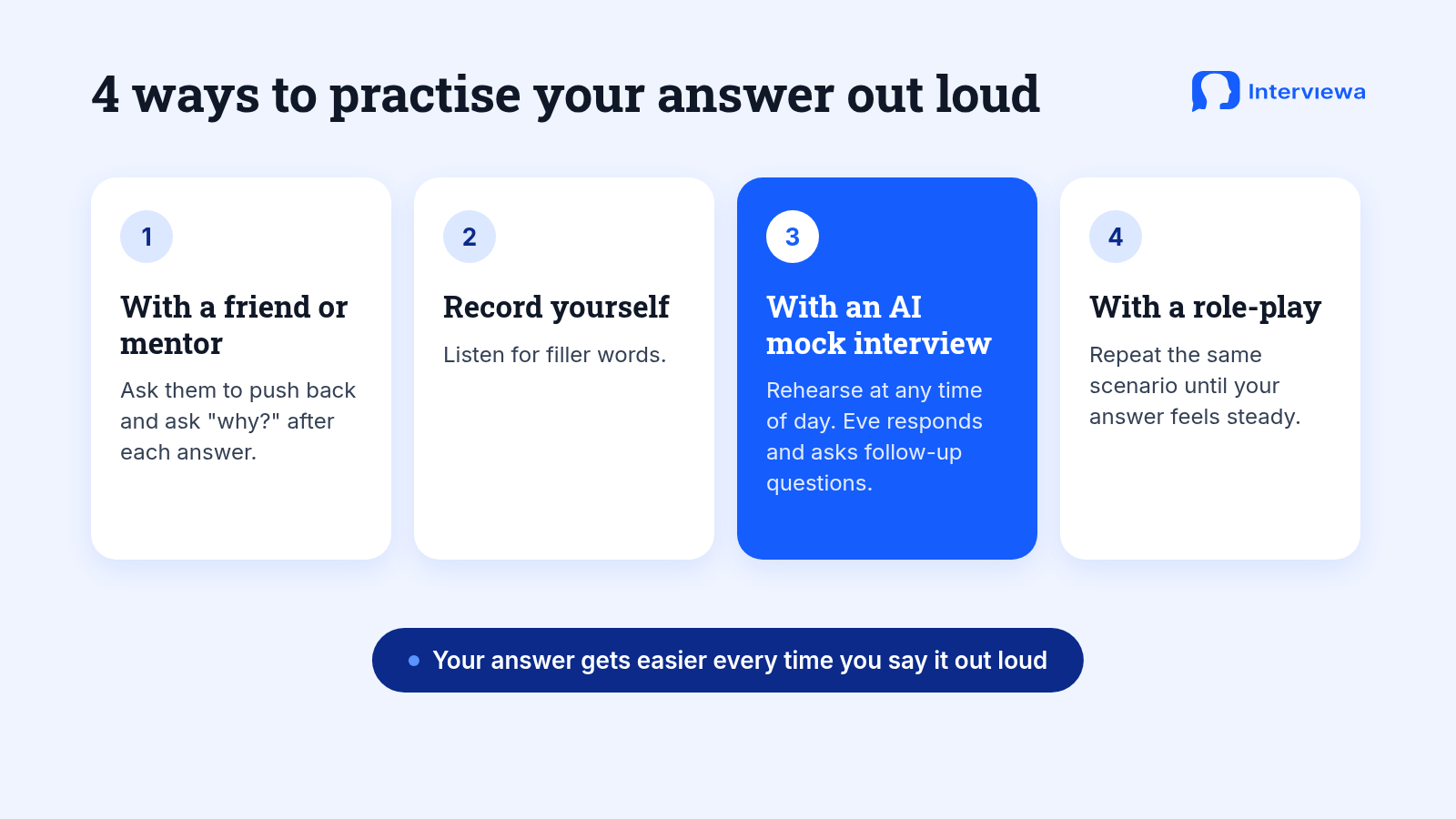
- With a friend or mentor. Ask them to push back and ask "why?" after each answer.
- Record yourself. Listen for filler words.
- With an AI mock interview. An AI mock interview lets you rehearse at any time of day. Interviewa is a 24/7 AI conversation agent with two-way AI avatars, so you answer out loud and the AI interviewer, Eve, responds and asks follow-up questions, much like a real interviewer would.
- With a role-play. If tricky questions knock your confidence, try an interview role-play where you can repeat the same scenario until your answer feels steady.
If you are not sure which strengths to lead with, or you are changing careers and your strong points are less obvious, a career coach session can help you focus on what to say before you start practising.
FAQ
What is the best answer to "what is your greatest weakness"?
The best answer names a real weakness that is not critical to the job, explains what you are doing to improve it, and shows progress. For example: "I used to find public speaking hard, so I volunteered to present at team meetings, and I am now much more comfortable."
Is it OK to say perfectionism is my weakness?
Avoid it. Prospects lists "I'm a perfectionist" among the clichéd answers that can make you seem dishonest or lacking in self awareness. If attention to detail really slows you down, describe the specific problem and what you changed.
How long should my answer be?
Aim for about one to two minutes in total. That leaves room for follow-up questions.
Should I give more than one strength or weakness?
Give one of each unless asked for more, and keep a second example ready. One well-evidenced strength beats a list of five adjectives.
What are good strengths to mention in a job interview?
Good strengths are ones the job needs and you can prove with personal or work examples. Communication skills, problem solving, organisation, teamwork and adaptability are common, but check the job description first.
How do I stop sounding rehearsed?
Learn the structure, not a script, so you speak naturally. Know your three points for each half and say them in slightly different words each time you practise.
Get started free
Your answer gets easier every time you say it out loud. Practise with Eve in an AI mock interview and walk into your next interview prepared. Get started free.