Competency based interview: how to prepare, with example questions
A competency based interview asks you to prove you have a skill by describing a real time you used it. Prepare by matching each competency in the job description to a specific example, then practise telling each one out loud in under two minutes.
This guide covers competency based interview questions, UK examples, a planning grid you can copy and the mistakes that cost people the job.
What is a competency based interview?
A competency based interview is a structured interview where every question links to key competencies the employer has already chosen for the job role. Instead of asking what you would do, the interviewer asks what you did.
You will hear openers such as "Tell me about a time when..." or "Give me an example of...". The hiring manager usually asks every candidate the same questions and judges answers against the same criteria, which is fairer than unstructured interviews. Competency based interviews are common in the public sector, the NHS, graduate schemes, banks and management roles.
Past behaviour is a reasonable guide to future performance, so the employer wants evidence, not gut feelings. The UK Civil Service says this directly in its Success Profiles guidance on behaviours: behaviours can be observed and measured, which helps predict how you could perform in the role.
How is a competency based interview different from other formats?
The short answer: competency questions look backwards, while other formats look forwards or at your motivation.
- Competency based questions ask for a real past example. "Tell me about a time you dealt with a difficult customer."
- Situational interviews and scenario based questions ask what you would do in a made-up situation. "A customer is shouting at the till. What do you do?"
- Strength based questions ask what you enjoy and do naturally well. "What kind of tasks give you energy?"
Many interviews now mix two or three of these. The Civil Service guidance, for example, lists interviews, assessment centres, written exercises and role-play as ways it may assess behaviours, and notes you may be asked how you would act in a given situation as well as what you have done. Read the job advert closely, because it often tells you which methods will be used.
Which competencies do UK employers test most?
Most employers test a short list of core competencies drawn straight from the job description. The usual suspects are:
- Communication skills and the ability to communicate effectively
- Teamwork and working with people from different backgrounds
- Problem solving and decision making
- Leadership skills, even for roles with no direct reports
- Customer focus or delivering a quality service
- Adaptability and dealing with change
- Planning, organising and working to a tight deadline
- Analytical skills, data analysis and strategic thinking
- Self awareness and continuous learning
If you are applying for a Civil Service job, you get a head start. The Success Profiles framework publishes nine behaviours, including Seeing the big picture, Making effective decisions, Communicating and influencing, Working together and Delivering at pace. The guidance is clear that you will not be asked about all of them for one role, so check which ones your advert names.
How do you answer competency based interview questions?
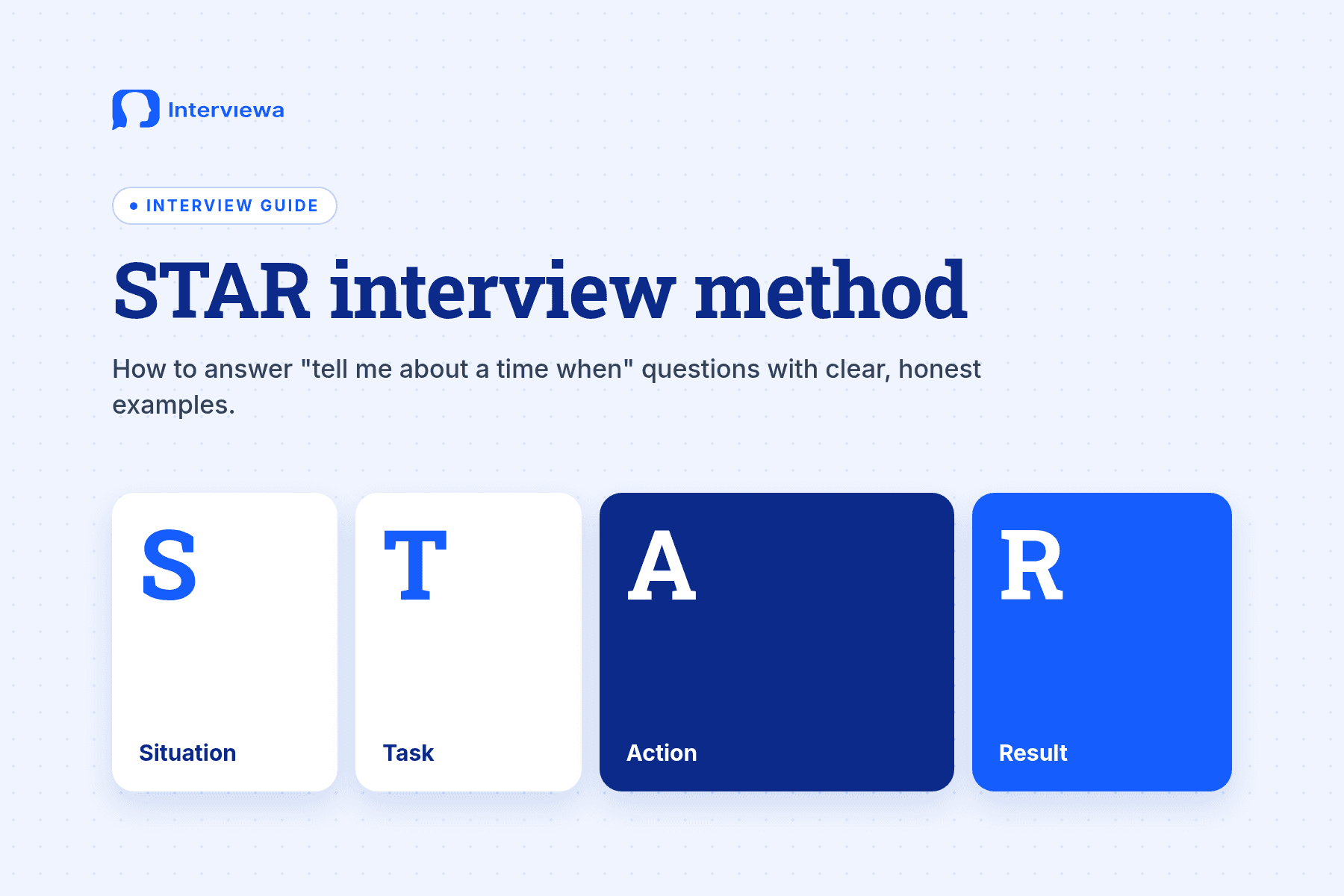
Use a clear framework, focus on what you did, and finish with a result. Most UK candidates answer competency based questions with the STAR method: Situation, Task, Action, Result.
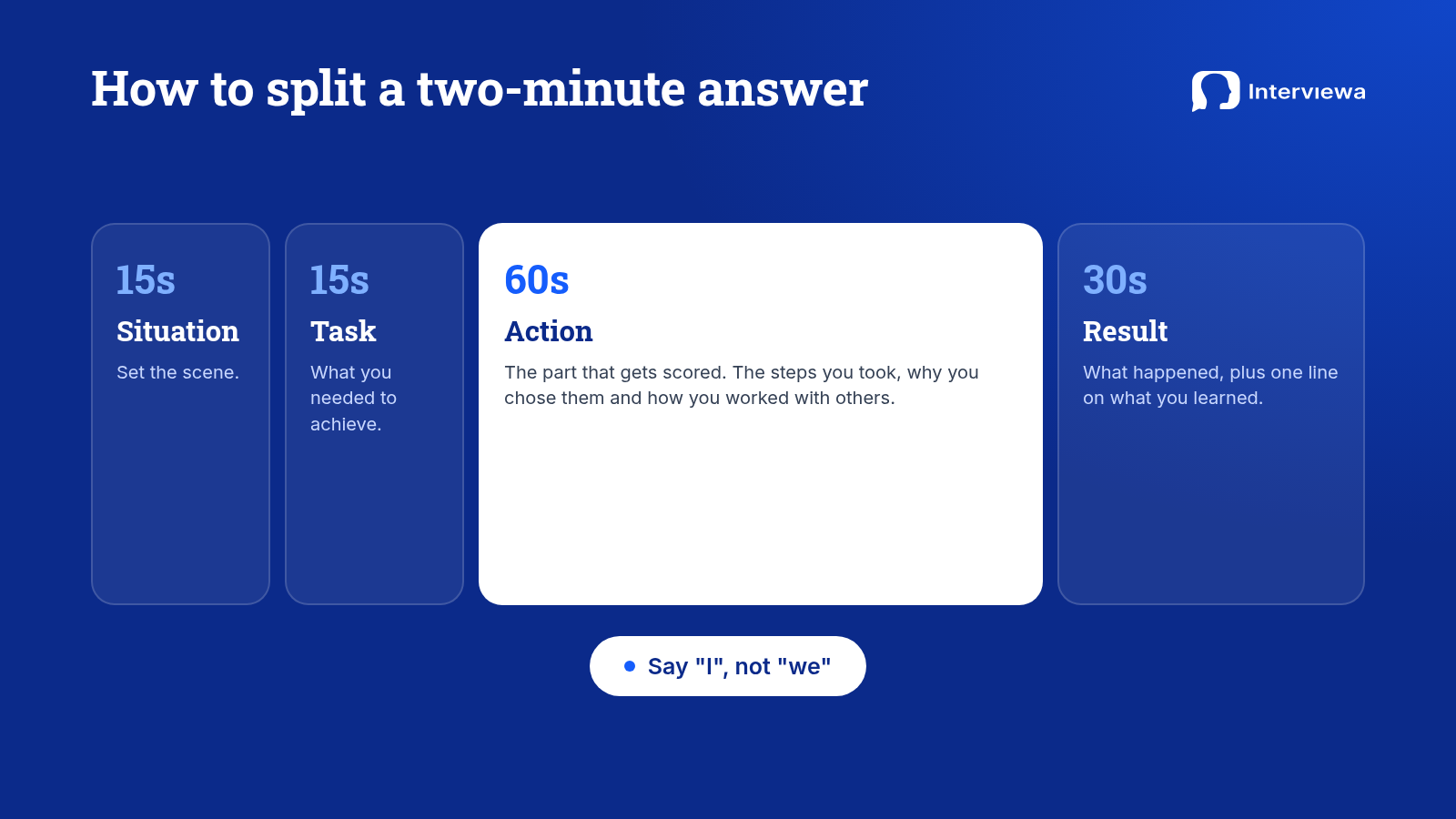
Here is how the time should split in a two-minute answer:
- Situation (about 15 seconds). Set the scene in one or two sentences. Where were you, and what was going on?
- Task (about 15 seconds). What did you need to achieve, and why did it matter?
- Action (about 60 seconds). This is the part that gets scored. Explain the steps you took, why you chose them and how you worked with others. Say "I", not "we".
- Result (about 30 seconds). What happened? Use a real number if you have one. Then add one line on what you learned.
Expect follow ups such as "What would you do differently?". That is normal. It means they want more detail, not that you failed.
What do strong sample answers sound like?
A strong answer is specific, honest and short. Here is a worked example.
Question: "Tell me about a time you solved a problem under pressure."
Weak answer: "I'm good under pressure. In my last job we often had tight deadlines and I always stayed calm and got things done."
That answer has no situation, no actions and no result. It is a claim, not evidence.
Stronger answer: "In my retail supervisor role, our delivery system failed on the Saturday before Christmas, so we had no stock data for the busiest day of the year. My job was to keep the shop floor running. I split the team so two people counted the top-selling lines by hand while the rest stayed on the tills. I set up a shared sheet so everyone could see what was left, and I called the area manager to warn other stores. We kept serving customers all day and only ran out of one product line. Afterwards I wrote a one-page backup plan, which the store still uses."
It shows a clear moment, thought processes, actions and a result.
How should you prepare for a competency based interview?
Prepare one or two examples for each of the specific competencies, not one per possible question. A small bank of strong stories covers most competency based questions.
Copy this grid into a document and fill it in:
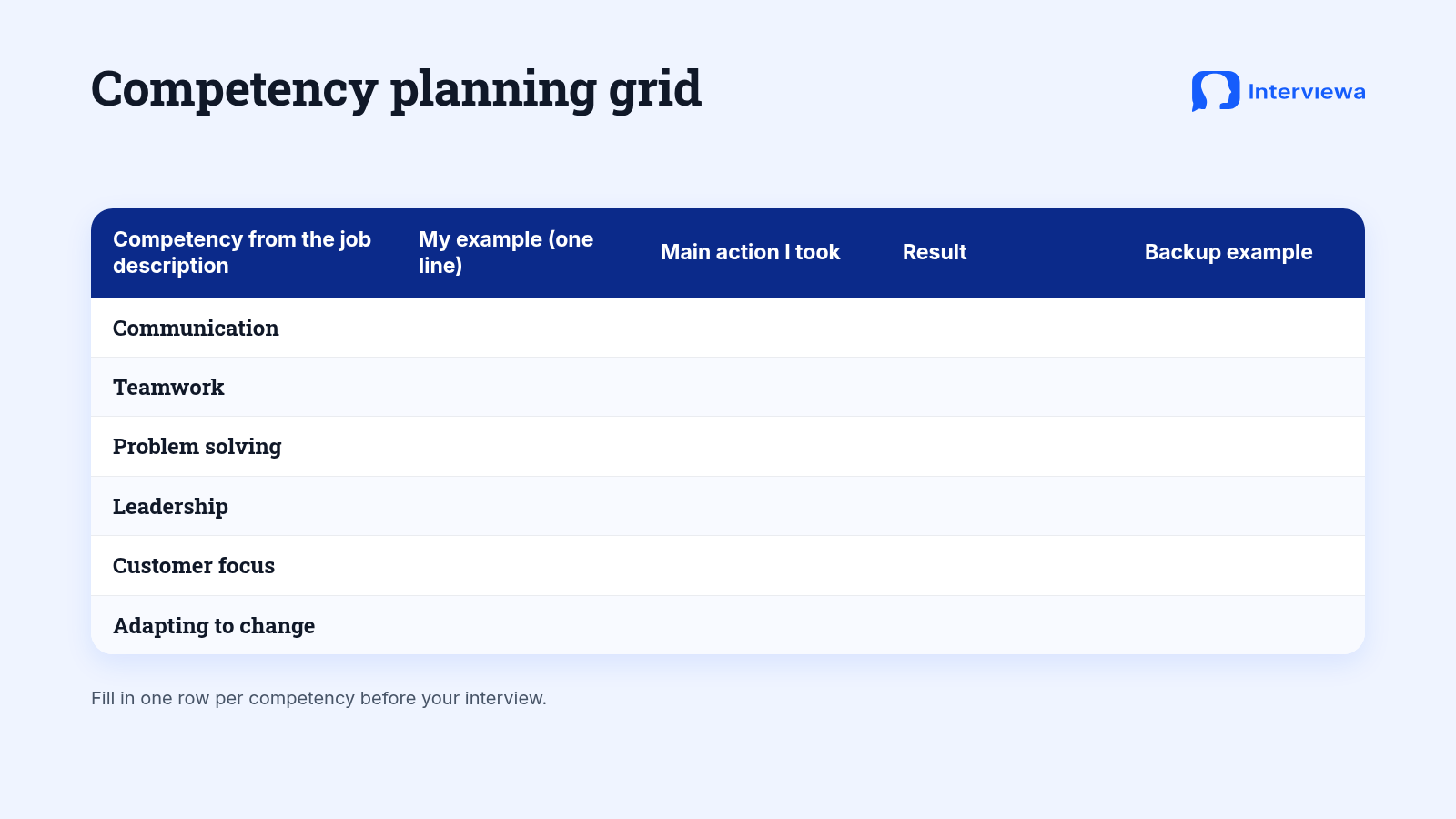
Then work through these steps for your interview prep:
- Highlight the key skills required in the job description. Look for repeated words. If "stakeholders" appears four times, expect a question on it.
- Pick real life examples from the last two to three years. Recent stories feel more convincing. If you are new to work, use volunteering, part-time jobs, sport, university projects or caring responsibilities. The Civil Service guidance explicitly accepts examples from work experience, volunteering and hobbies.
- Write bullet points, not scripts. Bullets keep you natural.
- Say each answer out loud. Time it. Cut anything over two and a half minutes.
- Prepare for the follow up. For every story, think of one thing that went wrong and one thing you would change.
If you are changing career, the same grid works well for showing transferable skills. Our guide to a career change at 40 covers how to frame past experience for a new sector.
What mistakes do candidates make in competency based interviews?
Most weak answers in competency interviews fail for the same few reasons.
- Talking about the team, not your individual contribution. "We fixed it" tells the panel nothing about your part.
- Giving generic answers. "I always..." is not an example. Pick one moment.
- No result. Always say what happened, even if the outcome was mixed.
- Making things up. Follow-up questions expose invented stories quickly. Honest examples beat impressive fake ones.
How can you practise competency questions?
Practise competency based interview questions out loud, under light pressure, and get feedback on structure. Reading answers in your head is not the same as saying them to someone who might interrupt.
You have three practical options. Ask a friend or family member to read questions from your grid and push you with follow ups. Record yourself on your phone and listen back for "we", filler words and missing results. Or use an AI mock interview that asks questions out loud and gives feedback afterwards.
Interviewa Training lets you run realistic practice interviews with Eve, our AI interviewer. You tell it what you want to train for, answer on video, and get personalised feedback. If you are still deciding which roles to go for, the free Job Consultant career call can suggest roles and a next-step plan first.
It is also worth practising your opening answer. Many competency based interviews open with a warm-up before the main interview stage, and our guide on how to answer "tell me about yourself" helps you set the tone.
FAQ
How many examples should I prepare for a competency based interview?
Aim for one or two examples for each of the different competencies in the job description. For most roles that means six to ten stories in total.
Can I use real life examples from outside work?
Yes. Volunteering, education, sport and caring roles all count if they show the skill clearly. Many UK employers, including the Civil Service, say so in their guidance.
How long should each answer be?
Around two minutes is a good target. Under one minute usually lacks detail, and over three minutes tends to lose the panel.
Are competency based interviews used for graduate jobs?
Yes, often alongside strength based questions, online tests and assessment centres. Graduate employers know you have limited work history, so examples from study and part-time work are expected.
Get started free
Competency questions reward preparation more than talent. Build your grid, pick your stories and say them out loud until they feel natural. When you are ready to practise with realistic questions and feedback, get started free with Interviewa Training. You get five practice interviews free, with no credit card needed.