Interview scorecard: how to build one that makes hiring fairer
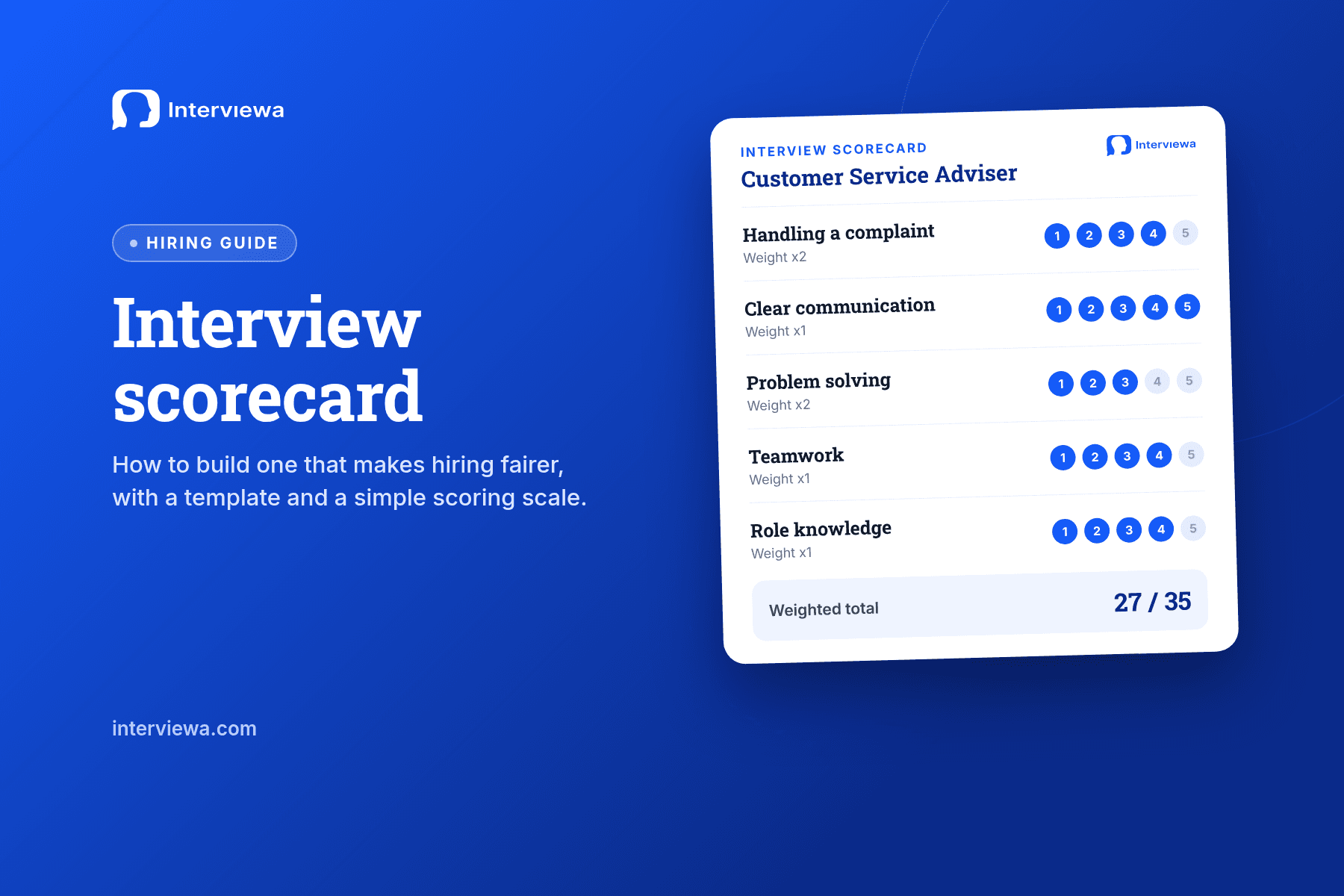
Most hiring managers have left an interview with a strong feeling about a candidate and very little written down to back it up. An interview scorecard fixes that. It gives every interviewer the same criteria, the same questions and the same scale, so you compare candidates on evidence rather than memory or gut feel.
This guide explains what an interview scorecard is, how to build one in five steps, how to score answers, and how AI first-round interviews can structure screening around your criteria so every applicant is treated the same way.
What is an interview scorecard?
Short answer: an interview scorecard is a simple form that lists the skills a role needs, the questions that test each one, and a scoring scale with clear descriptions of what a weak, good and excellent answer looks like.
It turns an interview into a structured interview. Instead of a free-flowing chat, each candidate is asked the same questions in the same order and judged against the same objective criteria. The Chartered Institute of Personnel and Development (CIPD) describes this as asking "a predefined set of questions, in the same order, to all candidates" and scoring responses "against a set of pre-agreed criteria for each question" (CIPD, Selection methods factsheet).
A good scorecard usually has four parts:
- Criteria: four to six skills or behaviours that matter most for success in the role.
- Questions: one or two interview questions for each criterion.
- Anchors: short descriptions of what a 1, 3 and 5 answer looks like.
- Notes and total: space for detailed notes, an optional weighting, and a final score.
Why use an interview scorecard instead of an unstructured interview?
Short answer: because structured interviews predict job performance better and leave less room for bias.
The research here is strong. A major 2022 review of selection methods in the Journal of Applied Psychology found that structured interviews were the top-ranked selection procedure for predicting job performance, with an estimated validity of 0.42 (Sackett, Zhang, Berry and Lievens, 2022). The same paper notes that earlier estimates for most methods were too high, but structured interviews still came out on top.
Fairness is the other reason. UK government guidance on fair and structured interviews says structured methods "are more likely to lead to fairer outcomes for applicants compared to unstructured methods", while unstructured interviews "are often conversational and lack consistent questions or scoring", which can increase the risk of unconscious bias (GOV.UK, Use fair and structured interview techniques).
A scorecard also makes hiring decisions easier to explain. If a candidate asks for feedback, or a colleague questions a choice, you can point to the scores and notes rather than a vague impression.
How do you create an interview scorecard?
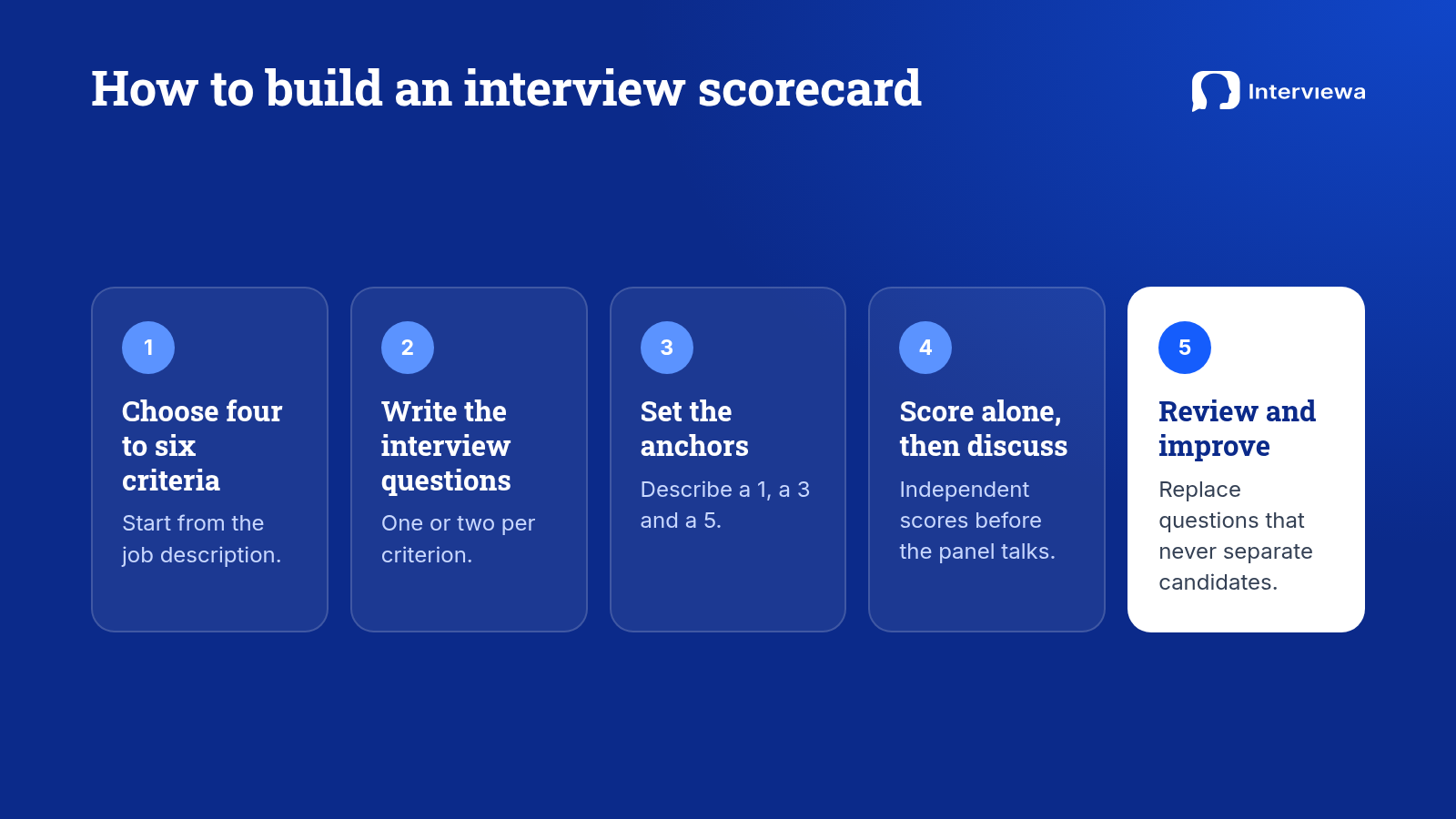
Short answer: pick the criteria from the job, write questions for each one, set scoring anchors, then train your interviewers to score on their own before they discuss.
Step 1. Choose four to six criteria. Start from the job description and ask what someone must do well in the first six months. Mix technical skills with behaviours such as communication skills, problem solving and teamwork. More than six criteria and interviewers start to rush.
Step 2. Write the interview questions. Use one or two questions per criterion. Behavioural questions ("Tell me about a time you...") and situational questions ("What would you do if...") both work well. Keep each question short, and split long ones into parts, as the GOV.UK guidance suggests.
Step 3. Set the anchors. For each criterion, write a one-line description of a 1 (little or no evidence), a 3 (meets the standard) and a 5 (strong, specific evidence). Anchors based on observable behaviours are the heart of a clear rubric, because they stop one interviewer's 4 being another interviewer's 2.
Step 4. Score alone, then discuss. Ask each interviewer to score independently before the panel talks. CIPD guidance warns that discussing candidates first makes interviewers more likely to be swayed by others, "and potentially by the opinion of the most senior person there".
Step 5. Review and improve. After a few hiring rounds, check whether high scorers turned out to be strong performers. If a question never separates candidates, replace it.
What should an interview scorecard template include?
Short answer: a role title, criteria, questions, a 1 to 5 scale with anchors, optional weights, a notes column and a total.
Here is a simple interview scorecard template you can copy into a spreadsheet or document.
- Role and date: the job title, the interview stage and the interviewer's name.
- Criterion: for example "Handling a complaint" or "Problem solving".
- Question: the exact interview question every candidate is asked.
- What good looks like: the anchor for a 4 or 5 answer.
- Weight: x2 for the criteria that matter most, x1 for the rest.
- Score and notes: a number from 1 to 5, plus evidence from the answer.
- Overall recommendation: proceed, hold or reject, with a reason.
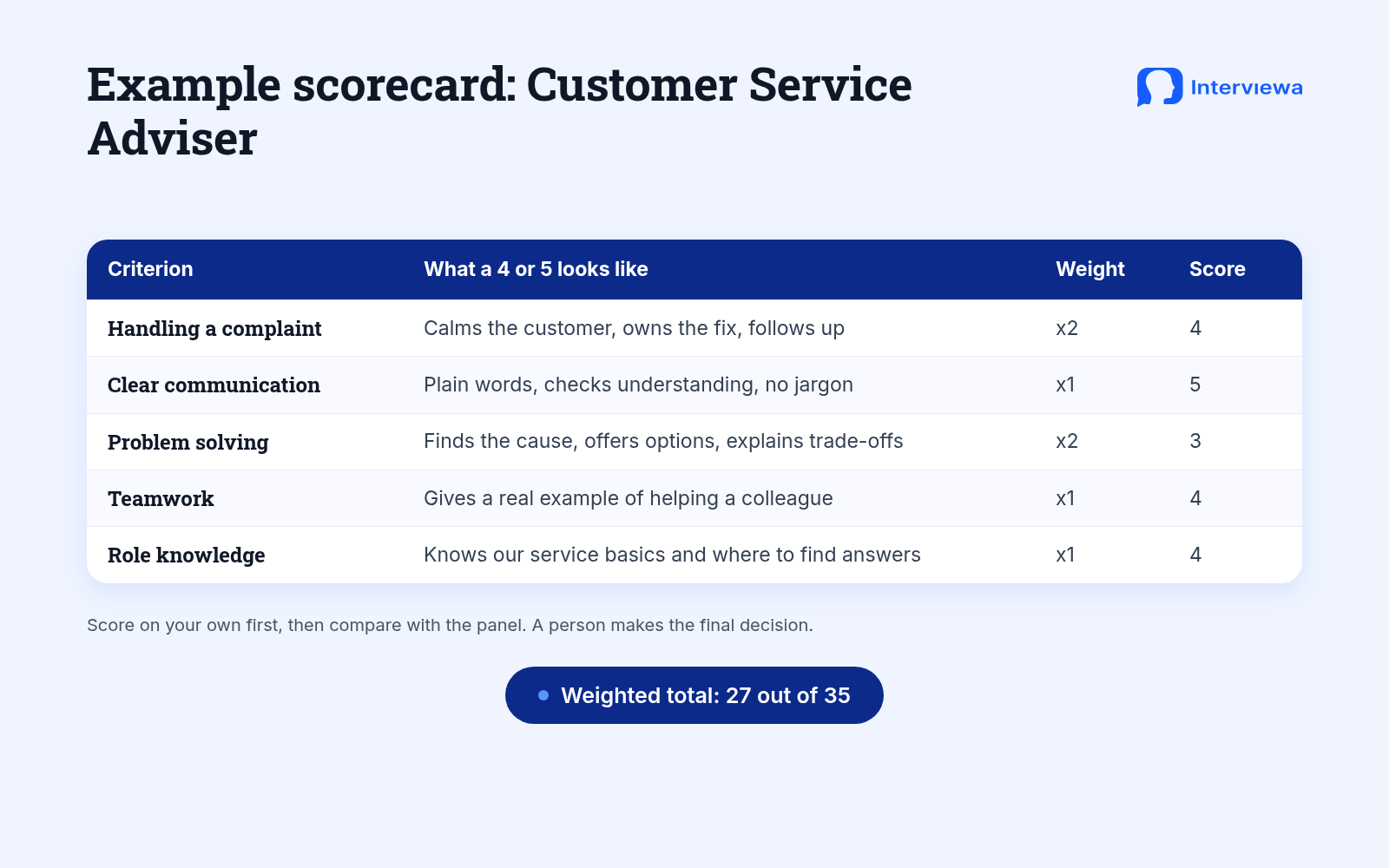
In the example above, the candidate scores 27 out of 35 once the weights are applied. The total helps you rank candidates, but it should start a conversation, not end one.
How do you score candidates in an interview?
Short answer: score each answer straight after it is given, using the anchors, and write down the evidence that justifies the number.
A 1 to 5 scale is enough for most roles. Avoid scales of 1 to 10, because interviewers struggle to explain the difference between a 6 and a 7. Some practical rules help keep the scoring system consistent:
- Score against the anchors, not against the previous candidate.
- Write what the candidate actually said, not your impression of them.
- Define "culture fit" clearly. Write down the specific values or behaviours you mean and score those, so the criterion cannot become a proxy for "people like us".
- If two interviewers differ by two points or more, talk through the evidence before agreeing a final score.
- Interview in batches where you can. The GOV.UK guidance notes that comparing people as a group may help strong candidates stand out.
Can AI interviews use an interview scorecard?
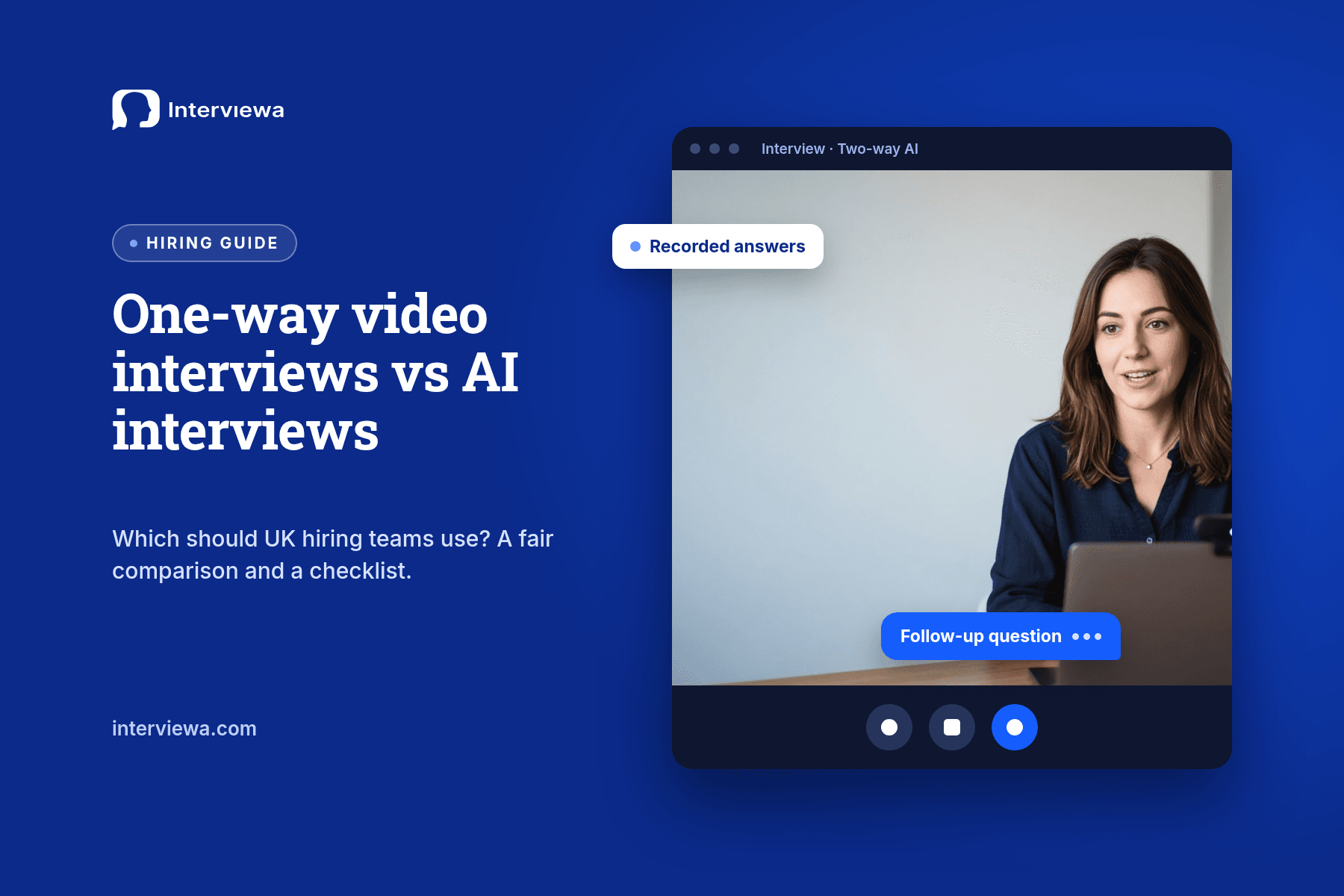
Short answer: yes, in a way. An AI interviewer can ask every candidate consistent questions built around the criteria you set, probe for evidence, and pass candidate summaries to a person who makes the final decision. It applies your criteria at scale. It does not replace human judgement.
This is where structured interviews often break down in real life. When you have hundreds of applicants, it is hard to give each one a fair first-round interview built around the same criteria. Interviewa is a 24/7 AI conversation agent with two-way AI avatars. With Interviewa Hiring, you start from the job description, then select your must-haves, nice-to-haves and cultural fits. Questions are auto-generated from those criteria, and you can alter them. Eve, our default AI interviewer, runs the first-round interview at any time of day, with follow-up questions and probing aimed at what you are looking for. Each candidate gets a summary based around those criteria.
Interviewa Hiring screens and shortlists candidates, and a human always makes the final decision. It includes anti-cheat checks and works with Workable, so results can sit alongside your existing hiring process. Interviewa is GDPR compliant and Cyber Essentials certified, and is working towards ISO 27001.
As one example, School of Coding used Interviewa to go from 250 applications to 12 hires in 11 days, instead of the 30 or more days it used to take, with an estimated 70% less admin.
Frequently asked questions
What is a scorecard in hiring?
A hiring scorecard is a document that defines what success in a role looks like and how candidates will be judged. The interview scorecard is the part used during interviews to rate each answer.
How many criteria should an interview scorecard have?
Four to six is a good range. It covers the skills that matter most without making interviewers rush or lose focus.
What scale should I use to score interview answers?
A 1 to 5 scale with written anchors for 1, 3 and 5 works for most roles. It is simple enough to use quickly and detailed enough to separate candidates.
Should every interviewer use the same scorecard?
Yes. Using the same criteria, questions and scale across multiple interviewers is what makes scores comparable and reduces interviewer bias.
Can I share interview scores with candidates?
You can give feedback based on the scorecard, and it often makes feedback clearer and fairer. Keep in mind that under UK GDPR, candidates can ask to see personal data you hold about them, which can include interview notes.
Does an AI interview replace the hiring manager?
No. With Interviewa, the AI interviewer runs the first-round interview around your must-haves, nice-to-haves and cultural fits, and summarises each candidate against them. A person reviews the shortlist and makes the final decision.
Get started free
Want every candidate to get the same fair, structured first interview? Try Interviewa: start from your job description, pick your must-haves, nice-to-haves and cultural fits, edit the auto-generated questions, and get candidate summaries built around what you are looking for, while your team makes the final call. Get started free at interviewa.com.